A Export Potential and Competitiveness of Thai Agricultural and Agro-Industrial Products to the United Arab Emirates and Saudi Arabia
Keywords:
International Trade, Gravity Model, Export Potential, CompetitivenessAbstract
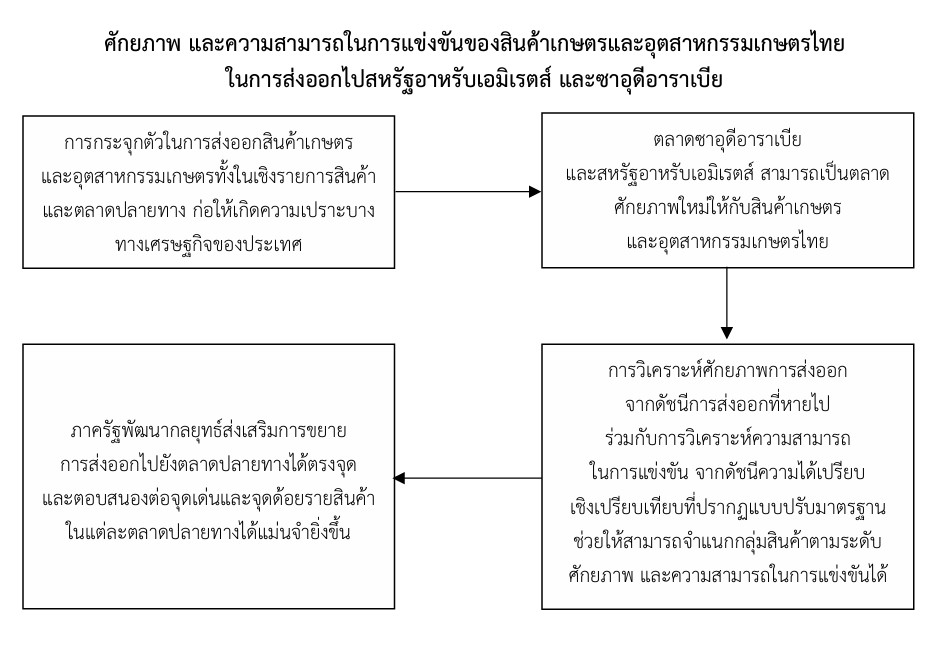
This study examines the export potential and international competitiveness of Thailand’s major agricultural and agro-industrial products in the United Arab Emirates and Saudi Arabia, with a particular focus on product-level differences across destination markets. The products under investigation include rice, fruits, chicken, rubber, and cassava products. Export potential is estimated using a gravity model with Poisson Pseudo Maximum Likelihood (PPML) estimation based on secondary panel data covering Thailand and its top 36 export partner countries during 2002–2023. The estimated trade flows are subsequently used to compute the Index of Missing Exports (IME). International competitiveness is assessed using the Normalized Revealed Comparative Advantage (NRCA) index. The findings reveal heterogeneous patterns of export potential and competitiveness across products and markets. Rubber exhibits strong export potential and competitive advantage in both destinations. Chicken shows significant room for export expansion but lacks a competitive advantage. In contrast, cassava products demonstrate a competitive advantage but face constraints in export expansion potential. Rice and fruits appear to have largely exhausted their export potential in both markets; however, their competitive advantage is evident only in the United Arab Emirates. Overall, the results suggest that export potential and competitiveness do not necessarily move in the same direction. Therefore, export promotion policies should be tailored to product-specific characteristics and destination-market conditions rather than adopting a uniform policy approach.
References
นิพนธ์ พัวพงศกร, อภิวัฒน์ รัตนวราหะ, อิทธิพงศ์ มหาธนเศรษฐ์, อรรถชัย จินตะเวช, ศิริพร กิรติการกุล, กานพิชชา บุญศิริ, นิภา ศรีอนันต์, กัมพล ปั้นตะกั่ว, ณัฐธิดา วิวัฒน์วิชา และ คุณชวัลรัตน์ บูรณะกิจ. (2565). อนาคตชาวนา-ชาวสวนรายเล็ก (Future of Small Farmers) (รายงานการวิจัย).กรุงเทพฯ: สำนักงานการวิจัยแห่งชาติ.
วลัยพร บวรกุลวัฒน์. (2554). การศึกษาความสามารถในการแข่งขันและศักยภาพเชิงลึกของอุตสาหกรรมยางธรรมชาติในประเทศไทย. (เศรษฐศาสตรมหาบัณฑิต, มหาวิทยาลัยธรรมศาสตร์).
วิจัยกรุงศรี. (2566). แนวโน้มธุรกิจ/อุตสาหกรรม ปี 2566-68 อุตสาหกรรมไก่แช่เย็น แช่แข็ง และแปรรูป. สืบค้นจาก https://www.eatecon.com/wp-content/uploads/2023/11/Krungsri-research-Chicken-2023-2025.pdf.
วีระชัย เพ็งเปิ้น. (2564). รูปแบบการค้าและศักยภาพการส่งออกสินค้าเกษตรสำคัญของประเทศไทย: การวิเคราะห์แบบจำลองแรงโน้มถ่วงกับกระแสการค้าที่เป็นศูนย์. (เศรษฐศาสตรมหาบัณฑิต, จุฬาลงกรณ์มหาวิทยาลัย).
สมประสงค์ ทวีพงษ์. (2556). การวิเคราะห์ความสามารถในการแข่งขันการส่งออกผลิตภัณฑ์จากมันสำปะหลังของประเทศไทย. (เศรษฐศาสตรมหาบัณฑิต, มหาวิทยาลัยสุโขทัยธรรมาธิราช).
สำนักงานนโยบายและยุทธศาสตร์การค้า. (2564). แนวโน้มการปรับตัวของภาคการส่งออกไทยหลังสถานการณ์โควิด-19 (รายงานการวิจัย). นนทบุรี: กองวิจัยเศรษฐกิจการค้ามหภาค.
สำนักงานนโยบายและยุทธศาสตร์การค้า. (2569). การค้าระหว่างประเทศ. สืบค้นจาก https://xn--42ca1c5gh2k.com/data/?tab=dashboard&_cat=international-trade.
Anderson, J. E., & Van Wincoop, E. (2003). Gravity with gravitas: A solution to the border puzzle. American economic review, 93(1), 170-192.
Balassa, B. (1965). Trade liberalisation and “revealed” comparative advantage 1. The manchester school, 33(2), 99-123.
Egger, P. (2002). An econometric view on the estimation of gravity models and the calculation of trade potentials. World Economy, 25(2), 297-312.
García Juárez, H. D., Montes Ninaquispe, J. C., Arbulú Ballesteros, M. A., Palma Vallejo, J. G., Sandoval Reyes, C. J., Agurto Ruiz, K. P., Olaya Guerrero, L. M., Angeles Goicochea, D. E., Corrales Otazú, C. D., & Apaza Miranda, S. J. (2026). Market Diversification and Revealed Comparative Advantage in Salmon Exports: Comparative Evidence from Norway, Sweden, Chile, and the United Kingdom. Sustainability, 18(2), 568.
Head, K., & Mayer, T. (2014). Gravity equations: Workhorse, toolkit, and cookbook. In Handbook of international economics (Vol. 4, pp. 131-195). Amsterdam, Netherlands: Elsevier.
International Monetary Fund. (2025). IMF staff completes 2025 Article IV mission to Thailand. Retrieved from https://www.imf.org/en/news/articles/2025/11/13/pr25367-thailand-imf-staff-completes-2025-article-iv-mission.
Maneewong, N., & Aroman, B. (2025). Guidelines for Developing Standards for Exporting Halal Thai Poultry Products for Thai Entrepreneurs to Saudi Arabia After the Restoration of Thai-Saudi Relations. Thailand Islamic Journal, 2(1), 21-38.
Montes Ninaquispe, J. C., Orejuela Guerrero, L. A., Rodriguez Novoa, F. E., Mendoza Ocaña, P. R., Sánchez Yarleque, A. M., Mendoza Ocaña, C. E., Pairazaman Lam, F. L., Gutiérrez Albán, L. I., Flores Castillo, M. M., & Semillan Rosales, Y. P. (2026). Diversification and Competitiveness Patterns in International Shrimp and Prawn Trade: Evidence from Ecuador, India, Vietnam, and Indonesia. Sustainability, 18(4), 1793.
Mulabdic, A., & Yasar, P. (2021). Gravity Model–Based Export Potential. Washington: World Bank.
Prasada, I. Y., & Dhamira, A. (2021). The competitiveness of natural rubber by exporting countries in the global market. Retrieved from https://www.e3s-conferences.org/articles/e3sconf/pdf/2021/81/e3sconf_rubis2021_02006.pdf.
Rahimi, J., Smerald, A., Moutahir, H., Khorsandi, M., & Butterbach-Bahl, K. (2023). The potential consequences of grain-trade disruption on food security in the Middle East and North Africa region. Frontiers in Nutrition, 10, 1239548.
Rangkakulnuwat, P., & Weravess, R. (2022). The gravity model for rice exports: The cases of India and Thailand. Economics Bulletin, 42(3), 1432-1473.
Rashid, N., & Mir, M. A. (2022). A Study on the Trade Relationship between China & Mongolia: With Special Focus on Revealed Comparative Advantage (RCA). Shanlax International Journal of Economics, 11(1), 37-45.
Silva, S. J. M. C., & Tenreyro, S. (2006). The log of gravity. Review of Economics and Statistics, 88(4), 641–658.
Tinbergen, J. (1962). Shaping the World Economy: Suggestions for an International Economic Policy. New York: The Twentieth Century Fund.
Yotov, Y. V., Piermartini, R., Monteiro, J.-A., & Larch, M. (2016). An advanced guide to trade policy analysis: The structural gravity model. Retrieved from https://www.wto.org/english/res_e/booksp_e/advancedwtounctad2016_e.pdf.
Yu, R., Cai, J., & Leung, P. (2009). The normalized revealed comparative advantage index. The annals of regional Science, 43(1), 267-282.
Downloads
Published
How to Cite
Issue
Section
License
Copyright (c) 2026 Journal of Social Science Panyapat

This work is licensed under a Creative Commons Attribution-NonCommercial-NoDerivatives 4.0 International License.


