ปัจจัยส่วนประสมทางการตลาดออนไลน์และภาพลักษณ์องค์กรที่ส่งผลต่อการตัดสินใจซื้อสลากออมสินพิเศษดิจิทัล ของผู้บริโภคในอำเภอหาดใหญ่ จังหวัดสงขลา
คำสำคัญ:
ปัจจัยส่วนประสมทางการตลาดออนไลน์, ภาพลักษณ์องค์กร, การตัดสินใจซื้อ, สลากออมสินพิเศษดิจิทัลบทคัดย่อ
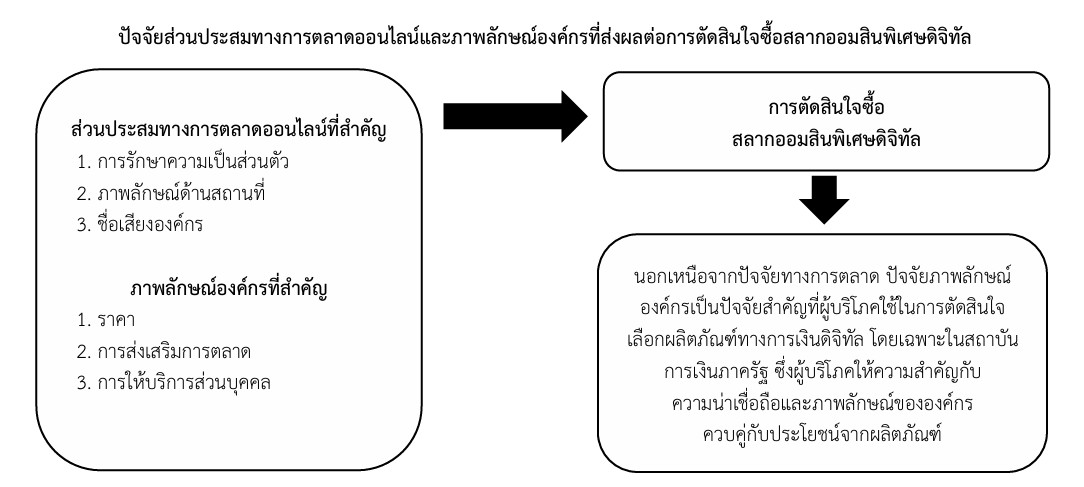
บทความวิจัยนี้มีวัตถุประสงค์เพื่อศึกษา (1) ปัจจัยส่วนประสมทางการตลาดออนไลน์ที่มีผลต่อการตัดสินใจซื้อสลากออมสินพิเศษดิจิทัลของผู้บริโภคในอำเภอหาดใหญ่ จังหวัดสงขลา และ (2) ภาพลักษณ์องค์กรที่มีผลต่อการซื้อสลากออมสินพิเศษดิจิทัลของผู้บริโภค กลุ่มตัวอย่างเป็นผู้บริโภคที่ซื้อสลากออมสินพิเศษดิจิทัล จำนวน 385 ราย งานวิจัยนี้เป็นการวิจัยเชิงปริมาณ ใช้วิธีการสุ่มตัวอย่างแบบเฉพาะเจาะจง เครื่องมือการวิจัยคือแบบสอบถาม ซึ่งมีข้อคําถามแบบเลือกตอบ และมาตรวัดประมาณค่า 5 ระดับ การวิเคราะห์ข้อมูล ประกอบด้วย ค่าร้อยละ ค่าเฉลี่ย ค่าส่วนเบี่ยงเบนมาตรฐาน การวิเคราะห์สหสัมพันธ์ และการวิเคราะห์การถดถอยพหุคูณ ผลการวิจัยพบว่าปัจจัยส่วนประสมทางการตลาดออนไลน์ ซึ่งประกอบด้วย ด้านราคา ด้านการส่งเสริมการตลาด และด้านการให้บริการส่วนบุคคล ส่งผลเชิงบวกต่อการตัดสินใจซื้อสลากออมสินพิเศษดิจิทัล อย่างมีนัยสำคัญทางสถิติที่ระดับ 0.05 โดยด้านการให้บริการส่วนบุคคลมีอิทธิพลมากที่สุด (β = 0.170) รองลงมา คือ ด้านการส่งเสริมการตลาด (β = 0.169) และด้านราคา (β = 0.142) ตามลำดับ ทั้งนี้แบบจำลองสามารถอธิบายความแปรปรวนของการตัดสินใจซื้อได้ร้อยละ 20.0 (R² = 0.200) ในขณะที่ด้านผลิตภัณฑ์ ด้านช่องทางการจัดจำหน่าย และด้านการรักษาความเป็นส่วนตัว ไม่ส่งผลต่อการตัดสินใจซื้อสลากออมสินพิเศษดิจิทัล ในขณะเดียวกัน ภาพลักษณ์องค์กร ซึ่งประกอบด้วย คือ ด้านชื่อเสียงองค์กร ด้านความรับผิดชอบต่อสังคม และด้านสถานที่ ส่งผลเชิงบวกต่อการตัดสินใจซื้อสลากออมสินพิเศษดิจิทัล อย่างมีนัยสำคัญทางสถิติที่ระดับ 0.05 โดยด้านสถานที่มีอิทธิพลมากที่สุด (β = 0.318) รองลงมา คือ ด้านชื่อเสียงองค์กร (β = 0.252) และด้านความรับผิดชอบต่อสังคม (β = 0.135) ตามลำดับ ทั้งนี้แบบจำลองสามารถอธิบายความแปรปรวนของการตัดสินใจซื้อได้ร้อยละ 24.2 (R² = 0.242) ผลการวิจัยชี้ให้เห็นว่าธนาคารออมสินควรมุ่งพัฒนาการให้บริการเฉพาะบุคคล ควบคู่กับการเสริมสร้างภาพลักษณ์องค์กรที่น่าเชื่อถือ เพื่อกระตุ้นการตัดสินใจซื้อสลากออมสินพิเศษดิจิทัลของผู้บริโภคได้อย่างมีประสิทธิภาพ
เอกสารอ้างอิง
กิตติพงษ์ พิพิธกุล. (2561). คุณภาพเครื่องมือแบบสอบถาม : Validity กับ Reliabilty ในการวิจัยทางรัฐประศาสนศาสตร์. วารสารวิชาการและวิจัย มหาวิทยาลัยภาคตะวันออกเฉียงเหนือ, 8(2), 104–110.
ณัฐวุฒิ ยอดใจ, ญาณิฐา ราชคม และ ทัดพงศ์ อวิโรธนานนท์. (2568). ความสัมพันธ์ระหว่างส่วนประสมทางการตลาดออนไลน์ (6Ps) และพฤติกรรมผู้บริโภค ชาวไทยบนแพลตฟอร์มเฟซบุ๊ก. วารสารบริหารธุรกิจและศิลปศาสตร์ ราชมงคลล้านนา, 13(2), 75–90.
ธนาคารออมสิน. (2567). รายงานผลประกอบการประจำปี 2567. สืบค้นจาก https://www.gsb.or.th.
ธนานันต์ นุ่มแสง และ ธนิตา ตันตระรุ่งโรจน์. (2561). การทดสอบความเที่ยงตรงและความเชื่อมั่นของแบบประเมินกลยุทธ์ ในการรับมือกับความเครียดแบบสั้นฉบับภาษาไทย. วารสารสมาคมจิตแพทย์แห่งประเทศไทย, 63(2), 189–198.
วรสิญน์ พานิชกุล. (2563). การยอมรับเทคโนโลยีและความตั้งใจที่จะใช้โมบายแบงกิ้งแอปพลิเคชัน ของผู้สูงอายุในกรุงเทพมหานคร. (บริหารธุรกิจมหาบัณฑิต, มหาวิทยาธุรกิจบัณฑิตย์).
สุจิตรา คำกัมพล. (2565). ปัจจัยด้านการตลาดและภาพลักษณ์องค์กรต่อการตัดสินใจ ซื้อซ้ำสลากออมทรัพย์ในจังหวัดเชียงใหม่. วารสารเศรษฐศาสตร์ มหาวิทยาลัยแม่โจ้, 2(2), 49–59.
Armstrong, G., & Kotler, P. (2009). Marketing: An introduction. (9th ed.). Upper Saddle River: Pearson Education.
Belsley, D. A. (1991). A guide to using the collinearity diagnostics. Computer Science in Economics and Management, 4(1), 33-50.
Borden, N. H. (1964). The concept of the marketing mix. Journal of advertising research, 4(2), 2-7.
Cai, H., & Mardani, A. (2023). Research on the impact of consumer privacy and intelligent personalization technology on purchase resistance. Journal of Business Research, 161, 113811.
Chen, X., Sun, J., & Liu, H. (2022). Balancing web personalization and consumer privacy concerns: Mechanisms of consumer trust and reactance. Journal of consumer behaviour, 21(3), 572-582.
Cochran, W. G. (1977). Sampling Techniques. (3rd ed.). New York: Wiley.
Kotler, P., & Armstrong, G. (2014). Principles of Marketing. (15th ed.). New York: Pearson Publishing.
Kotler, P., & Keller, K. L. (2016). Marketing Management. (15th ed.). New York: Pearson Education.
LeBlanc, G., & Nguyen, N. (1996). Cues used by customers evaluating corporate image in service firms: An empirical study in financial institutions. International Journal of service Industry Management, 7(2), 44-56.
McCarthy, E. J. (1960). Basic marketing: A managerial approach. Homewood, Illinois: Richard D. Irwin.
Pappas, I. O. (2018). User experience in personalized online shopping: a fuzzy-set analysis. European Journal of Marketing, 52(7-8), 1679-1703.
ดาวน์โหลด
เผยแพร่แล้ว
รูปแบบการอ้างอิง
ฉบับ
ประเภทบทความ
สัญญาอนุญาต
ลิขสิทธิ์ (c) 2026 วารสารสังคมศาสตร์ปัญญาพัฒน์

อนุญาตภายใต้เงื่อนไข Creative Commons Attribution-NonCommercial-NoDerivatives 4.0 International License.


