Work Motivation and Quality of Work Life Influencing Organizational Commitment of Generation Z Employees at the Government Savings Bank Head Office
Keywords:
Organizational Commitment, Government Savings Bank Headquarters, Quality of Work Life, Generation Z Employees, Work MotivationAbstract
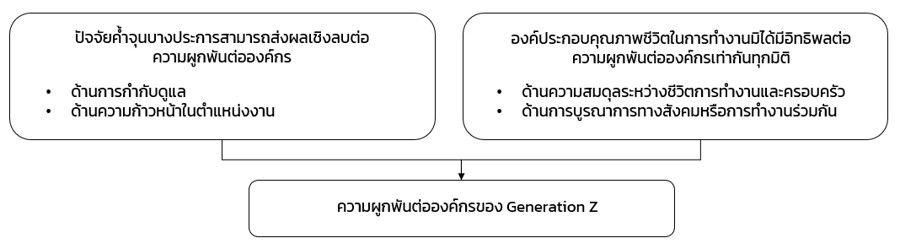
This article aimed to examine the effects of work motivation and quality of work life on organizational commitment among Generation Z employees in the context of a Thai state-owned enterprise. Drawing on Herzberg’s Two-Factor Theory, Walton’s Quality of Work Life framework, and Allen and Meyer’s organizational commitment model, data were collected from 205 Generation Z employees at the Government Savings Bank Headquarters using a structured questionnaire. Descriptive statistics, t-tests, one-way ANOVA, and multiple regression analysis were employed. The findings reveal that work motivation and quality of work life have a positive and statistically significant effect on organizational commitment, particularly in terms of job characteristics, workplace relationships, and work–life balance. The findings also indicate that supervision and career advancement have a negative and statistically significant effect on organizational commitment. This study contributes to the organizational behavior literature by extending empirical evidence on Generation Z employees within public-sector financial institutions.
References
กังวาน ยอดวิศิษฎ์ศักดิ์ และ รัตน์ติญา อยู่เย็น. (2566). การศึกษาปัจจัยที่ส่งผลต่อความผูกพันต่อองค์กรของพนักงานกลุ่มเจเนอเรชันซีที่ปฏิบัติงานในภูมิภาคของประเทศไทย. วารสารมหาวิทยาลัยพายัพ, 33(2), 108–125.
ธนาคารออมสิน. (2567). แผนวิสาหกิจธนาคารออมสิน ปี 2567 – 2571. สืบค้นจาก https://www.gsb.or.th/media/2024/02/เล่มแผนวิสาหกิจธนาคารออมสิน-ปี-67-71-ITA.pdf.
ธนาคารออมสิน. (2568). แผนวิสาหกิจธนาคารออมสิน ปี 2569 – 2573. สืบค้นจาก https://www.gsb.or.th/media/2026/03/ITA-เล่มแผนวิสาหกิจ-2569-2573-ฉ.ปรับปรุง.pdf.
ธันยพร วิศรียา. (2566). ปัจจัยที่ส่งผลต่อประสิทธิภาพการทำงานในองค์กรของประชากรวัยทำงาน Generation Y หลังสถานการณ์ COVID-19. (บริหารธุรกิจมหาบัณฑิต, มหาวิทยาลัยศรีนครินทรวิโรฒ).
ปริศรา ธานีใหญ่. (2565). ปัจจัยที่มีผลต่อการตัดสินใจเลือกเข้าทำงานในองค์กรของคน Generation Z. (บริหารธุรกิจมหาบัณฑิต, มหาวิทยาลัยนเรศวร).
พรรณอร รัชตมุทธา. (2566). คุณภาพชีวิตในการทำงานและความผูกพันต่อองค์กรของผู้ปฏิบัติงานฝ่ายบำรุงรักษาเครื่องกล การไฟฟ้าฝ่ายผลิตแห่งประเทศไทย. (รัฐประศาสนศาสตรมหาบัณฑิต, จุฬาลงกรณ์มหาวิทยาลัย).
พลอยชมพู เหมหงษา. (2563). แรงจูงใจและค่านิยมในการปฏิบัติงานของ Generation Z ในกรุงเทพมหานคร. (บริหารธุรกิจมหาบัณฑิต, มหาวิทยาลัยธุรกิจบัณฑิตย์).
เพชรวิภา ช่างเก็บ. (2566). ปัจจัยที่ส่งผลต่อความผูดกพันองค์กรของพนักงานบริษัทเอกชน Generation Z ในเขตพื้นที่กรุงเทพมหานคร. (บริหารธุรกิจมหาบัณฑิต, มหาวิทยาลัยธรรมศาสตร์).
ฤทธิชัย จันทร์ศรีนวล. (2567). ปัจจัยด้านแรงจูงใจในการทำงานที่ส่งผลต่อความผูกพันองค์กรของข้าราชการกรมชลประทาน. (รัฐศาสตรมหาบัณฑิต, มหาวิทยาลัยธรรมศาสตร์).
วรฤทัย แถลงกัณฑ์ (2567). ปัจจัยจูงใจและปัจจัยค้ำจุนที่ส่งผลต่อความผูกพันในองค์กรของกลุ่มคน Generation Y และ Generation Z ในเขตกรุงเทพมหานครและปริมณฑล. (บริหารธุรกิจมหาบัณฑิต, มหาวิทยาลัยรามคำแหง).
วัชรพงษ์ อนันต์วรปัญญา. (2564). คุณภาพชีวิตในการทำงานและคุณลักษณะของงานที่มีอิทธิพลต่อความผูกพันต่อองค์กรของพนักงานธนาคารของรัฐแห่งหนึ่งในกรุงเทพมหานคร. วารสารวิชาการมหาวิทยาลัยการจัดการและเทคโนโลยีอีสเทิร์น, 17(2), 244–253.
สำนักงานสภาพัฒนาการเศรษฐกิจและสังคมแห่งชาติ. (2568). โอกาสและความท้าทายของเด็กจบใหม่ในโลกการทำงาน. สืบค้นจาก https://www.nesdc.go.th/wordpress/wp-content/uploads/2025/08/1.1-publisher_q2-68-1-โอกาสและความท้าทายของเด็กจบใหม่ในโลกการทำงาน-1.pdf.
สุธิมา เกิดสุข. (2563). ปัจจัยจูงใจ ปัจจัยค้ำจุนและคุณภาพชีวิตในการทำงานที่มีต่อความผูกพันต่อองค์กรของพนักงานสถาบันวิจัยวิทยาศาสตร์และเทคโนโลยีแห่งประเทศไทย. (บริหารธุรกิจมหาบัณฑิต, มหาวิทยาลัยเทคโนโลยีราชมงคลธัญบุรี).
Allen, N. J., & Meyer, J. P. (1990). The measurement and antecedents of affective, continuance and normative commitment to the organization. Journal of occupational psychology, 63(1), 1-18.
Dimock, M. (2019). Where Millennials end and Generation Z begins. Retrieved from https://www.pewresearch.org/short-reads/2019/01/17/where-millennials-end-and-generation-z-begins/.
Francis, T., & Hoefel, F. (2018). True Gen’: Generation Z and its implications for companies. McKinsey & Company, 12(2), 1-10.
Gomez, K., Mawhinney, T., & Betts, K. (2019). Welcome to Generation Z. Retrieved from https://www2.deloitte.com/content/dam/Deloitte/us/Documents/consumer-business/welcome-to-gen-z.pdf.
Herzberg, F. (1959). The motivation to work. New York: McGraw-Hill.
Krejcie, R. V., & Morgan, D. W. (1970). Determining sample size for research activities. Educational and psychological measurement, 30(3), 607-610.
Parker, K., & Igielnik, R. (2020). On the Cusp of Adulthood and Facing an Uncertain Future: What We Know about Gen Z So Far. Retrieved from https://www.pewresearch.org/social-trends/2020/05/14/on-the-cusp-of-adulthood-and-facing-an-uncertain-future-what-we-know-about-gen-z-so-far/.
Walton, R. E. (1973). Quality of Working Life: What Is It?. Sloan Management Review, 15(1), 11-21.
Downloads
Published
How to Cite
Issue
Section
License
Copyright (c) 2026 Journal of Social Science Panyapat

This work is licensed under a Creative Commons Attribution-NonCommercial-NoDerivatives 4.0 International License.


