Buy Now Pay Later (BNPL): Implications for Consumption Behavior and Household Financial Risk
Keywords:
Buy Now Pay Later, Consumption Behavior, Household Financial RiskAbstract
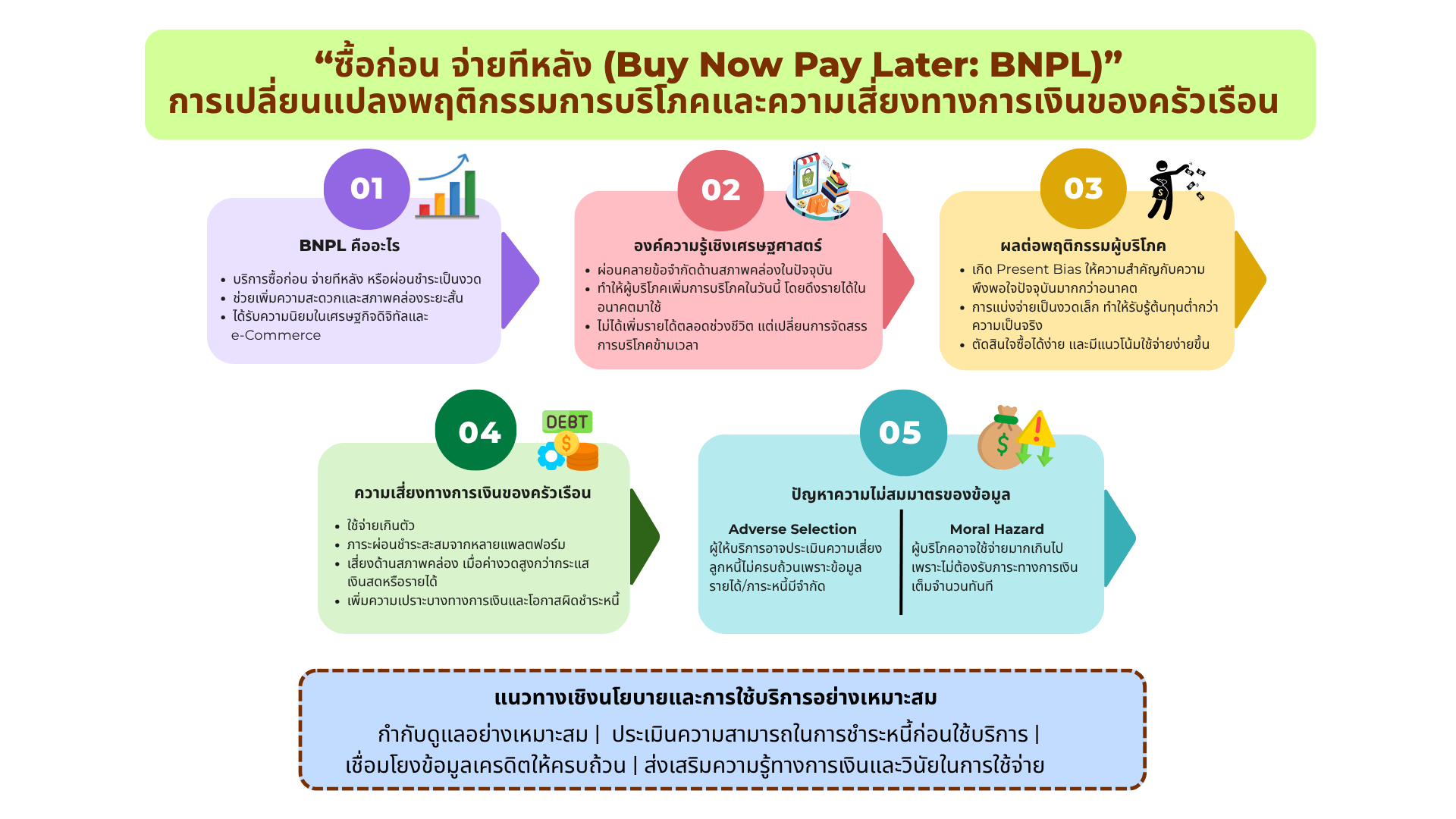
This academic article aims to present the effects of Buy Now Pay Later (BNPL) services on changes in consumption behavior and household financial risk in the context of the digital economy. It explains the characteristics of BNPL as a financial innovation that increases convenience and flexibility in payment, particularly for consumers with limited access to traditional credit. The article also applies the concepts of intertemporal consumption, the budget line, and indifference curves to explain that BNPL relaxes current liquidity constraints, enabling consumers to increase present consumption in exchange for future repayment obligations and a reduction in future consumption capacity. Although BNPL services can expand opportunities for access to liquidity and support economic activities, they may also create risks related to excessive spending, debt accumulation, liquidity risk arising from installment obligations that exceed cash flow or income in each period, and household financial vulnerability. In addition, this article highlights the problem of information asymmetry among consumers, service providers, and financial institutions, which may lead to adverse selection and moral hazard. Therefore, the development of BNPL services should proceed alongside appropriate regulation, transparent information disclosure, and the promotion of financial literacy, so that such services can generate benefits for both consumers and the economy.
References
ณัฐชิต บุรันทวีคูณ. (2568). รายงาน How Southeast Asia Buys and Pays 2025. สืบค้นจาก https://marketeeronline.co/archives/405929.
ธนาคารแห่งประเทศไทย. (2568). การให้บริการบัตรเครดิตแยกตามประเภทบัตรเครดิต. สืบค้นจาก https://app.bot.or.th/BTWS_STAT/statistics/BOTWEBSTAT.aspx?language=TH&reportID=1009&utm_source#.
นฤชยา สาตแฟง. (2568). แนวโน้มธุรกิจ/อุตสาหกรรม ปี 2568-2570: ธุรกิจบัตรเครดิต. สืบค้นจาก https://www.krungsri.com/th/research/industry/industry-outlook/financial-services/credit-card/io/io-credit-card-2025.
บริษัท เอสบีซีเอส จำกัด. (2569). เจาะเทรนด์การตลาด “ซื้อก่อนจ่ายทีหลัง” หรือ “Buy Now Pay Later” ที่กำลังเติบโตในประเทศไทย. สืบค้นจาก https://www.sbcs.co.th/th/articles/?p=249.
มยูร บุญยะรัตน์ และ อารีรัตน์ สวัสดิ์เป้า. (2568). BNPL กับพลวัตของหนี้ครัวเรือน. สืบค้นจาก https://www.fpojournal.com/bnpl-123/.
ศูนย์วิจัยเศรษฐกิจและธุรกิจ ธนาคารไทยพาณิชย์. (2568). ผลสำรวจเศรษฐกิจมหภาค ปี 2568 (Macro Survey 2025). สืบค้นจาก https://www.scbeic.com/th/detail/file/product/9994/he7xexj04t/MacroSurvey2025-20251225.pdf.
สภาองค์กรของผู้บริโภค. (2568). เตือนภัย “Buy Now Pay Later” กับดักหนี้ยุคใหม่ เสี่ยงใช้จ่ายเกินตัว. สืบค้นจาก https://www.tcc.or.th/appeal/buy-now-pay-later-fakepage/.
สฤณี อาชวานันทกุล. (2568). Moral hazard คืออะไร? เมื่อความเสี่ยงถูกผลักไปให้คนอื่น. สืบค้นจาก https://themomentum.co/citizen20-moral-hazard/.
สำนักงานสภาพัฒนาการเศรษฐกิจและสังคมแห่งชาติ. (2566). บทความเศรษฐกิจ ไตรมาสที่ 3 ปี 2566. สืบค้นจาก https://www.nesdc.go.th/wordpress/wp-content/uploads/2025/06/2566_article_q3_001.pdf.
อภิญญา วนเศรษฐ. (2565). ทฤษฎีการบริโภคข้ามช่วงเวลา (Intertemporal Consumption Theory) ภายใต้เส้นงบประมาณและเส้นอรรถประโยชน์. สืบค้นจาก https://ird01.stou.ac.th/researchlib/uploads/2565_041/%E0%B8%9A%E0%B8%97%E0%B8%97%E0%B8%B5%E0%B9%88%202.pdf.
Attanasio, O. P. (1995). The intertemporal allocation of consumption: theory and evidence. Carnegie-Rochester Conference Series on Public Policy, 42, 39–89.
Consumer Financial Protection Bureau. (2022). Buy now, pay later: Market trends and consumer impacts. Retrieved from https://files.consumerfinance.gov/f/documents/cfpb_buy-now-pay-later-market-trends-consumer-impacts_report_2022-09.pdf.
Donou-Adonsou, F., & Leslie-Piper, N. (2025). BNPL and financial fragility in US households. Finance Research Letters, 86, 108423.
Hayashi, F., & Routh, A. (2025). Financial Constraints Among Buy Now, Pay Later Users. Economic Review, 110(4), 01612387.
Kumar, A., Salo, J., & Bezawada, R. (2024). The effects of buy now, pay later (BNPL) on customers’ online purchase behavior. Journal of Retailing, 100(4), 602-617.
Nicholson, W., & Snyder, C. M. (2012). Microeconomic theory: Basic principles and extensions. (11th ed.). Ohio: South-Western Cengage Learning.
O'donoghue, T., & Rabin, M. (1999). Doing it now or later. American economic review, 89(1), 103-124.
Omni Calculator. (2026). Buy now pay later trends. Retrieved from https://www.omnicalculator.com/reports/buy-now-pay-later-trends.
Statista. (2025). Share of users of buy now, pay later services in the United States in 2021, by generation. Retrieved from https://www.statista.com/statistics/1262285/share-users-buy-now-pay-later-united-states-by-generation/.
Tutor2u. (2023). Information failure: What is adverse selection?. Retrieved from https://www.tutor2u.net/economics/reference/information-failure-what-is-adverse-selection.
Varian, H. R. (2014). Intermediate microeconomics with calculus: A modern approach. New York: W. W. Norton & Company.
Downloads
Published
How to Cite
Issue
Section
License
Copyright (c) 2026 Journal of Social Science Panyapat

This work is licensed under a Creative Commons Attribution-NonCommercial-NoDerivatives 4.0 International License.


