Financial Literacy, Saving Behavior, and Precautionary Saving of the Thai Sandwich Generation
Keywords:
Precautionary Saving, Sandwich Generation, Financial LiteracyAbstract
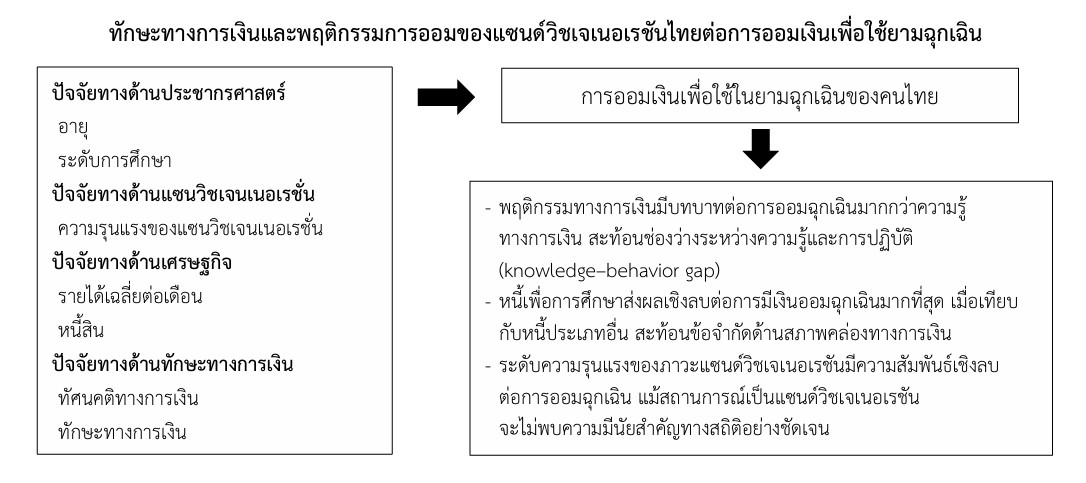
This study aims to examine the effects of financial literacy, saving behavior, and sandwich generation status on precautionary saving among Thai individuals. Primary data were collected from 402 respondents using a structured questionnaire. The data were analyzed using descriptive statistics and a Logit Model to investigate the relationships between demographic characteristics, economic factors, sandwich generation status, financial literacy, and the likelihood of having precautionary savings equivalent to at least six months of living expenses. The results indicate that income, financial literacy, and financial behavior have statistically significant positive associations with precautionary saving, while debt burden, particularly personal and educational loans, has a statistically significant negative association with precautionary saving. Working-age individuals are significantly less likely to have adequate precautionary savings than older adults. Although sandwich generation status is not statistically significant, the severity of sandwich generation burden shows a weak negative association with precautionary saving, suggesting that greater caregiving responsibilities across multiple generations may reduce individuals' ability to accumulate emergency savings. The findings further demonstrate that financial behavior contributes more to precautionary saving than financial knowledge alone. In addition, income and debt burden remain major constraints on building adequate precautionary savings. These findings provide practical implications for policymakers in designing policies to promote saving, strengthen financial literacy, and develop targeted measures that address the financial circumstances of the Thai population, thereby enhancing long-term financial security.
References
จาคินี เรื่องธรรมศักดิ์. (2551). พฤติกรรมการบริโภคและการออมไว้ใช้ยามฉุกเฉินของครัวเรือนไทยภายใต้ความไม่แน่นอนของรายได้. (เศรษฐศาสตรมหาบัณฑิต, จุฬาลงกรณ์มหาวิทยาลัย).
ตลาดหลักทรัพย์แห่งประเทศไทย. (2568). หนี้ท่วมหัว “เดอะแบก” ไม่ต้องกลัว ปลดล็อกง่าย ๆ ดูแลทั้งครอบครัว. สืบค้นจาก https://shorturl.asia/S9Xnm.
ธนาคารแห่งประเทศไทย. (2566). ลดเสี่ยง เพิ่มสุข ด้วยเงินออมเผื่อฉุกเฉิน. สืบค้นจาก https://shorturl.asia/0SRQm
ธนาคารแห่งประเทศไทย. (2569). ผลสำรวจทักษะทางการเงินของคนไทย ปี 2567. สืบค้นจาก https://shorturl.asia/ZDXI2.
ธีรศักดิ์ ทรัพย์วโรบล และ นนทร์ วรพาณิชช์. (2568). ทักษะทางการเงิน แซนด์วิชเจนเนอเรชั่น และการก่อหนี้เกินตัว: หลักฐานเชิงประจักษ์ของประเทศไทย (รายงานการวิจัย). กรุงเทพฯ: ภาควิชาเศรษฐศาสตร์ คณะเศรษฐศาสตร์ มหาวิทยาลัยเกษตรศาสตร์.
นิวาน ผลพันธิน. (2562). ความเปราะบางทางการเงินของแรงงานไทยนอกภาคเกษตรกรรม (รายงานการวิจัย). ปทุมธานี: สถาบันเสริมศึกษาและทรัพยากรมนุษย์ มหาวิทยาลัยธรรมศาสตร์.
พัชรินทร์ คำนาศักดิ์, สุพรรณิกา ลือชารัศมี และ จิราคม สิริศรีสกุลชัย. (2566). ผลของความรู้สึกมั่นคงในการทำงานที่มีต่อการออมไว้ใช้ยามฉุกเฉินของพนักงานธนาคาร ในจังหวัดเชียงใหม่. วารสารเศรษฐศาสตร์ มหาวิทยาลัยแม่โจ้, 3(2), 39–50.
วันรักษ์ มิ่งมณีนาคิน. (2553). หลักเศรษฐศาสตร์มหภาค. (พิมพ์ครั้งที่ 14). กรุงเทพฯ : สำนักพิมพ์มหาวิทยาลัยธรรมศาสตร์.
ศิริวรรณ เสรีรัตน์. (2538). พฤติกรรมผู้บริโภค. กรุงเทพฯ: พัฒนาศึกษา.
แสงสุรีย์ เสมอใจ. (2559). พฤติกรรมการออมไว้ใช้ยามฉุกเฉินของครัวเรือนไทยภายใต้ความไม่แน่นอนด้านรายได้ที่แตกต่างกัน. (เศรษฐศาสตรมหาบัณฑิต, มหาวิทยาลัยธรรมศาสตร์).
Brunetti, M., Giarda, E., & Torricelli, C. (2016). Is financial fragility a matter of illiquidity? An appraisal for Italian households. Review of Income and Wealth, 62(4), 628-649.
Hasler, A., Lusardi, A., & Oggero, N. (2018). Financial fragility in the US: Evidence and implications. Washington, DC: Global Financial Literacy Excellence Center, The George Washington University School of Business.
OECD. (2023). OECD/INFE 2023 International Survey of Adult Financial Literacy. Retrieved from https://www.oecd.org/en/publications/oecd-infe-2023-international-survey-of-adult-financial-literacy_56003a32-en.html.
Downloads
Published
How to Cite
Issue
Section
License
Copyright (c) 2026 Journal of Social Science Panyapat

This work is licensed under a Creative Commons Attribution-NonCommercial-NoDerivatives 4.0 International License.


