Factors Affecting Knowledge and Understanding of the Protection of Consumer Rights in the Context of Digital Assets Among Upper Secondary School Students in Mueang District, Surat Thani Province
Keywords:
Consumer Rights Protection, Digital Assets, Upper Secondary School Students, Self-Perceived KnowledgeAbstract
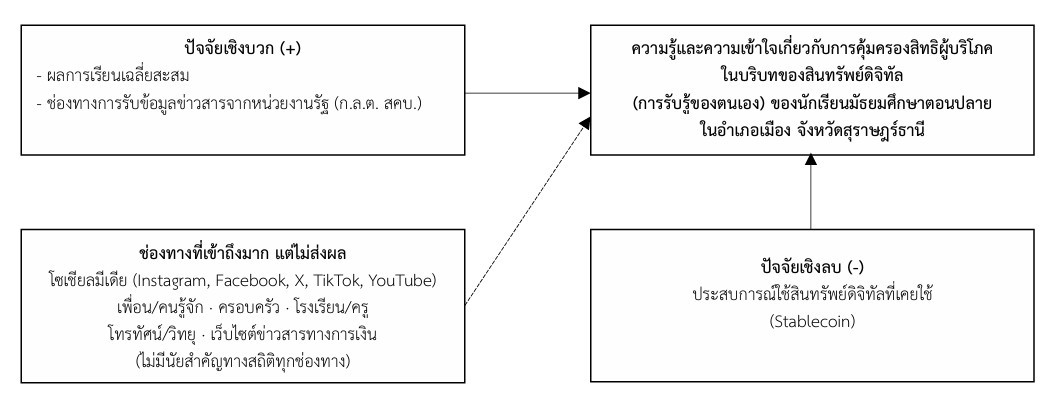
This research was conducted to (1) examine the personal, economic, and social characteristics, along with the digital-asset-related experience, of upper-secondary school students; (2) examine their level of knowledge and understanding of consumer rights protection; and (3) determine the factors influencing knowledge and understanding of consumer rights protection in the context of digital assets among upper-secondary school students in Mueang District, Surat Thani Province. A quantitative approach was adopted. The population consisted of 8,401 upper-secondary school students from ten schools in Mueang District, Surat Thani Province. A sample of 400 students was drawn by accidental sampling; the sample size was determined using the formula developed by Yamane (1973) together with the criterion set by Green (1991), and the sample was distributed proportionally according to the number of students in each school. The questionnaire developed for this research obtained an item-objective congruence (IOC) index of 0.76 and an overall Cronbach's alpha coefficient of 0.972. Data analysis involved descriptive statistics (percentage, mean, and standard deviation) and inferential statistics (multiple regression analysis using the Enter method). The findings were as follows: (1) most participants were female, earning a monthly income of 3,000–5,000 baht, with a monthly family income of 15,000–30,000 baht, and their families had never invested in digital assets; overall exposure to information was at a moderate level, the highest channel being social media and the lowest government agencies; (2) overall, participants' self-assessed knowledge and understanding of consumer rights protection in the context of digital assets was at a moderate level; and (3) exposure to information from government agencies and cumulative grade point average each had a positive effect on knowledge and understanding of consumer rights protection in the context of digital assets, whereas experience in using stablecoins had a negative effect, at the .05 level of statistical significance.
References
กฤตธี เปี่ยมสง่า. (2564). การเปิดรับข่าวสารและปัจจัยที่มีอิทธิพลต่อความตั้งใจใช้งานสินทรัพย์ดิจิทัลของกลุ่มผู้บริโภคเจเนอเรชันวาย. (นิเทศศาสตรมหาบัณฑิต, จุฬาลงกรณ์มหาวิทยาลัย).
กุลนันทน์ ศรีเจริญ. (2567). ปรากฏการณ์ล้มทั้งยืน: อาชญากรรมบนเทคโนโลยีการเงินแบบกระจายศูนย์. วารสารสังคมสงเคราะห์ศาสตร์และการบริหารสังคม, 32(1), 29-61.
ชนากานต์ ธนนิวัฒน์ และ ศิริชัย กาญจนวาสี. (2566). การพัฒนาแบบวัดความฉลาดรู้การเงินสำหรับนักเรียนระดับชั้นมัธยมศึกษาตอนต้น. วารสารการวัดผลการศึกษา, 40(107), 40-51.
ธนาคารแห่งประเทศไทย. (2569). มาตรการจำกัดวงเงินโอนของบัญชีเงินฝากและ e-Money สำหรับผู้เยาว์เพื่อป้องกันบัญชีม้า. สืบค้นจาก https://www.bot.or.th/th/news-and-media/news/news-20260731-2.html.
โธมัส กวาดามูซ, วรวลัญช์ วรัชวรวัลย์ และ ณัฐรัชต์ สาเมาะ. (2566). ภูมิคุ้มกันในโลกดิจิทัล (digital resilience) ทักษะที่เด็กและเยาวชนไทยยุคใหม่ต้องมี. สืบค้นจาก https://mahidol.ac.th/musef/ภูมิคุ้มกันในโลกดิจิทั/.
นัฐพัชร สมงาม, พนิดา นิลอรุณ และ ชลภัสสรณ์ สิทธิวรงค์ชัย. (2568). การพัฒนาสมรรถนะดิจิทัลและประสิทธิภาพการทำงาน. วารสารสังคมศาสตร์ปัญญาพัฒน์, 7(3), 503–518.
นันทิภา แสงทอง, สุชาดา นันทะไชย และ สุดารัตน์ สารสว่าง. (2567). สุขภาวะที่ดีทางดิจิทัลของนักเรียนโรงเรียนนวมินทราชินูทิศ สตรีวิทยา 2 สังกัดสำนักงานเขตพื้นที่การศึกษามัธยมศึกษากรุงเทพมหานคร เขต 2. วารสาร มจร สังคมศาสตร์ปริทรรศน์, 13(5), 239–249.
ประกายแก้ว ไกรสงคราม และ สุรศักดิ์ เก้าเอี้ยน. (2565). ปัจจัยที่ส่งผลต่อความฉลาดรู้ทางการเงินของนักเรียนมัธยมศึกษาตอนปลาย: การวิเคราะห์โมเดลสมการโครงสร้างพหุระดับ. วารสารวิชาการและวิจัย มหาวิทยาลัยภาคตะวันออกเฉียงเหนือ, 12(3), 27-40.
พงศธร ปริญญาวุฒิ. (2565). เผยผลสำรวจความสนใจสินทรัพย์ดิจิทัลของประชาชนชาวไทย พบ 46% มุ่งเก็งกำไร. สืบค้นจาก https://www.sec.or.th/TH/Template3/Articles/2565/170565.pdf.
สำนักงานคณะกรรมการกำกับหลักทรัพย์และตลาดหลักทรัพย์. (2565). รู้เขา รู้ระวัง รู้เท่าทัน สินทรัพย์ดิจิทัล. สืบค้นจาก https://www.sec.or.th/TH/Documents/DigitalAsset/DigitalAssetInvestment-Guide.pdf.
สำนักงานปลัดกระทรวงศึกษาธิการ. (2569ก). ข้อมูลสถิตินักเรียนรายสถานศึกษา ปีการศึกษา 2568 จังหวัดสุราษฎร์ธานี. กรุงเทพฯ: กระทรวงศึกษาธิการ.
สำนักงานปลัดกระทรวงศึกษาธิการ. (2569ข). ระบบข้อมูล RealTime: ข้อมูลสถานศึกษา จังหวัดสุราษฎร์ธานี อำเภอเมือง สุราษฎร์ธานี. สืบค้นจาก https://edurealtimedata.moe.go.th/dashboard/schools?provinceId=84&districtId=8401.
สำนักงานสถิติแห่งชาติ. (2568). สรุปผลที่สำคัญ การสำรวจการมีการใช้เทคโนโลยีสารสนเทศและการสื่อสารในครัวเรือน พ.ศ. 2568 (ไตรมาสที่ 1). สืบค้นจาก https://www.nso.go.th/nsoweb/storage/survey_detail/2025/20250526075340_14241.pdf.
อัครวิชช์ รอบคอบ และ เกสินี หมื่นไธสง. (2566). ทัศนคติเกี่ยวกับการลงทุนในสินทรัพย์ดิจิทัลของนักลงทุนช่วงเจเนอเรชันวายในประเทศไทย. Maejo Business Review, 5(1), 70-91.
Allgood, S., & Walstad, W. B. (2016). The effects of perceived and actual financial literacy on financial behaviors. Economic inquiry, 54(1), 675-697.
Bandura, A. (1977). Social learning theory. Englewood Cliffs, NJ: Prentice-Hall.
Best, J. W. (1981). Research in education. (4th ed.). Englewood Cliffs, NJ: Prentice-Hall.
Boston Consulting Group, & ADDX. (2022). Relevance of on-chain asset tokenization in crypto winter. Retrieved from https://documents.addx.co/relevance_of_onchain_asset_tokenization_in_crypto_winter.pdf.
Cronbach, L. J. (1951). Coefficient alpha and the internal structure of tests. Psychometrika, 16(3), 297-334.
Etikan, I., Musa, S. A., & Alkassim, R. S. (2016). Comparison of convenience sampling and purposive sampling. American Journal of Theoretical and Applied Statistics, 5(1), 1-4.
Field, A. (2018). Discovering statistics using IBM SPSS statistics. (5th ed.). London: SAGE Publications.
Green, S. B. (1991). How many subjects does it take to do a regression analysis?. Multivariate Behavioral Research, 26(3), 499-510.
Hair, J. F., Black, W. C., Babin, B. J., & Anderson, R. E. (2019). Multivariate data analysis. (8th ed.). Hampshire: Cengage.
Kolb, D. A. (1984). Experiential learning: Experience as the source of learning and development. Englewood Cliffs, NJ: Prentice-Hall.
LeBaron, A. B., & Kelley, H. H. (2021). Financial socialization: A decade in review. Journal of Family and Economic Issues, 42(Suppl 1), 195-206.
Lusardi, A., & Mitchell, O. S. (2014). The economic importance of financial literacy: Theory and evidence. Journal of Economic Literature, 52(1), 5-44.
Ward, S. (1974). Consumer socialization. Journal of Consumer Research, 1(2), 1-14.
Yamane, T. (1973). Statistics: An introductory analysis. (3rd ed.). New York: Harper & Row.
Yang, K., & Banamah, A. (2014). Quota sampling as an alternative to probability sampling? An experimental study. Sociological Research Online, 19(1), 1-11.
Downloads
Published
How to Cite
Issue
Section
License
Copyright (c) 2026 Journal of Social Science Panyapat

This work is licensed under a Creative Commons Attribution-NonCommercial-NoDerivatives 4.0 International License.


