Factors Affecting the Indebtedness of Savings Cooperative Members: A Case Study of Bangkok Savings Cooperative
Keywords:
Indebtedness, Financial Literacy, Savings Cooperative, Probit Model, Household DebtAbstract
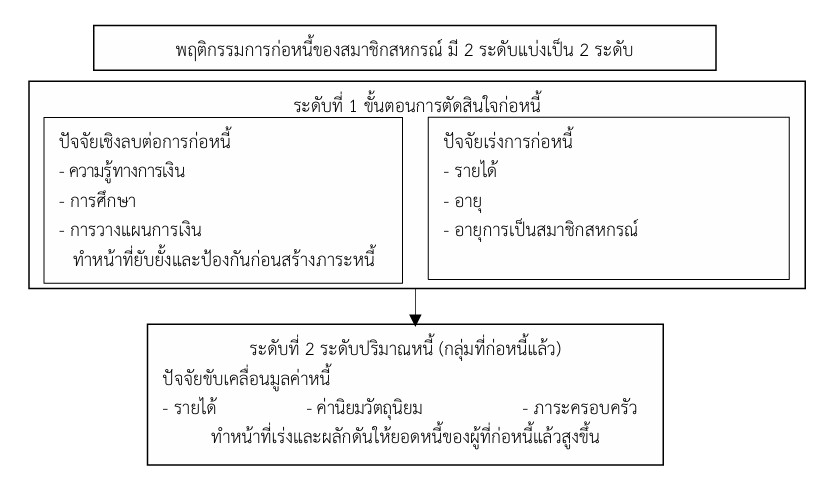
This study aimed to analyze the factors affecting debt incurrence among members of the Bangkok Metropolitan Administration Savings Cooperative Limited. The analysis was conducted in two dimensions: the decision to incur debt and the level of outstanding debt. It covered demographic, socioeconomic, behavioral, attitudinal, and financial-literacy factors. Data were collected from a sample of 400 respondents through a questionnaire and analyzed using descriptive and inferential statistics. Hypotheses were tested using a binary probit model and an ordered probit model. The results revealed that income level was the most influential factor, exerting a statistically significant positive effect on both the decision to incur debt and the level of outstanding debt, consistent with the Permanent Income Hypothesis and the Life-Cycle Theory. Financial literacy and postgraduate education significantly reduced the probability of incurring debt at the 0.05 significance level, while sound financial-planning behavior had a significant negative effect on the decision to incur debt at the 0.10 significance level. Materialism and the number of dependents had statistically significant positive effects on the level of outstanding debt at the 0.05 and 0.10 significance levels, respectively, but had no significant effect on the decision to incur debt. Gender, marital status, employee category, and spending behavior were not statistically significant in either dimension. The average marginal effects indicated that a one-category increase in income increased the probability of debt incurrence by an average of 8.04 percentage points, whereas a one-unit improvement in financial-planning behavior reduced it by 5.45 percentage points. In addition, the sample’s mean financial-literacy score was only 2.50 out of 6, reflecting a clear gap in basic financial knowledge. The findings suggest that long-term debt reduction among cooperative members requires the systematic promotion of financial literacy, the consideration of behavioral criteria in credit assessment, and the provision of advisory services aligned with members’ life stages and family responsibilities.
References
กานต์ชนก มณีพรหม. (2564). ความรู้ทางการเงินที่ส่งผลต่อการวางแผนทางการเงินเพื่อการเกษียณอายุของข้าราชการทหาร สังกัดกรมกำลังพลทหารบก. (รัฐศาสตรมหาบัณฑิต, มหาวิทยาลัยธรรมศาสตร์).
ชนาภา บุบโพ, ธำรงศักดิ์ เศวตเลข และ ณัฐวุฒิ คูวัฒนเธียรชัย. (2564). ปัจจัยที่ส่งผลต่อการออมและการกู้เงินของสมาชิกสหกรณ์ออมทรัพย์วังเดิม จำกัด. วารสารวิชาการสถาบันเทคโนโลยีแห่งสุวรรณภูมิ, 7(1), 420–432.
ไทยพีบีเอส. (2568). “ระเบิดเวลา” หนี้สหกรณ์ออมทรัพย์ 2.43 ล้านล้านบาท. สืบค้นจาก https://policywatch.thaipbs.or.th/article/economy-188.
ธนาคารแห่งประเทศไทย. (2568). เงินให้กู้ยืมแก่ภาคครัวเรือนจำแนกตามสถาบันการเงินและวัตถุประสงค์. สืบค้นจาก https://app.bot.or.th/BTWS_STAT/statistics/BOTWEBSTAT.aspx?reportID=985&language=TH.
พรทิพย์ แสงช่วง และ ศิวพงศ์ ธีรอำพน. (2564). ปัจจัยที่ส่งผลต่อการเป็นหนี้นอกระบบของประชาชนในกรุงเทพมหานคร และปริมณฑล. วารสารรัฐประศาสนศาสตร์ มหาวิทยาลัยราชภัฏสวนสุนันทา, 4(2), 59–69.
ภัทรนันท์ สงวนวัฒนารักษ์, ธีรศักดิ์ ทรัพย์วโรบล และ กนกวรรณ จันทร์เจริญชัย. (2567). ปัจจัยที่ส่งผลต่อพฤติกรรมการก่อหนี้เกินตัวตามวัฎจักรชีวิตของครัวเรือน. วารสารสังคมศาสตร์ปัญญาพัฒน์, 6(2), 25–36.
รัศมีจันทร์ ขวัญเมือง, กลางใจ แสงวิจิตร, พเนิน อินทะระ และ พรทิพย์ จิระธำรง. (2563). ผลกระทบของทักษะทางการเงินที่มีผลต่อสภาวะหนี้สินของข้าราชการครูและบุคลากรทางการศึกษาในกรุงเทพมหานคร. วารสารวิทยาการจัดการ มหาวิทยาลัยราชภัฏเชียงราย, 16(1), 1–16.
สหกรณ์ออมทรัพย์กรุงเทพมหานคร จำกัด. (2568). รายงานกิจการประจำปี 2568. กรุงเทพฯ: สหกรณ์ออมทรัพย์กรุงเทพมหานคร จำกัด.
Alderfer, C. P. (1969). An empirical test of a new theory of human needs. Organizational Behavior and Human Performance, 4(2), 142–175.
Cochran, W. G. (1977). Sampling techniques. (3rd ed.). New York: John Wiley & Sons.
de Matos, C. A., Vieira, V., Bonfanti, K., & Mette, F. M. B. (2019). Antecedents of indebtedness for low-income consumers: The mediating role of materialism. Journal of Consumer Marketing, 36(1), 92–101.
Duesenberry, J. S. (1949). Income, saving, and the theory of consumer behavior. Cambridge, Massachusetts: Harvard University Press.
Friedman, M. (1957). A theory of the consumption function. Princeton, NJ: Princeton University Press.
Klapper, L., Lusardi, A., & Van Oudheusden, P. (2015). Financial Literacy around the World. Washington DC: Standard & Poor’s Ratings Services Global Financial Literacy Survey.
Modigliani, F., & Brumberg, R. (1954). Utility analysis and the consumption function: An interpretation of cross-section data. In K. K. Kurihara (Ed.), Post-Keynesian economics (pp. 388–436). New Brunswick, NJ: Rutgers University Press.
OECD. (2018). OECD/INFE toolkit for measuring financial literacy and financial inclusion. Paris: OECD Publishing.
OECD. (2020). OECD/INFE 2020 International Survey of Adult Financial Literacy. Paris: OECD Publishing.
Downloads
Published
How to Cite
Issue
Section
License
Copyright (c) 2026 Journal of Social Science Panyapat

This work is licensed under a Creative Commons Attribution-NonCommercial-NoDerivatives 4.0 International License.


