Opinions towards Health Monitoring & Evaluation System of the Office of the Permanent Secretary, Ministry of Public Health
Keywords:
Health Monitoring and Evaluation System, System Usage Factors, Ministry of Public HealthAbstract
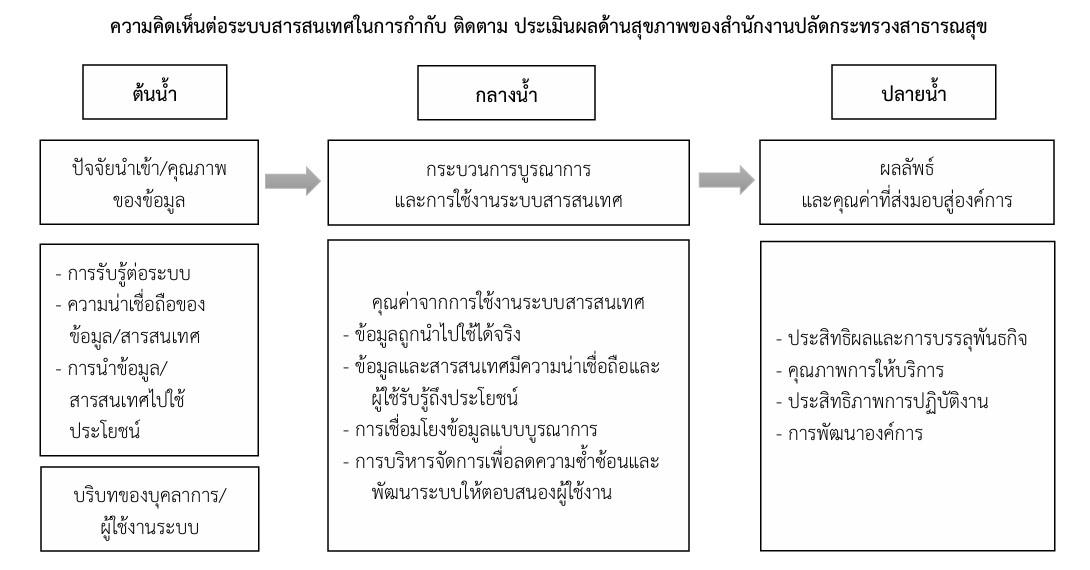
This research aimed to (1) examine the level of opinions toward the health monitoring and evaluation information system; (2) compare opinions toward the health monitoring and evaluation information system according to personal factors; and (3) examine the relationship between information system usage factors and opinions toward the health monitoring and evaluation information system of the Office of the Permanent Secretary, Ministry of Public Health. This study employed a quantitative research design. The sample consisted of 310 personnel from the Office of the Permanent Secretary, Ministry of Public Health, selected using stratified sampling with proportional allocation. Data were collected using a questionnaire and analyzed using a statistical software package. The statistical methods employed included frequency, percentage, mean, standard deviation, independent samples t-test, one-way analysis of variance (One-Way ANOVA), and Pearson’s product-moment correlation coefficient. The level of statistical significance was set at .05. The results revealed that: (1) the overall level of opinions toward the health monitoring and evaluation information system was moderate. Among the dimensions examined, operational efficiency had the highest mean score and was rated at a high level; (2) personnel with different ages, job positions, and lengths of work experience had significantly different opinions toward the health monitoring and evaluation information system, whereas personnel with different sexes and educational levels did not differ significantly in their opinions; and (3) information system usage factors were strongly and positively correlated with opinions toward the health monitoring and evaluation information system. Among the information system usage factors, the utilization of data and information in work practices showed the strongest positive correlation with opinions toward the system.
References
กระทรวงสาธารณสุข. (2561). แผนยุทธศาสตร์ชาติ ระยะ 20 ปี ด้านสาธารณสุข (พ.ศ. 2560-2579). นนทบุรี: กองยุทธศาสตร์และแผนงาน สำนักงานปลัดกระทรวงสาธารณสุข.
กาญจน์วริน สิทธิปรีชาพงษ์. (2565). การศึกษาความต้องการการใช้งานระบบสารสนเทศเพื่อสนับสนุนการบริหารจัดการมหาวิทยาลัย (NSRU MIS) ระดับบุคคล มหาวิทยาลัยราชภัฏนครสวรรค์. วารสารจิตวิทยาพุทธศาสตร์ประยุกต์เพื่อสังคม, 8(1), 223–236.
นวิยา อินทร์มี และ ภิรดา ชัยรัตน์. (2567). ความคิดเห็นในการใช้งานระบบสารบรรณอิเล็กทรอนิกส์ของบุคลากรกรมประชาสัมพันธ์. วารสารมหาจุฬานาครทรรศน์, 11(4), 153–162.
วุฒินันท์ รัตนะ. (2564). การพัฒนาแนวทางการบริหารระบบเทคโนโลยีสารสนเทศสำหรับโรงพยาบาล สังกัดสำนักงานสาธารณสุขจังหวัดกาฬสินธุ์. (การศึกษามหาบัณฑิต, มหาวิทยาลัยมหาสารคาม).
สำนักงานคณะกรรมการพัฒนาระบบราชการ. (2567). คุณภาพการบริหารจัดการภาครัฐ (PMQA). สืบค้นจาก https://www.opdc.go.th/development/government4-0/.
Cronbach, L. J. (1990). Essentials of psychological testing. (5th ed.). New York: Harper & Row.
Yamane, T. (1973). Statistics, an introductory analysis. (3rd ed.). New York: Harper & Row.
Downloads
Published
How to Cite
Issue
Section
License
Copyright (c) 2026 Journal of Social Science Panyapat

This work is licensed under a Creative Commons Attribution-NonCommercial-NoDerivatives 4.0 International License.


