Packaging Attributes of Small-Format Wine Affecting Consumers' Purchase Decisions in Bangkok and Metropolitan
Keywords:
Small-Format Wine, Wine Packaging, Consumer Behavior, Purchase Decision, Conjoint AnalysisAbstract
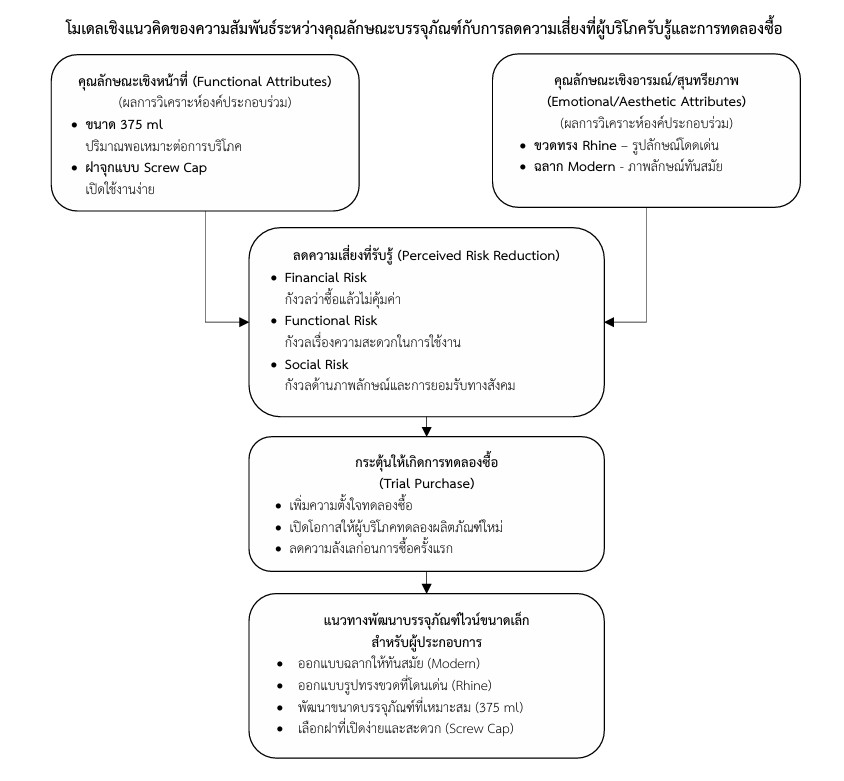
This article aimed to: (1) examine the wine purchasing and consumption behaviors of consumers in Bangkok and its metropolitan area, and (2) analyze the packaging attributes of small-format wine that influence consumers' purchase decisions. This study employed a quantitative research approach. Data were collected through an online questionnaire from 300 consumers aged 20 years and above who resided in Bangkok and its metropolitan area and had purchased or consumed wine during the period from May 2025 to April 2026. The respondents were selected using purposive sampling. Data were analyzed using descriptive statistics and Conjoint Analysis. This study focused exclusively on packaging attributes and excluded price as a factor to avoid its influence on respondents' preference evaluations. The results indicated that most consumers purchased wine for personal consumption, bought wine less than once a month, preferred purchasing from supermarkets, and typically consumed wine during social gatherings. The Conjoint Analysis revealed that label style was the most important packaging attribute (32.18%), followed by bottle shape, package size, and closure type. The most preferred packaging combination consisted of a 375 ml bottle, Rhine bottle shape, Modern label style, and Screw Cap closure. The findings suggest that producers, importers, and wine businesses should prioritize label style and bottle shape when developing small-format wine packaging, as these attributes have the greatest influence on consumers' purchase decisions. Such improvements can better meet consumer preferences and enhance market competitiveness.
References
กมลเนตร สุขวิลัย. (2566). การศึกษาพฤติกรรมผู้บริโภคและการพัฒนาผลิตภัณฑ์ไวน์นํ้ามะพร้าวจากมะพร้าวนํ้าหอมตกเกรด. (วิทยาศาสตรมหาบัณฑิต, มหาวิทยาลัยธรรมศาสตร์).
กุณฑลี รื่นรมย์. (2551). การวิจัยการตลาด. (พิมพ์ครั้งที่ 6). กรุงเทพฯ: โรงพิมพ์แห่งจุฬาลงกรณ์มหาวิทยาลัย.
ชูชัย สมิทธิไกร. (2553). พฤติกรรมผู้บริโภค. กรุงเทพฯ: สำนักพิมพ์แห่งจุฬาลงกรณ์มหาวิทยาลัย.
ธนาคารแลนด์ แอนด์ เฮ้าส์ จำกัด (มหาชน). (2568). ธุรกิจไวน์. สืบค้นจาก https://www.lhbank.co.th/getattachment/e67fbd27-98f7-4d10-8987-72468f30059/economic-analysis-Industry-Outlook-2025-Wine-Business_Nov25.
Carlin, S., Mattivi, F., Durantini, V., Dalledonne, S., & Arapitsas, P. (2022). Flint glass bottles cause white wine aroma identity degradation. Proceedings of the National Academy of Sciences of the United States of America, 119(29), e2121940119.
Chamorro, A., García-Gallego, J. M., & Trindade-Carlos, F. (2020). Study on the importance of wine bottle design on consumer choices. British Food Journal, 122(11), 3543–3556.
Ferrara, C., Zigarelli, V., & De Feo, G. (2020). Attitudes of a sample of consumers towards more sustainable wine packaging alternatives. Journal of Cleaner Production, 271, 122581.
Future Market Insights. (2025). Single Serve Wine Market: Global Industry Analysis 2015 - 2024 and Opportunity Assessment 2025 - 2035. Retrieved from https://www.futuremarketinsights.com/reports/single-serve-wine-market.
Green, P. E., & Srinivasan, V. (1978). Conjoint Analysis in Consumer Research: Issues and Outlook. Journal of Consumer Research, 5(2), 103–123.
Kellershohn, J., Lumby, N., & Kozar, M. (2025). Label design, packaging, and the Canadian Millennial/Gen Z wine consumer. Journal of Foodservice Business Research, 28(3), 485–510.
Orme, B. K. (2010). Getting started with conjoint analysis: Strategies for product design and pricing research. (2nd ed.). Manhattan Beach, California: Research Publishers LLC.
Rao, V. R. (2014). Applied conjoint analysis. Berlin Heidelberg: Springer.
Rocchi, B., & Stefani, G. (2006). Consumers’ perception of wine packaging: a case study. International Journal of Wine Marketing, 18(1), 33–44.
Schiffman, L. G., & Wisenblit, J. (2019). Consumer behavior. (12th Global ed.). New York: Pearson.
Silayoi, P., & Speece, M. (2007). The importance of packaging attributes: a conjoint analysis approach. European Journal of Marketing, 41(11-12), 1495–1517.
Downloads
Published
How to Cite
Issue
Section
License
Copyright (c) 2026 Journal of Social Science Panyapat

This work is licensed under a Creative Commons Attribution-NonCommercial-NoDerivatives 4.0 International License.


