Determinants of Spending Behavior and Government Policies Affecting Household Non-Performing Loans in Bangkok Metropolis and Its Vicinity
Keywords:
Spending Behavior, Government Policies, Non-Performing Loans (NPLs)Abstract
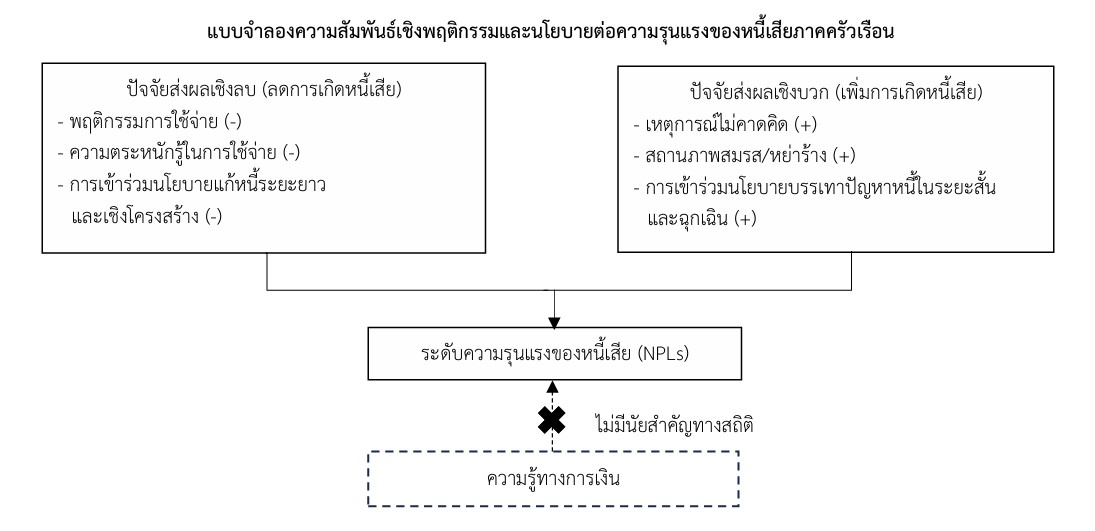
This research aims to study the determinants of spending behavior, demographic characteristics, and socioeconomic shocks affecting household non-performing loans (NPLs), as well as the impact of government policies on household NPLs in Bangkok and its vicinity. Data were collected via questionnaires from 443 respondents selected through multistage sampling. The instruments included measures of demographics, financial literacy, spending behavior, awareness, and policy participation. Data were analyzed using descriptive statistics and the Ordered Probit Model. Our empirical evidence reveals that 1) a critical behavioral gap exists, whereby respondents possess high financial literacy but demonstrate poor actual spending behavior. Spending behavior and awareness significantly reduce the probability of NPLs at the 95 percent confidence level, whereas unexpected economic shocks and being married or divorced significantly increase NPL risks; and 2) long-term structural debt-resolution policies significantly reduce the probability of NPLs, whereas short-term emergency measures exhibit a positive relationship with NPLs among vulnerable debtors. This study suggests that the Ministry of Finance, the Bank of Thailand, and educational institutions should promote practical financial literacy, shift financial institutions toward behavioral credit scoring, implement early warning systems, and prioritize long-term structural debt restructuring over short-term relief measures.
References
กมลพรรณ โคจรตระกูล และ ศิวพงศ์ ธีรอำพน. (2566). ปัจจัยที่มีผลต่อการก่อหนี้ครัวเรือนในช่วงสถานการณ์การแพร่ระบาดของเชื้อไวรัสโควิด-19. วารสารสังคมศาสตร์ปัญญาพัฒน์, 5(4), 171–186.
ขวัญฤทัย ฤคดี. (2563). การวิเคราะห์ปัจจัยกำหนดการผิดนัดชำระค่างวดในธุรกิจเช่าซื้อรถจักรยานยนต์. (เศรษฐศาสตรมหาบัณฑิต, มหาวิทยาลัยรังสิต).
ธนาคารแห่งประเทศไทย. (2567). รายงานประจำปี 2567. สืบค้นจาก https://www.bot.or.th/th/research-and-publications/reports/annual-report/report-2024.html.
ธนิดา ตันติอาภากุล. (2560). ปัจจัยที่ส่งผลต่อการผิดนัดชำระหนี้สินเชื่ออุปโภคบริโภคของธนาคารพาณิชย์และบริษัทที่ประกอบธุรกิจ แต่มิใช่สถาบันการเงินในไทย. (เศรษฐศาสตรมหาบัณฑิต, จุฬาลงกรณ์มหาวิทยาลัย).
บริษัท ข้อมูลเครดิตแห่งชาติ จำกัด. (2568). ข่าวเครดิตบูโร 002/2568: รายงานสถานการณ์หนี้ ณ เดือน มกราคม 2568 จากข้อมูลสถิติของเครดิตบูโร. สืบค้นจาก https://www.ncb.co.th/national-credit-bureau-news-and-event/ncb-news/news002-2568/.
วรัญญา ไชยทารินทร์ และ ธัญทิพย์ คฤหโยธิน. (2562). หนี้สินในระบบของครัวเรือนเกษตรกรจังหวัดพะเยา. วารสารการพัฒนาชุมชนและคุณภาพชีวิต, 7(3), 283–294
สำนักการวางผังและพัฒนาเมือง กรุงเทพมหานคร. (2556). แผนที่ผังเมืองรวมกรุงเทพมหานคร พ.ศ. 2556 รายเขต. สืบค้นจาก https://webportal.bangkok.go.th/cpud/page/sub/22628.
สำนักบริหารการทะเบียน กรมการปกครอง. (2567). สถิติจำนวนประชากรและบ้าน. สืบค้นจาก https://stat.bora.dopa.go.th/stat/statnew/statyear/#/.
หอการค้าไทย และ ศูนย์พยากรณ์เศรษฐกิจและธุรกิจมหาวิทยาลัยหอการค้าไทย. (2567). ผลสำรวจภาวะหนี้ครัวเรือนไทย 2567. สืบค้นจาก https://www.thaichamber.org/news/view/87/3142/%E0%B8%9C%E0%B8%A5%E0%B8%AA%E0%B8%B3%E0%B8%A3%E0%B8%A7%E0%B8%88%E0%B8%A0%E0%B8%B2%E0%B8%A7%E0%B8%B0%E0%B8%AB%E0%B8%99%E0%B8%B5%E0%B9%89%E0%B8%84%E0%B8%A3%E0%B8%B1%E0%B8%A7%E0%B9%80%E0%B8%A3%E0%B8%B7%E0%B8%AD%E0%B8%99%E0%B9%84%E0%B8%97%E0%B8%A2-2567.
อธิพันธ์ วรรณสุริยะ. (2566). ปัจจัยที่มีอิทธิพลต่อการก่อหนี้ของครัวเรือนไทย. วารสารเศรษฐศาสตร์และบริหารธุรกิจ มหาวิทยาลัยทักษิณ, 16(4), 139–158.
Arkornsakul, P., & Rattanasamakarn, T. (2025). Household Debt and Income Inequality in Thailand: A Vector Autoregressive Analysis. Community and Social Development Journal, 26(2), 42–56.
Bouis, R. (2021). Household Deleveraging and Saving Rates: A Cross-Country Analysis. Washington, D.C.: International Monetary Fund.
Chantarat, S., Lamsam, A., Samphantharak, K., & Tangsawasdirat, B. (2020). Household Debt and Delinquency over the Life Cycle. Asian Development Review, 37(1), 61–92.
Hair, J. F., Black, W. C., Babin, B. J., & Anderson, R. E. (2010). Multivariate data analysis: A global perspective. (7th ed.). Upper Saddle River, NJ: Pearson.
Kurowski, Ł. (2021). Household’s overindebtedness during the COVID-19 crisis: The role of debt and financial literacy. Risks, 9(4), 62.
Lusardi, A., & Tufano, P. (2015). Debt literacy, financial experiences, and overindebtedness. Journal of pension economics & finance, 14(4), 332-368.
Salas, M., Lamothe, P., Delgado, E., Fernández-Miguélez, A. L., & Valcarce, L. (2024). Determinants of Nonperforming Loans: A Global Data Analysis. Computational Economics, 64(5), 2695–2716.
Yamane, T. (1967). Statistics: An introductory analysis. (2nd ed.). New York: Harper & Row.
Downloads
Published
How to Cite
Issue
Section
License
Copyright (c) 2026 Journal of Social Science Panyapat

This work is licensed under a Creative Commons Attribution-NonCommercial-NoDerivatives 4.0 International License.


