An Evaluation of Educational Supervision Effectiveness Using Dashboard Technology in a Secondary School
Keywords:
Effectiveness Evaluation, Kirkpatrick Model, Educational Supervision, Dashboard TechnologyAbstract
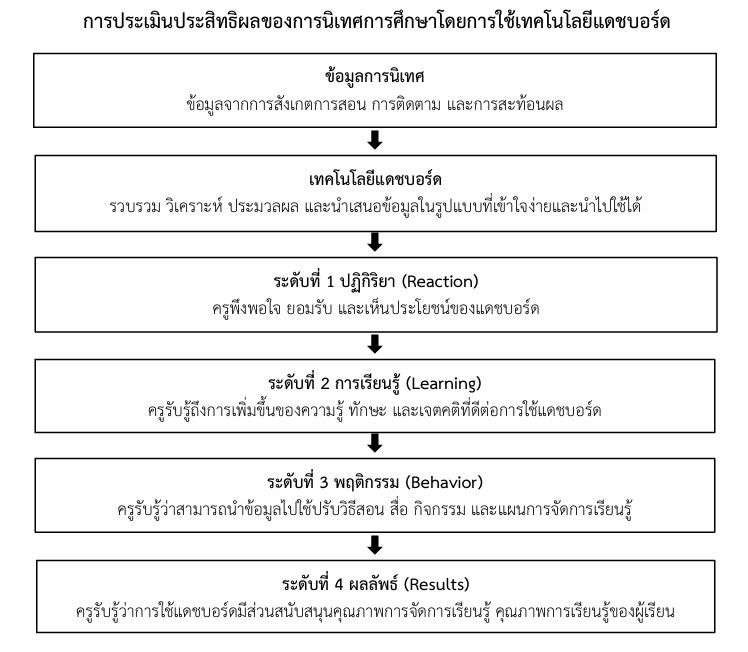
This study aimed to evaluate the effectiveness of educational supervision using dashboard technology in a secondary school. The four specific objectives were: 1) to evaluate the Reaction level by assessing teachers’ satisfaction with the educational supervision dashboard; 2) to evaluate the Learning level by assessing teachers’ perceptions of increased knowledge, skills, and positive attitudes toward the use of dashboard technology in educational supervision; 3) to evaluate the Behavior level by assessing teachers’ perceptions of changes in teaching behaviors that support students’ learning quality after using dashboard technology; and 4) to evaluate the Results level by assessing the beneficial outcomes for educational quality and stakeholders after using dashboard technology. The population consisted of 96 teachers at a secondary school who were under academic affairs supervision and had continuously used dashboard technology in educational supervision for at least two years. The research instrument was a 24-item, 5-point rating-scale questionnaire. Content validity was examined by three experts, with an Index of Item-Objective Congruence (IOC) of 1.00 for every item. The overall reliability coefficient was 0.949. Data were analyzed using the mean (μ) and standard deviation (σ). The findings revealed that the overall effectiveness of educational supervision using dashboard technology was at a high level, with a mean (μ) = 4.32 and a standard deviation (σ) = 0.66. When ranked from the highest to the lowest mean, the Reaction level was rated at the highest level, with a mean (μ) = 4.51 and a standard deviation (σ) = 0.58, reflecting teachers’ satisfaction and positive attitudes toward dashboard use, particularly regarding data accuracy and timeliness. This was followed by the Behavior level, which was at a high level, with a mean (μ) = 4.31 and a standard deviation (σ) = 0.65; the Results level, which was at a high level, with a mean (μ) = 4.27 and a standard deviation (σ) = 0.65; and the Learning level, which was at a high level, with a mean (μ) = 4.19 and a standard deviation (σ) = 0.72. The Learning level had the lowest mean, particularly in data interpretation and in-depth analysis skills, indicating an area requiring continuous development.
References
บุญชม ศรีสะอาด. (2560). การวิจัยเบื้องต้น. (พิมพ์ครั้งที่ 10). กรุงเทพฯ: สุวีริยาสาส์น.
ปัทมพันธ์ โชติชญาน์นันทน์. (2555). การประเมินผลการพัฒนาครูด้วยระบบยูทีคิว ออนไลน์ สำหรับโรงเรียนมัธยมศึกษา จังหวัดราชบุรี. (ศึกษาศาสตรมหาบัณฑิต, มหาวิทยาลัยสุโขทัยธรรมาธิราช).
พระราชบัญญัติการศึกษาแห่งชาติ (ฉบับที่ 4) พ.ศ. 2562. (2562, 1 พฤษภาคม). ราชกิจจานุเบกษา, 136(57 ก), 49–53.
ยุมนา ศรีจันทร์ดี. (2562). ระบบสารสนเทศในการสะท้อนคิดของครูเพื่อสนับสนุนชุมชนแห่งการเรียนรู้ทางวิชาชีพในโรงเรียน: การวิจัยส่วนต่อประสานกับผู้ใช้แดชบอร์ด. (ครุศาสตรมหาบัณฑิต, จุฬาลงกรณ์มหาวิทยาลัย).
สำนักงานเลขาธิการสภาการศึกษา. (2560). แผนการศึกษาแห่งชาติ พ.ศ. 2560–2579. สืบค้นจาก https://www.onec.go.th/th.php/page/view/Outstand/2532.
หน่วยศึกษานิเทศก์ สำนักงานคณะกรรมการการศึกษาขั้นพื้นฐาน. (2566). การนิเทศภายในสถานศึกษา. กรุงเทพฯ: สำนักงานคณะกรรมการการศึกษาขั้นพื้นฐาน.
Achuthan, K., Kolil, V. K., & Jyothy, S. N. (2023). Effectiveness of virtual laboratory teacher training workshops: A Kirkpatrick model analysis. International Journal of Emerging Technologies in Learning, 18(15), 225–239.
Glickman, C. D., Gordon, S. P., Ross-Gordon, J. M., & Solis, R. (2024). SuperVision and instructional leadership: A developmental approach. (11th ed.). Boston: Pearson.
Hjelle, S., Mikalef, P., Altwaijry, N., & Parida, V. (2024). Organizational decision making and analytics: An experimental study on dashboard visualizations. Information & Management, 61(6), 104011.
Karademir, O., Borgards, L., Di Mitri, D., Strauß, S., Kubsch, M., Brobeil, M., Grimm, A., Gombert, S., Rummel, N., Neumann, K., & Drachsler, H. (2024). Following the impact chain of the LA Cockpit: An intervention study investigating a teacher dashboard’s effect on student learning. Journal of Learning Analytics, 11(2), 215–228.
Kirkpatrick, D. L., & Kirkpatrick, J. D. (2006). Evaluating training programs: The four levels. (3rd ed.). San Francisco, CA: Berrett-Koehler Publishers.
Likert, R. (1932). A technique for the measurement of attitudes. Archives of Psychology, 140, 1–55.
Pallant, J. (2020). SPSS survival manual: a step by step guide to data analysis using IBM SPSS. (7th ed.). London: McGraw-Hill.
Ruiz, J., & Snoeck, M. (2018). Adapting Kirkpatrick’s evaluation model to technology enhanced learning. In Proceedings of the 21st ACM/IEEE International Conference on Model Driven Engineering Languages and Systems: Companion Proceedings (pp. 135–142). New York: Association for Computing Machinery.
UNESCO. (2019). Developing guidelines to improve teaching quality. Retrieved from https://www.unesco.org/en/articles/developing-guidelines-improve-teaching-quality.
Downloads
Published
How to Cite
Issue
Section
License
Copyright (c) 2026 Journal of Social Science Panyapat

This work is licensed under a Creative Commons Attribution-NonCommercial-NoDerivatives 4.0 International License.

