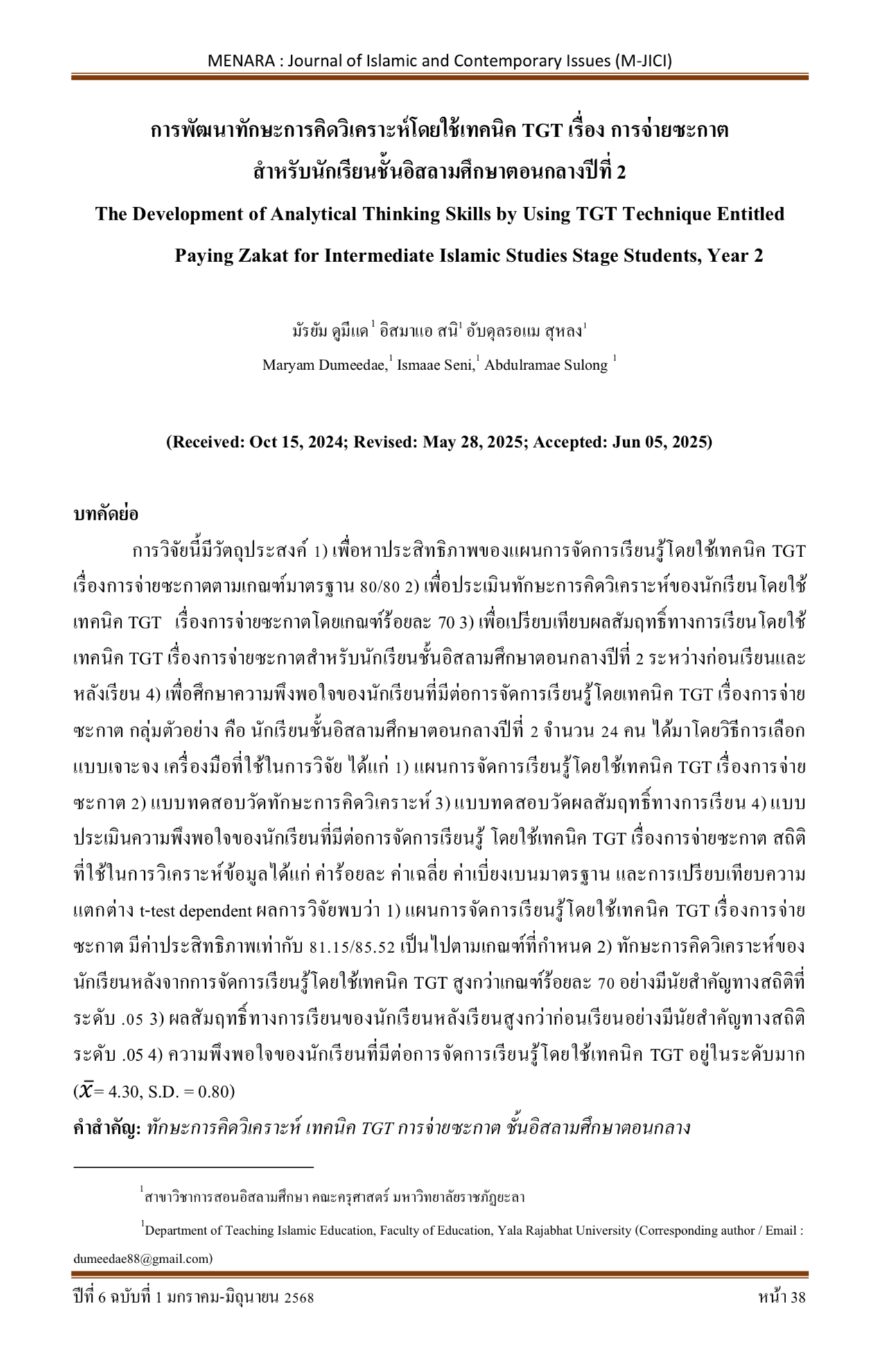
The Development of Analytical Thinking Skills by Using TGT Technique Entitled Paying Zakat for Intermediate Islamic Studies Stage Students, Year 2
Keywords:
Analytical Thinking Skill, TGT technique, Paying Zakat, Intermediate Islamic StudiesAbstract
This research aims 1) to develop and evaluate the effectiveness of the learning management plans using TGT Technique entitled paying Zakat for intermediate Islamic studies stage students, year 2, 2) to develop analytical thinking skills by using TGT technique entitled paying Zakat using the criteria of 70 percent, 3) to compare learning achievements before and after the learning management and 4) to examine students’ satisfaction towards learning management by using TGT technique. The research sample was 24 intermediate Islamic studies stage students, year 2 obtained through a purposive sampling technique. The research tools consisted of 1) learning management plans by using TGT technique entitled paying Zakat for intermediate Islamic studies stage students, year 2, 2) an analytical thinking skill assessment using TGT technique entitled paying Zakat, 3) an achievement test before and after studying by using TGT technique, and 4) a satisfaction questionnaire of the learning management by using TGT technique entitled paying Zakat Statistics used in data analysis were percentage, mean, standard deviation and t-test. The results of the research found that ; 1) the efficiency of learning management plans using TGT technique entitled paying Zakat for intermediate Islamic studies stage students, year 2 was an average of 81.15/85.52 as specified, 2) the students' analytical thinking skills after using the TGT technique entitled paying Zakat was higher than the criteria of 70 percent at statistical significance level of 0.5, 3) the learning achievement using TGT technique after learning statistical significance at the .05 level, and 4. the students’ satisfaction towards on learning management using TGT technique entitled paying Zakat in overall was at the high level ( x = 4.30, S.D. = 0.80)
References
เอกสารอ้างอิงฉบับภาษาไทย
ฐิตินันท์ บุญเสริม และสุรชา อมรพันธุ์. (2562). การเปรียบเทียบผลสัมฤทธิ์ทางการเรียนวิชาคณิตศาสตร์ความสามารถในการคิดวิเคราะห์และเจตคติต่อวิชาคณิตศาสตร์เรื่อง ระบบจำนวนเต็มของนักเรียนชั้น มัธยมศึกษาปีที่ 1 ระหว่างการจัดการเรียนรู้ตามแนวทฤษฎีพหุปัญญาและการจัดการเรียนรู้แบบกลุ่ม ร่วมมือ. วารสารมหาวิทยาลัยราชภัฏมหาสารคาม, 13(2), 249-260.
บุญทัน ดอกไธสง. (2565). การพัฒนาทักษะการคิดวิเคราะห์ของนักเรียนผ่านกิจกรรมการเรียนรู้แบบร่วมมือ. วารสารครุศาสตร์ มหาวิทยาลัยราชภัฏบุรีรัมย์, 34(2), 112–125.
พีรพัฒน์ เสียงล้ำ และไกรฤกษ์ ศิลาคม. (2568). การพัฒนาผลสัมฤทธิ์ทางการเรียนเรื่อง วันสำคัญทางพระพุทธศาสนา และศาสนพิธีของนักเรียนชั้นมัธยมศึกษาปีที่ 1 โดยใช้การจัดการเรียนรู้แบบร่วมมือเทคนิค TGT (Teams Games Tournaments). วารสารครุทรรศน์, 5(1), 126-142.
มูฮำหมัดรุสดี หะยีมะ. (2565). บทบาทของซะกาตในการพัฒนาชุมชนมุสลิมชายแดนใต้. วารสารวิชาการอิสลามศึกษา, 9(1), 88–102.
วิชาการ, กรม. (2546). หลักสูตรอิสลามศึกษา พุทธศักราช 2546. ปัตตานี : สำนักงานเขตพื้นที่การศึกษาเขต 1
สถาบันทดสอบการศึกษาแห่งชาติ, องค์กรมหาชน (2562-2564). รายงานผลการทดสอบมาตรฐานอิสลาม(I-NET) อิสลามศึกษาระดับกลาง (มุตตาวัตซีเตาะห์) ปีการศึกษา 2562-2564. ฉบับที่ 1. ปัตตานี : สำนักบริหารงานคณะกรรมการส่งเสริมการศึกษาเอกชนปัตตานี
สุชาติ อรุณเกษมสันต์. (2564). แนวทางการประเมินเพื่อพัฒนาทักษะการคิดวิเคราะห์ของผู้เรียนในศตวรรษที่ 21. วารสารศึกษาศาสตร์ มหาวิทยาลัยนเรศวร, 23(1), 89–101.
สุรัตน์ ศิริมงคล, อมรรัตน์ ช่างคิด. (2563). การพัฒนาผลสัมฤทธิ์ทางการเรียนของนักเรียนเรื่อง วัฒนธรรมไทยและวัฒนธรรมของประเทศในภูมิภาคเอเชียตะวันออกเฉียงใต้ โดยใช้การจัดการเรียนแบบร่วมมือเทคนิค TGT (Teams–Games-Tournaments). วารสารวิชาการครุศาสตร์สวนสุนันทา, 4(2), 18-26.
สุวิทย์ มูลคำ. (2546). วิธีจัดการเรียนรู้ : เพื่อพัฒนากระบวนการคิด. (พิมพ์ครั้งที่ 4). กรุงเทพฯ : ภาพพิมพ์
อดิวัฒน์ เรือนรื่น. (2563). การศึกษาผลสัมฤทธิ์ทางการเรียนวิชาคณิตศาสตร์ เรื่องจำนวนเต็ม ของนักเรียนชั้นมัธยมศึกษาปีที่ 1 โรงเรียนบ้านหนองเค็ด โดยใช้วิธีการสอนแบบ TGT. นครปฐม: มหาวิทยาลัยศิลปากร
อิสมาอีล หะยีวานิ. (2564). การวิเคราะห์ความเข้าใจของนักเรียนเกี่ยวกับซะกาตในบริบทเศรษฐกิจอิสลาม. วารสารศึกษาศาสตร์อิสลาม, 13(2), 45–60.
เอกสารอ้างอิงฉบับภาษาต่างประเทศ
Ennis, R. H. (2020). Critical Thinking Across the Curriculum: A Brief Edition of the Values and Knowledge Education (VAKE) Approach. n.p.: Rowman & Littlefield.
Halpern, D. F. (2023). Thought and Knowledge: An Introduction to Critical Thinking. (6th ed.). n.p.: Psychology Press.
Nasution, M. (2020). Effect of Team Games Tournament (TGT) Method Toward Vocabulary Mastery at the Tenth Grade Students of High School 1 Padangsidimpuan. Earth and Environmental Science, 478(1), 142-152.
Paul, R., & Elder, L. (2022). The Miniature Guide to Critical Thinking Concepts and Tools (8th ed.). Foundation for Critical Thinking.
Yusoff, A. M., & Alshater, M. M. (2022). Zakat Compliance and Its Socio-Economic Implications: A Critical Review. Journal of Islamic Accounting and Business Research, 13(4), 721–738.
Downloads
Published
How to Cite
Issue
Section
License
Copyright (c) 2025 MENARA : Journal of Islamic and Contemporary Issues

This work is licensed under a Creative Commons Attribution-NonCommercial-NoDerivatives 4.0 International License.


