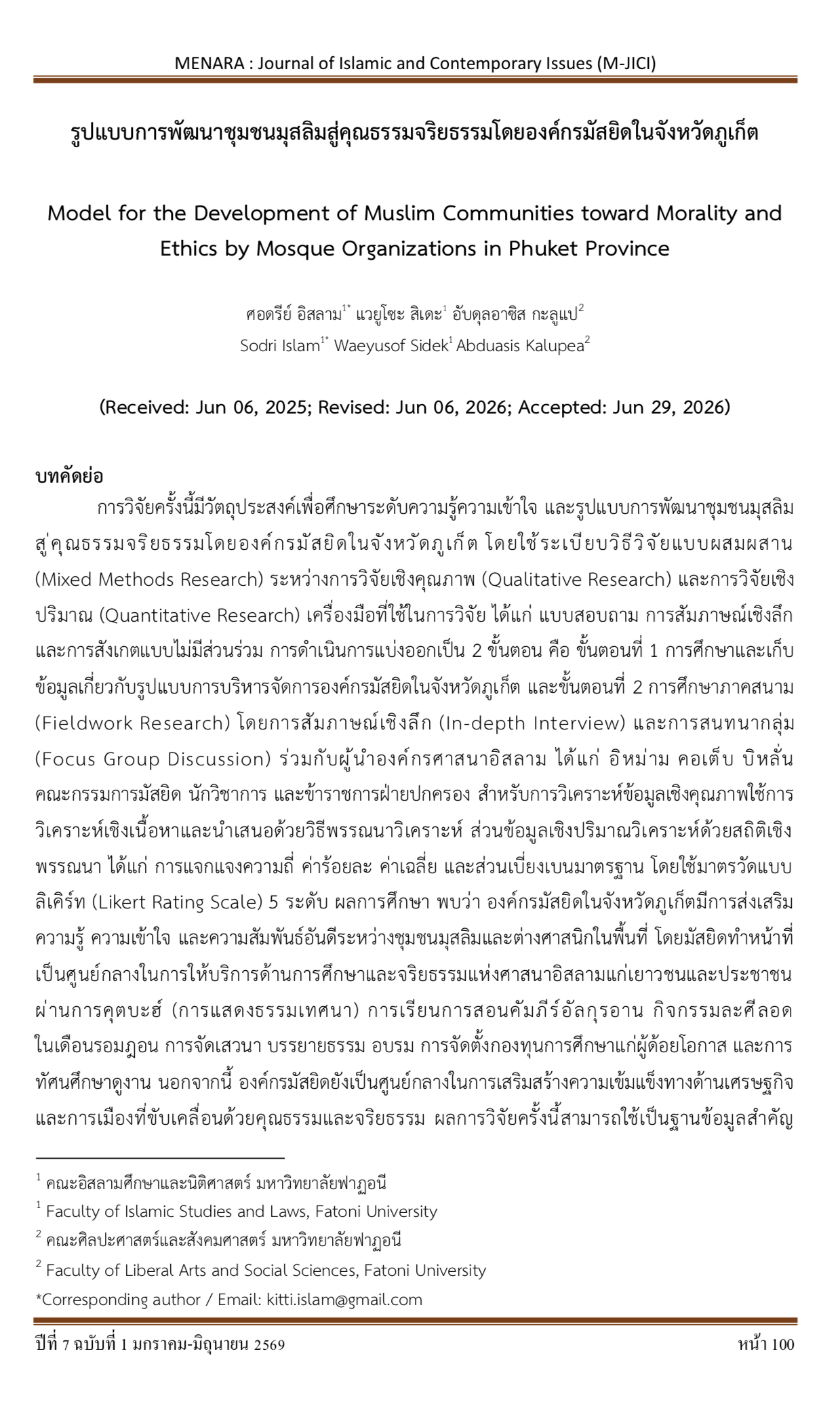
Model for the Development of Muslim Communities toward Morality and Ethics by Mosque Organizations in Phuket Province
Keywords:
Model, Community Development, Morality and Ethics, Mosque OrganizationAbstract
This research aimed to examine the level of knowledge and understanding, as well as to investigate the development models for Muslim communities toward morality and ethics by mosque organizations in Phuket Province. A mixed-methods research design was employed, integrating both qualitative and quantitative approaches. The research instruments included questionnaires, in-depth interviews, and non-participant observation. The research procedure was conducted in two distinct phases: Phase 1 involved studying and collecting data on the administrative and management models of mosque organizations in Phuket Province; Phase 2 comprised fieldwork research utilizing in-depth interviews and focus group discussions with Islamic religious leaders—including Imams, Khateebs, and Bilal—mosque committee members, academics, and local administrative officials. For data analysis, the qualitative data were analyzed using content analysis and presented descriptively. The quantitative data were analyzed using descriptive statistics, including frequency, percentage, mean, and standard deviation, based on a 5-point Likert rating scale. The findings revealed that mosque organizations in Phuket Province actively promoted knowledge, understanding, and harmonious relationships between Muslim and non-Muslim communities within the area. Mosques served as central hubs for providing Islamic education and ethical guidance to youth and the general public. Community development toward morality and ethics was facilitated through various religious activities, such as Khutbah (sermons), Quranic instruction, Ramadan iftar activities, seminars, Dhamma lectures, training sessions, educational funds for the underprivileged, and educational field trips. Furthermore, mosque organizations functioned as central pillars in empowering constructive economic and political development driven by morality and ethics. The results of this study serve as an essential database for Imams, Khateebs, Bilal, mosque committees, and relevant stakeholders to effectively apply systematic management practices to mosque administration and community development, thereby ensuring maximum efficiency and sustainability.
References
เอกสารอ้างอิง
เอกสารอ้างอิงฉบับภาษาไทย
ชินวัฒน์ แม้นเดช, ทวีศักดิ์ พุฒสุขขี, สามารถ ทองเฝือ, และสุกรี หลังปูเต๊ะ. (2562). แบบแผนในการขับเคลื่อนชุมชนตักวาโดยใช้มัสยิด. วารสารมหาวิทยาลัยราชภัฏยะลา, 14(2), 222-231.
ณัฐพงศ์ สวนดี และพรพรหม ชมงาม. (2561). รูปแบบการสื่อสารของกลุ่มดะวะฮ์ที่มีต่อกิจกรรมการเยี่ยมเยียนชุมชน. วารสารสุทธิปริทัศน์, 32(101), 173-184.
ต่วนอิสกันดาร์ ดาโต๊ะมูลียอ. (2567). บทบาทการเป็นผู้นำทางการเมืองของวันมูหะมัดนอร์ มะทา ในการเมืองไทย. วารสารการวิจัยการบริหารการพัฒนา, 14(4), 1392-1401.
เทวีพันธ์ เยาวไสย. (2563). การพัฒนาแนวทางการบริหารส่งเสริมสุขภาวะภายในโรงเรียนเอกชน สำกัดสำนักงานศึกษาธิการ จังหวัดกาฬสินธุ์ [วิทยานิพนธ์มหาบัณฑิต]. มหาวิทยาลัยมหาสารคาม.
เนตร์พัณณา ยาวิราช. (2556). ภาวะผู้นำและผู้นำเชิงกลยุทธ์ (พิมพ์ครั้งที่ 8). ทริปเพิ้ล กรุ๊ป.
รัตนวดี โชติกพนิช. (2550). จริยธรรมและจรรยาบรรณในวิชาชีพครู. สำนักพิมพ์มหาวิทยาลัยรามคำแหง.
วิรัช วิรัชนิภาวรรณ. (2561). การบริหารจัดการยุคดิจิทัล. บริษัทก้าวใหม่.
เสาวนีย์ จิตต์หมวด. (2531). กลุ่มชาติพันธ์ ชาวไทยมุสลิม. กองทุนสว่ารุจิระอัมพร.
อับดุลเลาะ หนุ่มสุข (2562). บทบาทของมัสยิดในการพัฒนาชุมชนอย่างยั่งยืน. https://www.darulebadahsamwa.com
เอกสารอ้างอิงฉบับภาษาต่างประเทศ
Ahmad, K. (2015). The Qur’an: basic teachings. Islamic Founadation.
Al-Ghazali, A. H. (2005). Ihya ulum al-din. Dar ibn hajm.
Chapra, M. U. (2001). The Future of economics: An Islamic perspective. The Islamic Foundation.
Rosenthal, F. (2005). The Muqaddimah: an introduction to history. Princeton University Press.
Ramadan, T. (2017). Introduction to Islam. Oxford University Press.
Downloads
Published
How to Cite
Issue
Section
License
Copyright (c) 2026 MENARA : Journal of Islamic and Contemporary Issues

This work is licensed under a Creative Commons Attribution-NonCommercial-NoDerivatives 4.0 International License.


