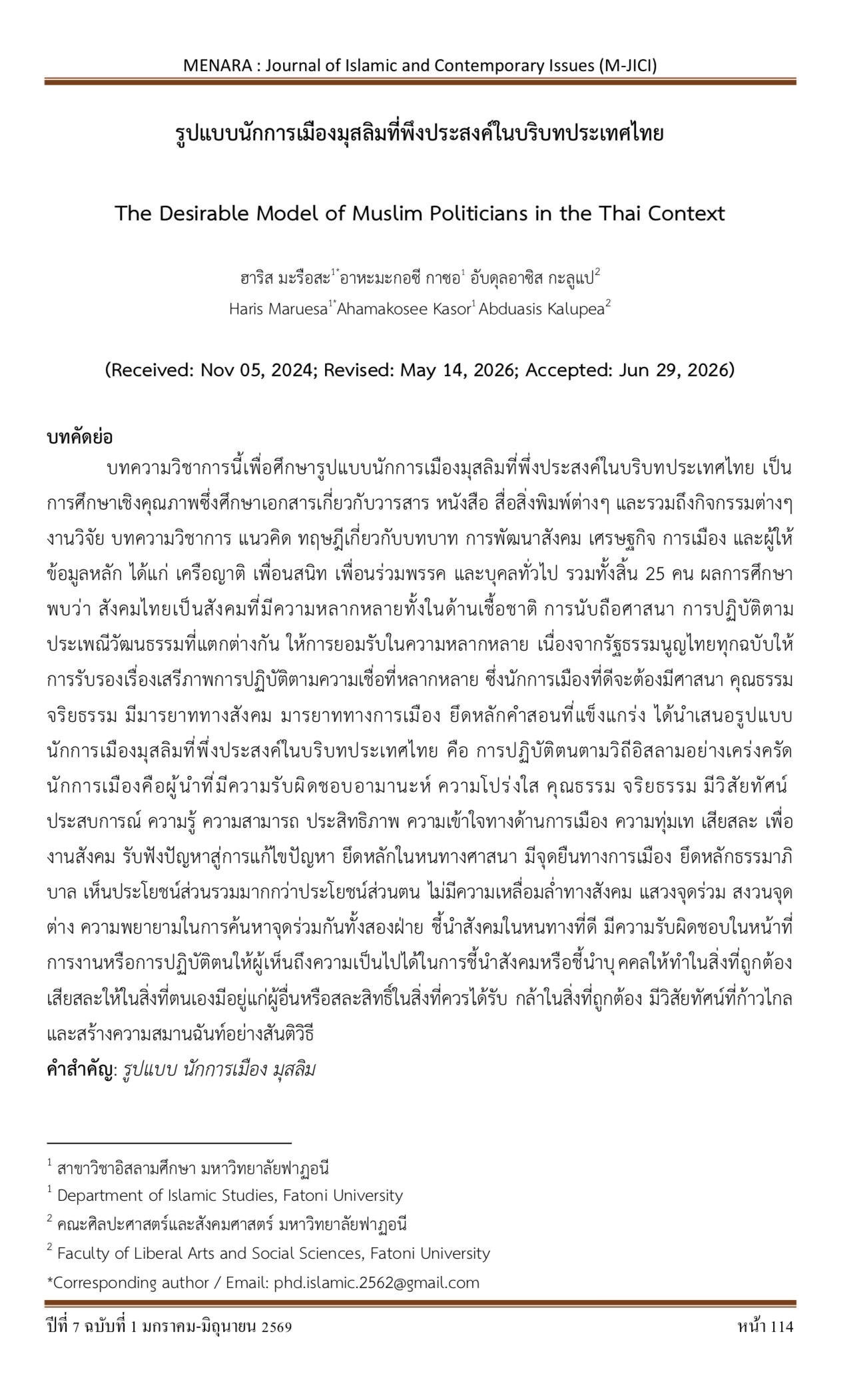
The Desirable Model of Muslim Politicians in the Thai Context
Keywords:
Model, Politicians, MuslimsAbstract
This research aims to study the desirable model of Muslim politicians within the Thai context. Employing a mixed methodology of qualitative research, this study examines academic journals, books, publications, related activities, research papers, academic articles, as well as concepts and theories regarding social, economic, and political development. Primary data were gathered from 25 key informants, including relatives, close friends, fellow party members, and members of the general public. The findings reveal that Thai society is inherently diverse in terms of ethnicity, religion, and cultural practices, yet heavily embraces this diversity, as every iteration of the Thai Constitution guarantees the freedom to practice varied religious beliefs. Consequently, a good politician must possess religious devotion, morality, ethics, and both social and political etiquette, firmly adhering to robust religious teachings. Furthermore, this study proposes a desirable model for Muslim politicians in the Thai context, characterized by strict adherence to the Islamic way of life. Under this model, a politician is defined as a leader imbued with responsibility, Amanah (trustworthiness), transparency, morality, and ethics. They must possess vision, experience, knowledge, capability, and efficiency, coupled with a deep understanding of politics, dedication, and self-sacrifice for social benefit. Essential traits also include active listening to resolve public issues, steadfast adherence to religious principles, clear political stances, and commitment to good governance. Ultimately, such politicians must prioritize the collective interest over personal gain, work toward reducing social inequality, and strive to seek common ground while preserving differences. They must lead society toward righteousness, demonstrate the feasibility of guiding individuals and communities toward the right path, and willingly sacrifice personal resources or entitlements for the benefit of others. Finally, they must courageously stand for justice, maintain a far-reaching vision, and actively foster social harmony through peaceful means.
References
เอกสารอ้างอิง
ศราวุธ ขันธวิชัย, พระสังวาน เขมปญโญ, พระมหาจักรเทพ จกฺกวโร, และสมนึก จันทร์โสดา. (2568).
ธรรมาภิบาลกับการยกระดับระบบราชการไทยสู่ยุค 4.0 เพื่อการบริหารภาครัฐอย่างยั่นยืน. วารสารชัยภูมิปริทรรศน์, 8(2), 56-70.
ณัฐภัสสร ธนาบวรพาณิชย์, พิสมัย จารุจิตติพันธ์, และพิสิฐ โอ่งเจริญ. (2563). ภาวะผู้นำและบทบาทของผู้บริหารในองค์กรรัฐในยุคการเปลี่ยนแปลง.วารสารวิชาการ มหาวิทยาลัยนอร์ทกรุงเทพ, 9(1), 28–39.
ชาติชาย คงเพ็ชรดิษฐ์ และธีระวัฒน์ จันทึก. (2559). การบริหารการเปลี่ยนแปลง: บทบาทของภาวะผู้นำและการสื่อสารในองค์การ. Veridian E-Journal, Silpakorn University, 9(1), 895–919.
ดวงเดือน พันธุมนาวิน. (2544). ทฤษฎีต้นไม้จริยธรรมสำหรับคนไทย. สถาบันบัณฑิตพัฒนบริหารศาสตร์.
วรภาคย์ ไมตรีพันธ์. (2563). จากกระบวนทัศน์ใหม่ของทฤษฎีภาวะผู้นำ สู่บทบาทของผู้บริหารโรงเรียนในการสร้างความสัมพันธ์ระหว่างโรงเรียนและชุมชน.วารสารศึกษาศาสตร์ มหาวิทยาลัยสงขลานครินทร์ วิทยาเขตปัตตานี, 30(3), 17–29.
ลักษวงษ์ จิระสุวรรณภักดี, สมชาย เทพแสง, และสนั่น ประจงจิตร. (2566). ภาวะผู้นำแห่งการเรียนรู้ในยุคดิจิทัล. วารสารร่มพฤกษ์ มหาวิทยาลัยเกริก, 41(2), 219–239.
สำนักงานคณะกรรมการข้าราชการพลเรือน. (2552). คู่มือจริยธรรมข้าราชการพลเรือน. สำนักงานคณะกรรมการข้าราชการพลเรือน.
อิมรอน ซาเหาะ และยาสมิน ซัตตาร์. (2559). อิสลามการเมืองในเอเชียตะวันออกเฉียงใต้ : จุดยืน ตำแหน่ง และการเคลื่อนไหวทางการเมืองของมุสลิมในระบอบประชาธิปไตย. วารสารมนุษยศาสตร์สังคมศาสตร์ มหาวิทยาลัยทักษิณ, 10(2), 65–88.
Downloads
Published
How to Cite
Issue
Section
License
Copyright (c) 2026 MENARA : Journal of Islamic and Contemporary Issues

This work is licensed under a Creative Commons Attribution-NonCommercial-NoDerivatives 4.0 International License.


