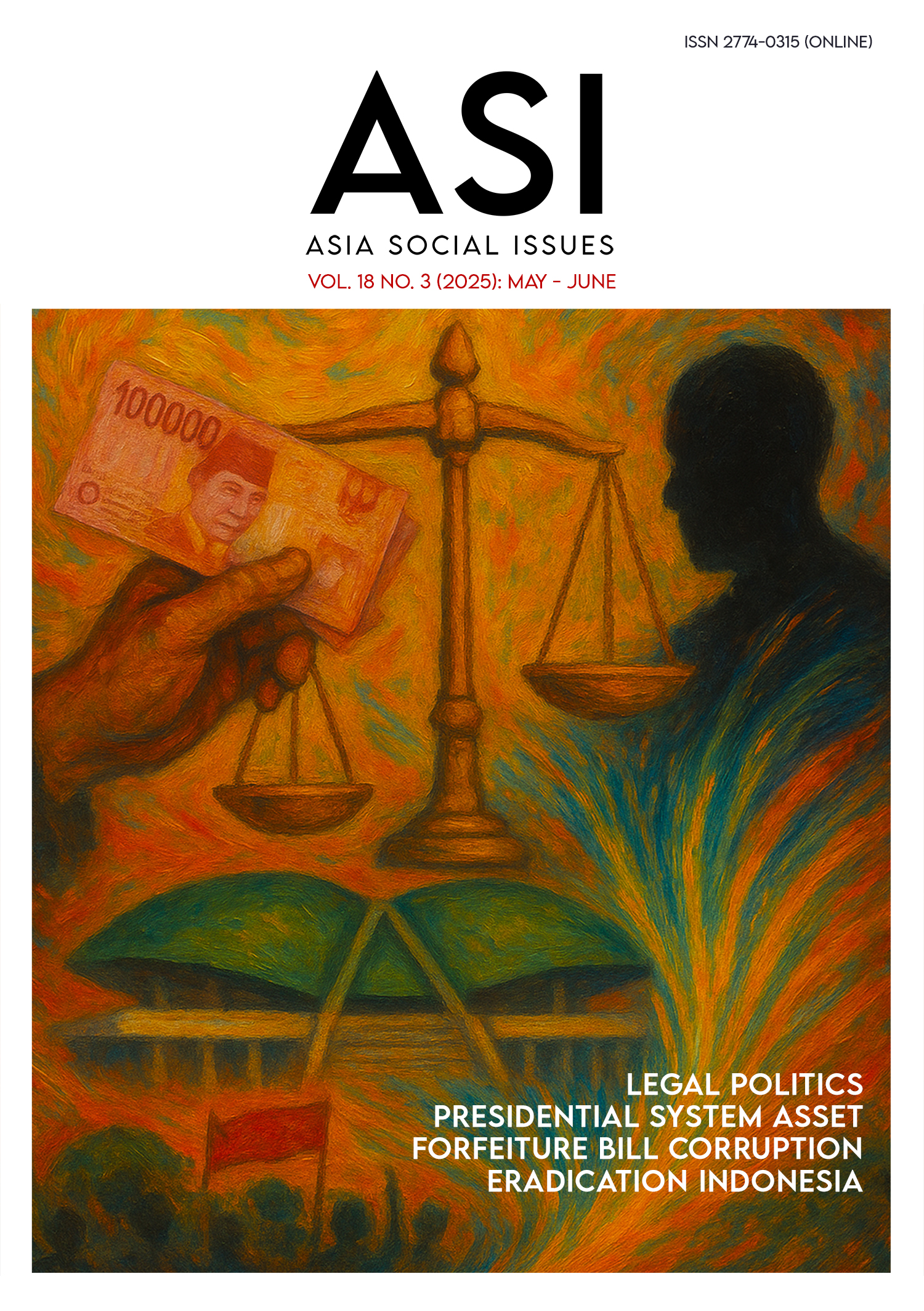
Legal Politics in the Indonesian Presidential System: How to Leverage Potential of Asset Forfeiture Bill for Corruption Eradication?
Article Sidebar
Main Article Content
Abstract
This study examines the potential for the ratification of the Asset Forfeiture Bill in Indonesia, particularly by the Parliament for the 2024-2029 period, and its role in the eradication of corruption. The analysis includes the legal politics of law formation in Indonesia, the political party coalition composition in the 2024-2029 Parliament (MAP). and the potential for the promulgation of the Asset Forfeiture Bill. This research employs a qualitative method using juridical normative approaches, with legal and conceptual analyses. Primary legal materials include laws, while secondary legal materials encompass rulings, journals, and books. The data are analyzed through the lens of Legal Politics theory. The study indicate that the House of Representatives and the President in Indonesia can initiate the Bill. Furthermore, the President can also make a Perppu. However, any presidential initiative requires approval from the DPR. The position of the DPR is crucial, reflecting the dominant role of the legislative institution. The composition of the KIM coalition in Parliament increases the likelihood of passing the Asset Forfeiture Bill. However, passing the Asset Forfeiture Bill could potentially criminalize and delegitimize the law, so it is necessary to emphasize enforcing the LHKPN law.This study examines the potential for the ratification of the Asset Forfeiture Bill in Indonesia, particularly by the Parliament for the 2024-2029 period, and its role in the eradication of corruption. The analysis includes the legal politics of law formation in Indonesia, the political party coalition composition in the 2024-2029 Parliament (MAP). and the potential for the promulgation of the Asset Forfeiture Bill. This research employs a qualitative method using juridical normative approaches, with legal and conceptual analyses. Primary legal materials include laws, while secondary legal materials encompass rulings, journals, and books. The data are analyzed through the lens of Legal Politics theory. The study indicate that the House of Representatives and the President in Indonesia can initiate the Bill. Furthermore, the President can also make a Perppu. However, any presidential initiative requires approval from the DPR. The position of the DPR is crucial, reflecting the dominant role of the legislative institution. The composition of the KIM coalition in Parliament increases the likelihood of passing the Asset Forfeiture Bill. However, passing the Asset Forfeiture Bill could potentially criminalize and delegitimize the law, so it is necessary to emphasize enforcing the LHKPN law.
Article Details

This work is licensed under a Creative Commons Attribution-NonCommercial-NoDerivatives 4.0 International License.
Copyright: CC BY-NC-ND 4.0
References
Adam, R. (2010). Masa Depan Ada di Tengah: Toolbox Manajemen Koalisi. Jakarta, Indonesia: Friedrich Naumann Stiftung.
Agustine, O. V. (2019). Ruu Perampasan Aset Sebagai Peluang Dan Tantangan Dalam Pemberantasan Korupsi Di Indonesia. Hukum Pidana Dan Pembangunan Hukum, 1(2), 1-6.
Asshiddiqie, J. (2005). Kemerdekaan Berserikat Pembubaran Partai Politik dan Mahkamah Konstitusi. Jakarta, Indonesia: Konstitusi Press.
Firmanzah. (2011). Mengelola Partai Politik. Jakarta, Indonesia: Yayasan Obor Indonesia.
Friedrich, carl J. (1967). Constitutional government and democracy: Theory and practice in Europe and America. Massachussets, Uniterd States of America: Blaisdell Publishing Company.
Hamdan, M. (1997). Politik Hukum Pidana. Jakarta, Indonesia: RajaGrafindo Persada.
Hidayat, R. (2021). Lima Urgensi atas RUU Perampasan Aset Tindak Pidana. Retrieved from www.hukumonline.com website: https://www.hukumonline.com/berita/a/lima-urgensi-atas-ruu-perampasan-aset-tindak-pidana-lt61a73220c1b8f
Ichvani, L. F., & Sasana, H. (2019). Pengaruh Korupsi, Konsumsi, Pengeluaran Pemerintah Dan Keterbukaan Perdagangan Terhadap Pertumbuhan Ekonomi Di Asean 5. Jurnal REP (Riset Ekonomi Pembangunan), 4(1), 61-72.
Imam Syaukani dan A. Ahsin Thohari. (2018). Dasar-Dasar Politik Hukum. Depok, Indonesia: Rajawali Press.
Konradus, D. (2016). Politik hukum berdasarkan konstitusi. Masalah-Masalah Hukum, 45(3), 198-206.
Mahfud, M. (2009). Politik Hukum di Indonesia. Jakarta, Indonesia: Rajawali Pers.
Martiar, N. A. D. (2023). Komisi III DPR: Bahas RUU Perampasan Aset Berdasarkan Perdebatan Hukum, Bukan Perdebatan Politis. Retrieved from https://www.kompas.id/baca/polhuk/2023/05/07/komisi-iii-dpr-bahas-ruu-perampasan-aset-berdasar-perdebatan-hukum-bukan-perdebatan-politis
Marzuki, P. M. (2005). Penelitian Hukum. Jakarta, Indonesia: Kencana.
Meima, M. (2015). Penerapan Sistem Presidensial dalam Demokrasi Modern. Wacana Paramarta: Jurnal Ilmu Hukum, 14(1), 1-12.
Miriam Budiardjo. (2008). Dasar-dasar Ilmu Politik. Jakarta, Indonesia: Gramedia Pustaka.
Mochtar, Z. A., & Hiariej, E. O. . (2021). Dasar-Dasar Ilmu Hukum; Memahami Kaidah, Teori, Asas, dan Filsafat Hukum. Jakarta, Indonesia: Red & White Publishing.
Muchsin, S. (2018). Peran Serta Masyarakat Dalam Pencegahan Dan Pemberantasan Tindak Pidana Korupsi Di Indonesia. Lex Et Societatis, 6(9), 63-69.
Muhaimin. (2020). Metode Penelitian Hukum. Mataram, Indonesia: Mataram University Press.
Naibaho, R. (2023). PDIP Soal RUU Perampasan Aset: Cegah Korupsi Tak Bisa Hanya dengan UU. Retrieved from https://news.detik.com/berita/d-6675496/pdip-soal-ruu-perampasan-aset-cegah-korupsi-tak-bisa-hanya-dengan-uu
Paramita, N. D. (2021). Potret LHKPN dan LPPDK dalam Pemilihan Gubernur dan Wakil Gubernur di Provinsi Jawa Barat dan Jawa Timur Tahun 2018 untuk Mewujudkan Pemilu Berintegritas.
Pohan, A. (2008). Pengembalian Aset Kejahatan. Yogyakarta, Indonesia: Pusat Kajian Anti Korupsi Fakultas Hukum UGM.
Pramono, A. (2018). Ideologi dan Politik Hukum Pancasila. Gema Keadilan, 5(1), 74-83.
Putra, D. A. K., & Prahassacitta, V. (2021). Tinjauan Atas Kriminalisasi Illicit Enrichment dalam Tindak Pidana Korupsi di Indonesia: Studi Perbandingan dengan Australia. Indonesia Criminal Law Review, 1(1), 43-59.
Rahayu, D. P. (2015). Aktualisasi Pancasila Sebagai Landasan Politik Hukum Indonesia. Yustisia, 4(1), 190-202.
Rahmawati, D. (2023). Surpres RUU Perampasan Aset Masuk DPR, Ini Mekanisme Selanjutnya. Retrieved from https://news.detik.com/berita/d-6709432/surpres-ruu-perampasan-aset-masuk-dpr-ini-mekanisme-selanjutnya
Rosa, S. Da. (2018). Perlindungan Terhadap Pelaku Tindak Pidana Korupsi Dalam Pelaksanaan Perampasan Aset Secara Tidak Wajar. Jurnal Bina Mulia Hukum, 2(2), 1-13.
Saputra, R. (2017). Tantangan Penerapan Perampasan Aset Tanpa Tuntutan Pidana (Nonconviction Based Asset Forfeiture) Dalam Ruu Perampasan Aset Di Indonesia. Integritas: Jurnal Anti Korupsi, 3(1), 115-130.
Schumpeter, J. (1942). Capitalism, socialism, and demonacy. New York: Harper.
Soltau, R. H. (1961). An introduction to politics. London: Longmans, Green & Co.
Strong, C. F. (2004). Konstitusi-Konstitusi Politik Modern. Bandung, Indonesia: Nusa Media.
Syahputra, R. Y. (2023). RUU Perampasan Aset dan Kawanan Domba dalam Pemberantasan Korupsi. Retrieved from https://www.kompas.id/baca/opini/2023/05/05/ruu-perampasan-aset-dan-kawanan-domba-dalam-pemberantasan-korupsi
Tardjono, H. (2016). Reorientasi Politik Hukum Pembentukan Undang-Undang di Indonesia. Jurnal Renaissance, 1(02), 61-74.
Waluyo, B. (2014). Optimalisasi Pemberantasan Korupsi di Indonesia. Yuridis, 1(1), 1-14.
