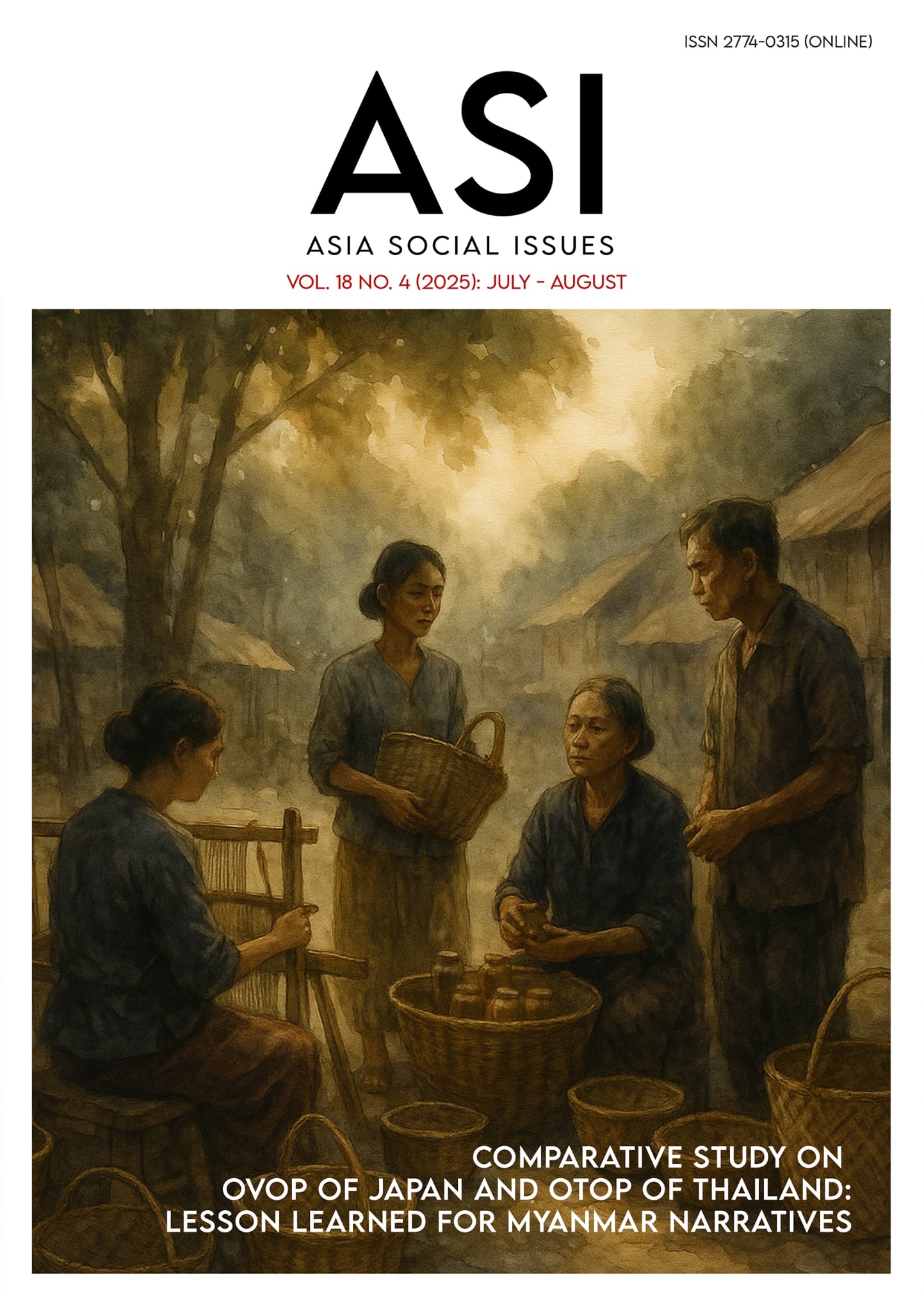
Comparative Study on OVOP of Japan and OTOP of Thailand: Lesson Learned for Myanmar Narratives
Article Sidebar
Main Article Content
Abstract
This study examines the one village – one product public policy process by comparing Thailand’s OTOP scheme and Japan’s OVOP scheme. The specific objectives of this study are 1) to examine the policy process on the OVOP of Japan and OTOP of Thailand and 2) to explore lessons learn for OVOP practices in Myanmar by comparing the OVOP scheme and OTOP scheme. This study conducted the comparative analysis with a backbone of the public process: problem identification, policy formulation, and policy implementation for one village, one product (OVOP), and one tampon, one product (OTOP). The three diagnosis models analyzed these three phases of the public policy process for each respective stage. Multiple streams such as the iron triangle, and top-down, bottom-up approach models exist. This study adopted documentary analysis techniques such as comparative contextual, and thematic analysis as major research methods. The system extracts the required data and information form relevant textbooks, academic articles periodical journals, and websites. The first findings of this comparative analysis indicate that the 1997 financial crisis was a significant problem for OTOP, while the economic stagnation of Oita Prefecture was a major factor in the agenda-setting of OVOP. In the policy formulation process, Thailand established OTOP by the iron triangle because Thaksin and the TRT party won the election and took the major role in coordinating the iron triangle mechanism. On one side, OVOP is advocated solely by Hiramatsu and is not aligned with an iron triangle. OTOP used the Top-down policy implementation approach, and OVOP used bottom-up approach for policy implementation. According to the result of the comparative analysis, Myanmar can learn lessons from its One village, one product scheme initiatives for forthcomings.
Article Details

This work is licensed under a Creative Commons Attribution-NonCommercial-NoDerivatives 4.0 International License.
Copyright: CC BY-NC-ND 4.0
References
Adachi, F. (2003). One village one product movement and contemporary Asia: Some observations from the field survey of Oita profecture and Northern Thailand (pp.40-52). In Proceedings of the Japan Association for Small Business studies Chiba Regional Meeting. Chiang Mai, Thailand: Faculty of Economics, Chiang Mai University.
Aldrich, D. (2012). Top down versus bottom up: Post-crisis Japanese nuclear policy. Honolulu: East-West Center Amorn Raksasat. (1977). Policy development (2nd eds.). Bangkok, Thailand: National Institute of Development Administration Press.
Anh, N. T. (2013). One Village One Product (OVOP) in Japan to One Tambon One Product (OTOP) in Thailand: Lessons for Grass Root Development in Developing Countries. Journal of Social and Development Sciences, 4(12), 529-537.
Bryce, H. J. (2012). Policy formulation, nonprofit advocacy, and the principal-agent framework (pp. 153-168). In Herrington J. B. (Ed.). Players in the Public Policy Process. New York: Palgrave Macmillan.
Department of Community Development, Ministry of Interior. (2001). Implementation approach of one Tambon one product. Bangkok, Thailand: Department of Community Development.
Ding, H. (2022). Qualitative comparative analysis: Search target, reflection on the top-down approach and introduction of the bottom-up approach Nydalsveien 37, 0484. Oslo, Norway: SAGE Publications
Kapilima, V. C. (2020). The impact of power and power relationships in the public policy formulation process: A case study of the formulation process of 2014 Tanzania’s education and training policy. Open Political Science, 3(1), 220-230.
Kemavuthanon, S. (2014). Leadership in the OVOP and similar movements: The comparative study between the OVOP movement in Japan and OTOP project in Thailand. International Journal of Public Administration, 37(9), 542-555.
King, L., & Shannon, W. (1986). Political network in policy process: The case of the national sea grant college program. Polity, 19(2), 213-231.
Kingdon, J. (2001). A model of agenda - setting, with applications. Law Review, 2, 331-337.
Kingdon, J. W. (2003). Agendas, alternatives, and public policies (2nd eds.). New York: Longman.
Thanapongsathorn, K. (1992). General concept of public policy in public policy and planning lecture note. Nonthaburi, Thailand: Sukhothai Thammathirat University Press.
Kurokawa, K. (2009). Effectiveness and limitations of the one village one product (OVOP) approach as a government-led development policy: Evidence from Thai OTOP studies in regional science. The Journal of the Japan Section of the Regional Science Association International, 39(4), 809-821.
Widiyanti, A. (2018). A comparative study: One Village One Product (Ovop) as an engine of local economic development in Japan and Indonesia. Jurnal Litbang Sukowati : Media Penelitian Dan Pengembangan, 1(2), 80–94.
