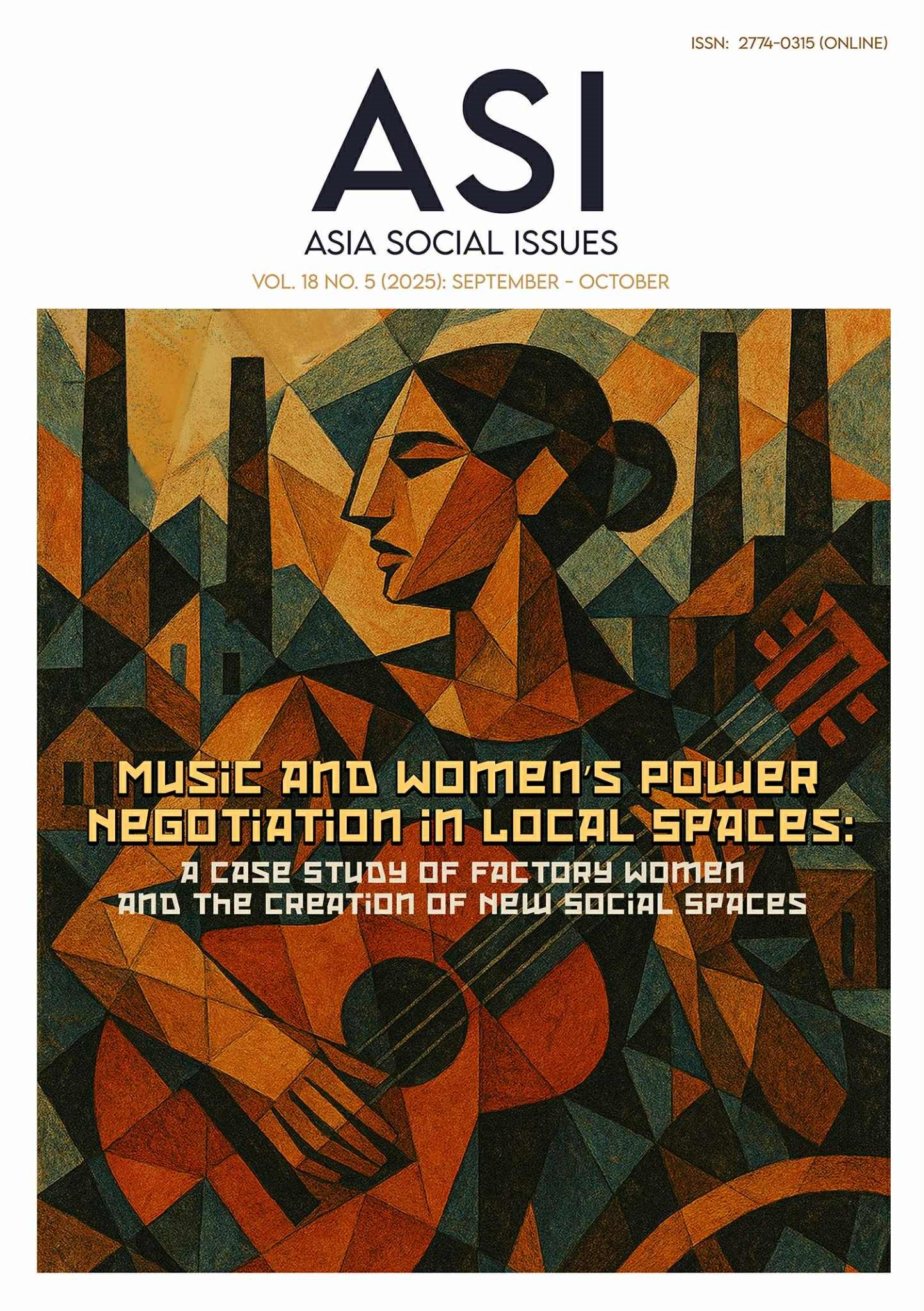
Music and Women’s Power Negotiation in Local Spaces: A Case Study of Factory Women and the Creation of New Social Spaces
Article Sidebar
Main Article Content
Abstract
This article examines how women in local communities, particularly factory workers, use music for power negotiation by analyzing musical events and cultural activities. The study uses theoretical frameworks of social space and everyday forms of resistance to show that music has become a significant space for women to assert their identity and negotiate power in local contexts. This reflects the changing economic and social roles of women in communities. Musical events serve as entertainment spaces and new social spaces that challenge traditional power structures and capitalist cultural domination. The findings highlight the importance of promoting women’s cultural spaces in local communities and understanding music’s role as a tool for empowerment and social change.
Article Details

This work is licensed under a Creative Commons Attribution-NonCommercial-NoDerivatives 4.0 International License.
Copyright: CC BY-NC-ND 4.0
References
Bennett, A. (2017). Music, space and place: Popular music and cultural identity. London, UK: Routledge.
Bennett, K. (2004). A Time for change? Patriarchy, the former coalfields and family farming. Sociologia Ruralis, 44, 147-166.
Berger, H. M., & Carroll, M. T. (2003). Global pop, local language. Jackson, USA: University Press of Mississippi.
Bilge, S. (2010). Beyond subordination vs. resistance: An intersectional approach to the agency of veiled Muslim women. Journal of Intercultural Studies, 31(1), 9-28.
Brown, A. R. (2016). Understanding Musical Practices as Agency Networks (pp. 45-52). In Proceedings of the International Conference on Innovative Computing and Cloud Computing. New York, USA: ACM Press.
Carter-Ényì, Q., & Carter-Enyi, A. (2019). Decolonizing the mind through song. Performance Research, 24, 58-65.
Chatterjee, C. (2002). Celebrating women: Gender, festival culture, and Bolshevik ideology, 1910-1939. Pittsburgh, USA: University of Pittsburgh Press.
Cochrane, T., Fantini, B., & Scherer, K. R. (2013). The emotional power of music: Multidisciplinary perspectives on musical arousal, expression, and social control. Oxford, UK: OUP Oxford.
Corngreat, S. (2016). Music, festivals and occupations: Isan diasporic identity and negotiation. Journal of Letters, 44(2), 71-102.
Crehan, K. (2016). Gramsci’s common sense: Inequality and its narratives. Durham, USA: Duke University Press.
Danaher, W. F. (2010). Music and social movements. Sociology Compass, 4(9), 811-823.
Davis, T. C. (2002). Actresses as working women: Their social identity in Victorian culture. London, UK: Routledge.
Diamond, B., & Moisala, P. (2000). Music and gender. Urbana, USA: University of Illinois Press.
Evans, P. (2000). Fighting marginalization with transnational networks: Counter-hegemonic globalization. Contemporary Sociology, 29(1), 230-241.
Ferguson, R., Gever, M., Minh-Ha, T. T., & West, C. (1992). Out there: Marginalization and contemporary culture. Cambridge, USA: MIT Press.
Ferrer, A. F., & Retis, J. (2019). Ethnic minority media: Between hegemony and resistance. Journal of Alternative & Community Media, 4(3), 1-13.
Frith, S. (1996). Music and identity (pp. 108-127). In Hall, S., & Du Gay, P. (Eds.). Questions of cultural identity. London, UK: Sage Publications.
Gans, H. J. (2002). The Sociology of Space: A Use-Centered View. City and Community, 1, 329-339.
Gaventa, J. (2006). Finding the spaces for change: A power analysis. IDS Bulletin, 37(6), 23-33.
Golež Kaučič, M. (2020). Singing the other: Singing in two languages and code-switching/stitching. Tautosakos darbai, 59, 100-119.
Grüning, B. (2024). The spatialization of music and politics in festival spaces: The social, symbolic and emotional structuring of the festival of political songs in the German democratic republic. European Journal of Cultural Studies, 27(1), 52-69.
Gupta, A., & Ferguson, J. (2008). Beyond ‘culture’: Space, identity, and the politics of difference (pp. 72-79). In Oakes, T. S., & Price, P. L. (Eds.). The cultural geography reader. London, UK: Routledge.
Hall, S. (1997). Representation: Cultural representations and signifying practices. London, UK: Sage Publications.
Hanson, S., & Pratt, G. (2003). Gender, work and space. London, UK: Routledge.
Harvey, D. (2012). From space to place and back again: Reflections on the condition of postmodernity (pp. 2-29). In Bird, J., Curtis, B., Putnam, T., Robertson, G., & Tickner, L. (Eds.). Mapping the futures. London, UK: Routledge.
Hebert, D. G., & McCollum, J. (2014). Philosophy of history and theory in historical ethnomusicology (pp. 85-148). In McCollum, J., & Hebert, D. G. (Eds.). Theory and method in historical ethnomusicology. Lanham, USA: Lexington Books.
Hesmondhalgh, D. (2013). Why music matters. Chichester, UK: John Wiley & Sons.
Hooks, B. (1990). Yearning: Race, Gender and Cultural Politics. Boston, USA: South End Press.
James, R. (2015). Resilience & melancholy: Pop music, feminism, neoliberalism. Winchester, UK: John Hunt Publishing.
Kim, G. (2020). From factory girls to K-pop idol girls: Cultural politics of developmentalism, patriarchy, and neoliberalism in South Korea’s popular music industry. Lanham, USA: Rowman & Littlefield.
Knights, V. (2016). Music, national identity and the politics of location: Between the global and the local. London, UK: Routledge.
Korczynski, M. (2014). Songs of the factory: Pop music, culture, and resistance. Ithaca, USA: ILR Press.
Koskoff, E. (2014). A feminist ethnomusicology: Writings on music and gender. Urbana, USA: University of Illinois Press.
Lefebvre, H. (1991). The Production of Space (D. Nicholson-Smith, Trans.). Cambridge, USA: Blackwell.
Lessinger, J. (2002). Work and love: The limits of autonomy for female garment workers in India. Anthropology of Work Review, 23(1‐2), 13-18.
Loos, T. (2020). Reading Gender Trouble in Southeast Asia. Journal of Asian Studies, 79(4), 927-946.
Manago, A. M., & McKenzie, J. (2022). Culture and digital media in adolescent development. Cambridge, UK: Cambridge University Press.
Martiniello, M., & Lafleur, J. M. (2008). Ethnic minorities’ cultural and artistic practices as forms of political expression: A review of the literature and a theoretical discussion on music. Journal of Ethnic and Migration Studies, 34(8), 1191-1215.
Mawa, B. (2020). Challenging patriarchy: The changing definition of women’s empowerment. Social Science Review, 37(2), 239-264.
McClary, S. (2002). Feminine endings: Music, gender, and sexuality. Minneapolis, USA: University of Minnesota Press.
Mosedale, S. (2005). Assessing women’s empowerment: Towards a conceptual framework. Journal of International Development, 17(2), 243-257.
Mukdawijit, Y. (2021). Anthropological debates: Theoretical paths and methodology. Bangkok, Thailand: Siam Paritat.
Muñoz‐Puig, M. (2024). Intersectional power struggles in feminist movements: An analysis of resistance and counter‐resistance to intersectionality. Gender, Work & Organization, 31(3), 1133-1147.
Nerland, M. (2007). One-to-one teaching as cultural practice: Two case studies from an academy of music. Music Education Research, 9(3), 399-416.
Ngai, P. (2005). Made in China: Women factory workers in a global workplace. Durham, USA: Duke University Press.
Nicholls, W. (2009). Place, networks, space: Theorising the geographies of social movements. Transactions of the Institute of British Geographers, 34(1), 78-93.
Oppenheimer, V. K. (1994). Women’s rising employment and the future of the family in industrial societies. Population and Development Review, 20(2), 293-342.
Pedelty, M. (2009). Musical news: Popular music in political movements. In S. E. Bird (Ed.), The Anthropology of News and Journalism: Global Perspectives (pp. 215-237). Bloomington, USA: Indiana University Press.
Phukhao-Thong, S. (1996). Thai music and pathways to Thai music (2nd eds.). Bangkok, Thailand: Ruen Kaew Publishing.
Piekut, B. (2014). Actor-Networks in Music History: Clarifications and Critiques. Twentieth-Century Music, 11(2), 191-215.
Rice, T. (2007). Reflections on music and identity in ethnomusicology. Muzikologija, 1(7), 17-38.
Rusak, H. (2023). Women, Music and Leadership (1st ed.). London, UK: Routledge.
Ruud, E. (1997). Music and identity. Nordic Journal of Music Therapy, 6(1), 3-13.
Sahay, S. (1998). Women and empowerment: Approaches and strategies. New Delhi, India: Discovery Publishing House.
Scott, J. C. (1985). Weapons of the weak: Everyday forms of peasant resistance. New Haven, CT, USA: Yale University Press.
Sharpe, E. K. (2008). Festivals and social change: Intersections of pleasure and politics at a community music festival. Leisure Sciences, 30(3), 217-234.
Soja, E. W. (2010). Seeking spatial justice. Minneapolis, USA: University of Minnesota Press.
Testaverde, M., Moroz, H., Hollweg, C. H., & Schmillen, A. (2017). Migrating to opportunity: Overcoming barriers to labor mobility in Southeast Asia. Washington, DC, USA: World Bank.
Turino, T. (2008). Music as social life: The politics of participation. Chicago, USA: University of Chicago Press.
Vinthagen, S., & Johansson, A. (2013). Everyday resistance: Exploration of a concept and its theories. Resistance Studies Magazine, 1(1), 1-46.
Williams, R. (1977). Marxism and literature. Oxford, UK: Oxford University Press.
Wolf, D. L. (1992). Factory daughters: Gender, household dynamics, and rural industrialization in Java. Berkeley, USA: University of California Press.
