Preserving the Art of Quan họ Singing and Folk Theatrics amid the Fourth Industrial Revolution: A Preliminary Proposal
Article Sidebar
Main Article Content
Abstract
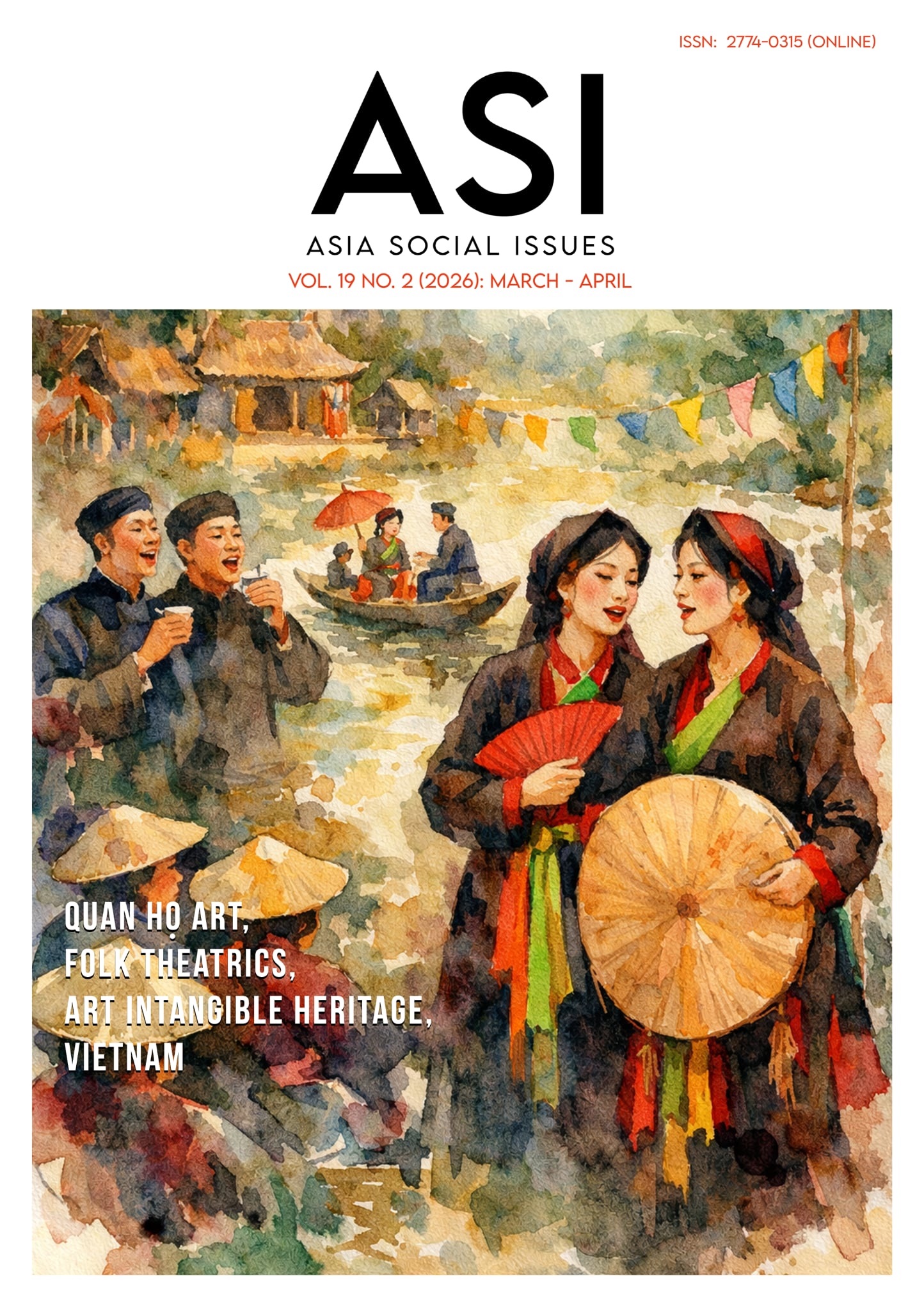
Quan họ folk songs and folk theatrics are two typical traditional performing arts heritages of the Vietnamese people in Northern Vietnam. They are also intangible cultural heritages that need to be prioritised for preservation and promotion in the current context of globalisation. Quan họ is an art form of male and female reciprocal singing, showcasing some typical characteristics of ancient Vietnamese folk music. It has been included in UNESCO’s list of World Intangible Cultural Heritage.
Along with that, folk theatrics have been created and practiced by the Indigenous people of this region for thousands of years and are still being passed down through generations of Vietnamese people. However, this art form is at risk of disappearing from the folk cultural life of the region. Folk theatrics contain many philosophies about traditional ethics and profound humanistic thoughts and are among the important factors in shaping the traditional culture of the Vietnamese people in the North. Therefore, they need to be preserved and promoted today.
For many years, numerous research works have discussed the cultural, artistic, and historical values of these heritage forms – most of which also mention the challenges of preserving and promoting them in contemporary social life.
However, using digital technologies as a solution for these issues has not received much attention from scientific studies. These are two types of intangible cultural heritage with similar artistic content, allowing digital technology to be applied to digitise each of their artistic elements in detail. Based on research at the Vietnam Institute of Music, as well as surveys and fieldwork in villages, the objective of this paper is to present the key aspects of Quan họ singing and folk theatrical art.
The outstanding contribution of this paper is that, for the first time, specific details of each heritage content are clearly identified from the perspective of an in-depth researcher in ethnomusicology. This provides valuable insights for digital experts to support the preservation and promotion of similar folk art heritages across different cultures. However, a limitation of this study is that it does not analyse in depth the formulas and algorithms used for digitisation activities.
Highlight
- Compared with previously published studies, this scientific article is the first to specifically research and propose digital technologies for detailed digitalization of traditional music and folk theatric performing arts, in the case of Vietnam.
- The article shows that, in the process of digitizing traditional arts, there is a fundamental difference between digitizing folk music melodies and folk dances; between digitizing performance costumes and archaeological sources and knowledge of the art history of each art heritage; between the movement process of actors on folk stages and the scripts and chapters of each theatrical work; etc. This is an important scientific gap that this study discovered and studied.
- The research results also suggest future research directions on strengthening the coordination and interdisciplinary cooperation between technology and arts to create quality scientific products, promoting the cultural industrialization process, especially in countries with long-standing and rich cultures like Vietnam.
Article Details

This work is licensed under a Creative Commons Attribution-NonCommercial-NoDerivatives 4.0 International License.
Copyright: CC BY-NC-ND 4.0
References
References
Nguyen, T. A. (2004), Quan họ Music, Hanoi, Vietnam: Vietnamese Institute for Musicology.
A Public Trust at Risk: Findings of the Heritage Health Index (2007), Videos. Retrieved from https://www.loc.gov/item/webcast-5252/
Belhi, A., Bouras, A., & Foufou, S. (2017, December). Digitization and preservation of cultural heritage: The CEPROQHA approach (pp. 1-7). In Proceedings of the 2017 11th International Conference on Software, Knowledge, Information Management and Applications (SKIMA). New York, USA: IEEE.
Berezin, M. (1994). Cultural form and political meaning: State-subsidized theater, ideology, and the language of style in fascist Italy. American Journal of Sociology, 99(5), 1237-1286.
Cartocci, C. (2024). The rise of the concept of “The Theatrical” outside the performative arts (Doctoral dissertations). Venice, Italy: Ca' Foscari University.
CyArk. (2018). Taos Pueblo - LiDAR - Terrestrial, Photogrammetry. Retrieved from https://doi.org/10.26301/yva5-pc90
Dang, V. L, Hong, T., & Tran, L.Q. (1978). Quan họ origin and development process. Hanoi, Vietnam: Publishing House of Social Science, Hanoi.
Dessaux, C., & Hagedorn-Saupe, M. (2013). Digitisation of cultural heritage in France: An interview with Christophe Dessaux. Uncommon Culture, 3(5/6), 116-125.
Doulamis, A. D., Voulodimos, A., Doulamis, N. D., Soile, S., & Lampropoulos, A. (2017). Transforming Intangible Folkloric Performing Arts into Tangible Choreographic Digital Objects: The Terpsichore Approach (pp. 451-460). In Proceedings of the 12th International Joint Conference on Computer Vision, Imaging and Computer Graphics Theory and Applications. Setúbal, Portugal: The SciTePress Digital Library.
Doulamis, N., Doulamis, A., Ioannidis, C., Klein, M., & Ioannides, M. (2017). Modelling of static and moving objects: digitizing tangible and intangible cultural heritage (pp. 567-589). In Proceedings of the Mixed reality and gamification for cultural heritage. Cham, Switzerland: Springer International Publishing.
Eco, U. (1977). Semiotics of theatrical performance. The drama review, 21(1), 107-117.
Evens, T., & Hauttekeete, L. (2011). Challenges of digital preservation for cultural heritage institutions. Journal of Librarianship and Information Science, 43(3), 157-165.
Fischer-Lichte, E. (1995). I — Theatricality Introduction: Theatricality: A Key Concept in Theatre and Cultural Studies. Theatre research international, 20(2), 85-89.
Ha, C. C. (2018). Changes of the Bắc Ninh Quan ho culture in the current period (Doctoral dissertations). Vietnam: Hanoi University of Culture.
Hoang, P. (1997). Vietnamese Dictionary. Da Nang, Vietnam: Danang Publishing House.
Hou, Y., Kenderdine, S., Picca, D., Egloff, M., & Adamou, A. (2022). Digitizing intangible cultural heritage embodied: State of the art. Journal on Computing and Cultural Heritage, 15(3), 1-20.
Kico, I., Grammalidis, N., Christidis, Y., & Liarokapis, F. (2018). digitisation and visualization of folk dances in cultural heritage: A review. Inventions, 3(4), 72.
Khac, D. L., Minh, H. N., Dinh, L. N., & Van, S. Q. (2021). Digitalization of traditional performance art heritage in Quảng Ninh for conservation, management, and tourism development (pp. 030020- 030028). In Proceedings of the AIP Conference. New York, USA: AIP Publishing.
Le, D.K. Hoac, C.H., Le, T.C. (2006). Quan ho cultural space. Bac Ninh, Vietnam: Center for Culture and Information of Bắc Ninh province.
Muriel, F. (2003). Recherche et numérisation du patrimoine en Europe. Dans Document numérique, 3-4 (7), 179-189.
Nguyen, H. V. (2010). Two Quan ho characters in ancient bibliography. Retrieved from http://baotangnhanhoc.org/vi/bai-nghien-cu-lch-s/592
Nguyen, V. P., Luu, H. P., Tu, N., Nguyen, V. (1962). Bắc Ninh Quan ho folk songs. Hanoi, Vietnam: Fine Arts Publishing House - Institute of Culture.
Näslund, A., & Wasielewski, A. (2020). Cultures of digitisation: A historiographic perspective on digital art history. Visual Resources, 36(4), 339-359.
Nguyen, D. L. (2012). Discover about a Quan họ singing stage (Canh hát). Journal of Propaganda, 5, 58-61.
Nguyen, D. L. (2014). Music in Buddhist rituals in Hanoi (Doctoral dissertations). in Religious Studies, Hanoi, Vietnam: National Library of Vietnam.
Nguyen, D. L, Le, T. T. T., Tran, T. T., Luong, K. D. (2022). Traditional Vietnamese performing arts: An interdisciplinary approach. Hanoi, Vietnam: The Gioi Publishing House.
National Council directs the compilation of the Vietnam Encyclopedia. (2005). The Vietnam Encyclopedia (1995 - 2005), Hanoi, Vietnam: Publishing House of Encyclopedia Dictionary.
Quinn, M. (1995). Concepts of theatricality in contemporary art history. Theatre Research International, 20(2), 106-113.
Robertson, J. L. (2009). Theatrical ideology: Toward a Rhetoric Theatricality. Provo, USA: Brigham Young University.
Petri, I., & Julien, F. (2017). Digitising the Performing Arts. Assessment Report.Ottawa, Ontario, Canada: The Canadian Arts Presenting Association (CAPACOA) and Strategic Moves.
Valentyna, D. (2018). “Digital Transformation at Work: an Analysis of Professional Frameworks and Discourses of Actors in the context of Open Data Reuse in France” NEON 2018: Innovation in organizations – challenges and potentials. Lillehammer, Norway: HAL open science.
Vietnam National University. (2022). Website on training and scientific research, accessed October 19. Hanoi, Vietnam: VNU.
Vu, N.P. (1972). Some preliminary opinions on Bac Ninh Quan Ho folk songs. In Some issues on Quan Ho folk songs, Bac Giang, Vietnam: Ha Bac Culture Department.
Wilcer, S. (2019). Preserving Performance and Purpose: An Audio and Audiovisual digitisation Cross-Analysis within the Performing Arts. Retrieved from https://doi.org/10.17615/85sg-8859
Zhanna, R. (2020). Digitization of Intangible Cultural Heritage as a method to save and actualize it on the example of Kazakh folk dance (pp. 1-7). In Proceedings of the 6th International Conference on Engineering & MIS 2020. New York, USA: ACM Digital Library.
