From Watwat to Betel Nut: How are Cordillerans Portrayed in Local Memes?
Article Sidebar
Main Article Content
Abstract
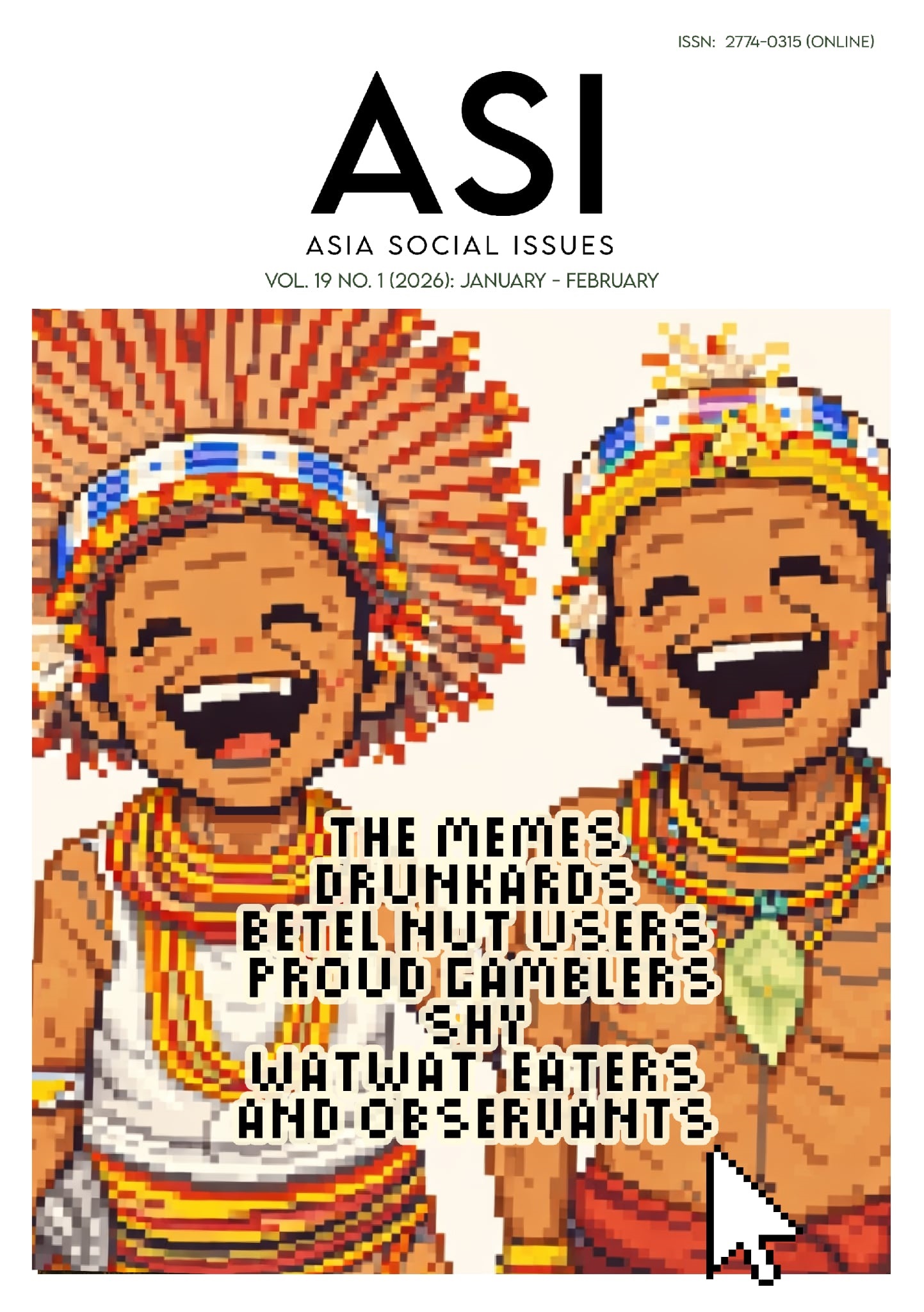
The growth of social media has enabled users to quickly generate memes on digital platforms. Even though users design memes to express ideas and identities, researchers need to give more attention to the evident gap in how Cordillerans are portrayed through memes on social media. Therefore, this research aims to fill this gap by specifically examining how the Taga Lakandula Facebook Page portrays Cordillerans through memes. Using netnography, the researchers had to immerse themselves in the virtual world for two months, repeatedly reading and analyzing the memes, which included constant correspondence with the person in charge of the Facebook page. The researchers adopted stages of content analysis and sought help from an external expert in the field who reviewed the memes vis-à-vis the findings to see if they were plausible and accurate. The findings revealed that the memes portray Cordillerans as drunkards, betel nut users, proud, gamblers, shy, ‘watwat’ eaters, and observants. Overall, this research adds to the literature on Cordilleran portrayals and Internet memes and recommends future research trajectories.
Article Details

This work is licensed under a Creative Commons Attribution-NonCommercial-NoDerivatives 4.0 International License.
Copyright: CC BY-NC-ND 4.0
References
Andrade, S. B. (2019). The temporal rhythm of alcohol consumption: On the development of young people’s weekly drinking patterns. Young, 27(3), 225-244.
Antonio Jr, F. F. (2024). The significance of food in the parable of the wedding feast in matthew 22: 1-14 and the kanyaw. Religion and Social Communication, 22(1), 34-57.
Balan, S. G., et al. (2023). Meme virality and humour style: Exploring internet memes as a multimodal language in social media. Journal of Language and Pragmatics Studies, 2(3), 228-233.
Bartram, M. (2020). ‘It’s really about wellbeing’: A Canadian investigation of harm reduction as a bridge between mental health and addiction recovery. International Journal of Mental Health and Addiction, 19(5), 1497-1510.
Botangen, K. A., Vodanovich, S., & Yu, J. (2018). Preservation of indigenous culture among indigenous migrants through social media: The Igorot peoples (pp. 2303-2312). In Proceedings of the 50th Hawaii International Conference on System Sciences. Hilton Waikoloa Village, Hawaii, USA: AIS Electronic Library.
Braitman, A. L., Lau-Barraco, C., & Stamates, A. L. (2020). Personalized feedback tempers weekend increases in alcohol use among nonstudent emerging adult drinkers. Addictive Behaviors, 105, 106332.
Caluzzi, G., MacLean, S., & Pennay, A. (2020). Re-configured pleasures: How young people feel good through abstaining or moderating their drinking. International Journal of Drug Policy, 77, 102709.
Conroy, D., & De Visser, R. O. (2021). Strategies for managing alcohol intake and refusing offers of alcoholic drinks. Cham: Palgrave Macmillan.
Cox, W. M., & Klinger, E. (1988). A motivational model of alcohol use. Journal of Abnormal Psychology, 97(2), 168-180.
Dawkins, R. (2016). The selfish gene. US: Oxford University Press.
Denisova, A. (2019). Internet memes and society. US: Routledge.
Faraji, H., Özarabacı, T., & Anıl, M. B. (2024). Investigation of the relationship between borderline personality traits, shyness and anger. International Journal of Western Black Sea Social and Humanities Sciences 8(1), 67-86.
Finlay, A., Ram, N., Maggs, J., & Caldwell, L. (2012). Leisure activities, the social weekend, and alcohol use: Evidence from a daily study of first-year college students. Journal of Studies on Alcohol and Drugs, 73(2), 250-259.
Graber, R., De Visser, R., Abraham, C., Memon, A., Hart, A., & Hunt, K. (2015). Staying in the ‘sweet spot’: A resilience-based analysis of the lived experience of low-risk drinking and abstention among British youth. Psychology and Health, 31(1), 79-99.
Hser, Y. I., Li, J., Jiang, H., Zhang, R., Du, J., Zhang, C., Zhang, B., Evans, E., Wu, F., Chang, Y. J., Peng, C., Huang, D., Stitzer, M. L., Roll, J., & Zhao, M. (2011). Effects of a randomized contingency management intervention on opiate abstinence and retention in methadone maintenance treatment in China. Addiction (Abingdon, England), 106(10), 1801-1809.
Hwang, E., & Shwartz, V. (2023). Memecap: A dataset for captioning and interpreting memes. arXiv preprint.
Kartikawati, A. (2024). Code switching analysis: English memes reaction video as the supplemental resources for Indonesian EFL learners (pp. 205-213). In Proceedings of the Asian Conference on Education 2023. Tokyo, Japan: ACE.
Katainen, A., Härkönen, J., & Mäkelä, P. (2022). Non-drinkers’ experiences of drinking occasions: A population-based study of social consequences of abstaining from alcohol. Substance Use & Misuse, 57(1), 57-66.
Kozinets, R. V. (2002). The field behind the screen: Using netnography for marketing research in online communities. Journal of Marketing Research, 39(1), 61-72.
Liontas, J. I., & Raafat, F. (2024). Memes that meme idiomatics: Cultivating critical memetic literacy and authentic communication. The TESOL Encyclopedia of English Language Teaching.
Marwick, A. E. (2013). Memes. Contexts, 12(4), 12-13.
Morris, D. (1998). Social and cultural aspects of drinking. The Social Issues Research Centre.
Omamalin, J. (2022). “Tagay ta, bai!” the social dynamics of Filipino social drinking. Philippine Social Science Journal, 5(3), 9-20.
Piacentini, M. G., & Banister, E. N. (2009). Managing anti-consumption in an excessive drinking culture. Journal of Business Research, 62(2), 279-288.
Quinto, J. B., & Cho-oy, D. M. (2023). TeachTokerists in the Philippines: A Husserlian Phenomenology. Asia Social Issues, 16(1), e258636-e258636.
Quinto, J. B., & Kitani, A. B. (2022). On code-switching in English major courses. Innovations, 71(3), 538-551.
Reich, R., Cummings, J., Greenbaum, P., Moltisanti, A., & Goldman, M. (2015). The temporal “pulse” of drinking: Tracking 5 years of binge drinking in emerging adults. Journal of Abnormal Psychology, 124(3), 635-647.
Rinker, D. V., & Neighbors, C. (2013). Reasons for not drinking and perceived injunctive norms as predictors of alcohol abstinence among college students. Addictive behaviors, 38(7), 2261-2266.
Way, L. C. (2019). The importance of memes. European Journal of Communication, 34(5), 552-556.
Zubaidah, N., & Ardelia, I. (2018). A disclosure analysis of memes. Getsempena English Education Journal, 5(2), 58-64.
