About The Journal

International Standard Serial Numbers (ISSN):
ISSN 2774-0919 (Print)
ISSN 2774-0897 (Online)
Objectives and Scope of the Journal:
The journal focuses on humanities and social sciences with the aim of promoting and supporting scholars, researchers, students, and interested individuals to disseminate academic works such as Buddhist studies, business and management, political science, public administration, and education. Articles are accepted in Thai languages.
Types of Works Published in the Journal:
The journal publishes academic articles, Research Articles, and book reviews.
Academic Articles: These include analysis, critique, knowledge synthesis, identifying backgrounds, objectives, and problem-solving approaches related to theories pertinent to Buddhist philosophy, business and management, political science, public administration, and education. Articles should present existing or new theories supported by credible and balanced scholarly perspectives, contributing to knowledge development in the respective fields. The average word count for academic articles should not exceed 8,000 words.
Research Articles: These present original research demonstrating novelty and relevance to Buddhist philosophy, business and management, political science, public administration, and education. Research Articles should have clear, concise content, novelty, good structure, and discussion summarizing research findings. The average word count for Research Articles should not exceed 8,000 words.
Book Reviews: These involve storytelling and commentary on specific books with the intention to introduce them to readers, providing complete bibliographic details, content scope, special features, or strengths of the books, such as illustrations, indexes, evaluations, reasoned recommendations for reading or acquisition, suitability for specific reader groups, and comparisons with other books in the same category. Reviewers should have expertise in the field of review and should identify themselves or provide information about themselves for credibility assessment.
Publication Schedule: 6 issues per year
Issue 1: January-February
Issue 2: March-April
Issue 3: May-June
Issue 4: July-August
Issue 5: September-October
Issue 6: November-December
Article Evaluation and Selection Process:
Each article undergoes peer review by a minimum of 2 reviewers who are experts in the relevant field. Articles must also receive approval from the editorial board before publication. The review process follows a double-blind format, where both the authors and the reviewers remain anonymous to each other.
Language Usage:
The journal accepts articles in Thai languages, emphasizing clarity and conciseness in language usage.
Publication Fee:
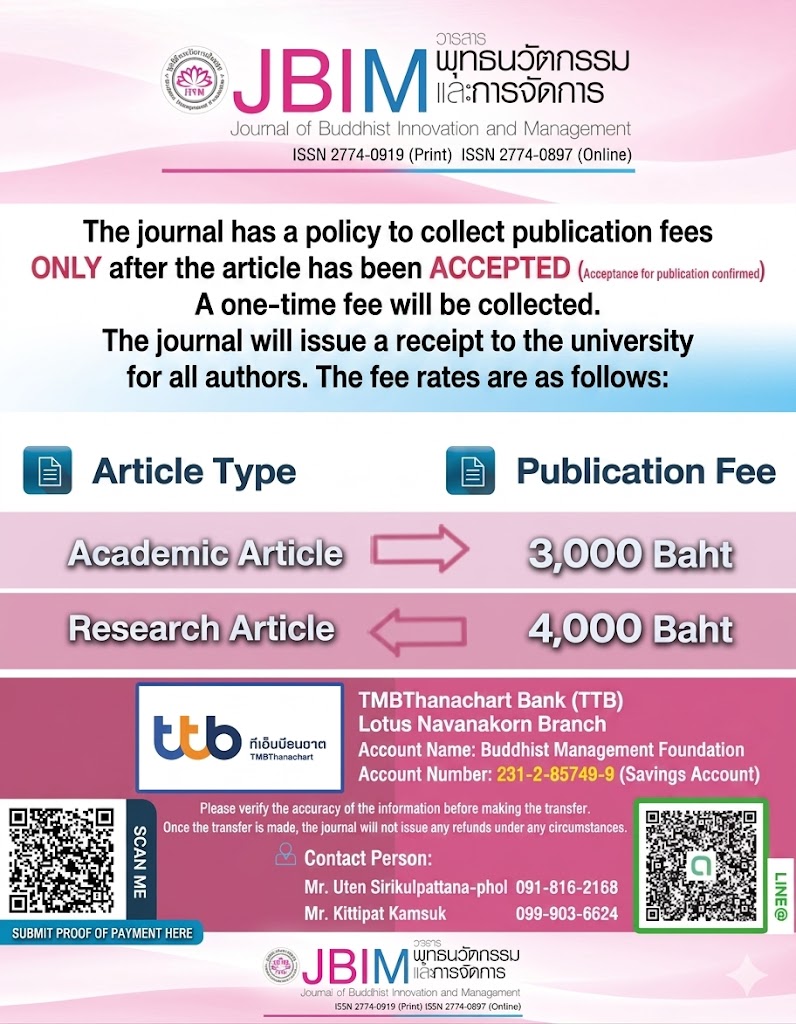
The journal operates on a publication fee policy, collected only after acceptance (upon acceptance for publication only, one-time fee). Authors will be issued receipts for payment by the foundation. The publication fees are as follows:
-Academic articles or book reviews: THB 3,000 per article
-Research Articles: THB 4,000 per article
Authors must pay the publication fee only after receiving an email notification from the journal. The journal will not refund publication fees under any circumstances.
Open Access Policy:
The journal aims to provide open access to articles related to Buddhist philosophy, business and management, political science, public administration, and education. All published articles are freely accessible online to everyone worldwide without any charges.
Ownership and Management:
The Journal of Buddhist Management is owned by the Buddhist Management Foundation and partially supported by Mahachulalongkornrajavidyalaya University. The journal's operations are funded through various sources, ensuring high publication standards. All content is rigorously reviewed by qualified experts.
Publisher:
The JBIM is an official peer-reviewed journal under the supervision of the Graduate Program in Political Science, Faculty of Social Sciences, Mahachulalongkornrajavidyalaya University, Thailand.
Copyright and Licensing:
The journal places importance on protecting copyrights and licensing to appropriately safeguard the rights of authors and disseminators. The policy emphasizes openness, accessibility, and proper attribution. Authors retain copyright ownership of their works, and articles are published under the Creative Commons Attribution License (CC BY), allowing for sharing, adaptation, and proper attribution. Authors are required to publish under the CC BY license, which permits reuse and distribution widely. The journal supports posting of articles in personal repositories, with institutional and funding constraints attached. Authors are expected to explain copyright terms and licenses, empowering them with knowledge of their rights and obligations. This policy delineates collaborative work boundaries, openness, and responsible sharing. Authors, both for-profit and research communities, retain intellectual property rights.
Revenue Sources:
The journal receives partial funding from the Buddhist Management Foundation and the Graduate Program in Political Science, Faculty of Social Sciences, Mahachulalongkornrajavidyalaya University. Additionally, publication fees are collected from article submitters.
Advertising Policy:
The journal employs direct marketing strategies, such as email, official Facebook page, and the ThaiJo website, while maintaining ethical standards. Direct communication with researchers and academics in related fields ensures accurate information dissemination about the journal's mission and characteristics. The journal adheres to the principles of legality, consent, and data privacy. Comprehensive guidelines aim to provide sufficient and beneficial information to recipients. The journal considers relevant regulations and continuously reviews our practices to ensure compliance. Marketing efforts are conducted ethically and responsibly to benefit academics, foster collaboration, and transparently disseminate esteemed research.