Guidelines for Empowering Youth in Promoting Cultural Tourism Businesses in Bangkok
Article Sidebar
Main Article Content
Abstract
This research aims to: 1) study the characteristics and patterns of cultural tourism in Bangkok; 2) examine the process of youth potential development in promoting cultural tourism businesses in Bangkok; and 3) propose guidelines for enhancing youth potential to support cultural tourism businesses in Bangkok. This study employed a qualitative research methodology. Data were collected using a semi-structured in-depth interview tool with 18 key informants, categorized into four main groups: 1) tourism faculty members, 2) tour guides, 3) tourism students and 4) tourists. Data were analyzed using thematic analysis to identify common characteristics and conclusions.
The research findings revealed that:ฺ
1. The characteristics and patterns of cultural tourism in Bangkok emphasize creating in-depth learning experiences and active tourist participation through activities reflecting traditional neighborhood identity, such as learning local crafts, wearing traditional attire, tasting local cuisine, and exchanging lifestyle experiences with the community.
2. The youth potential development is a systemic process encompassing four stages: inputs, processes, outputs, and outcomes. It focuses on cultivating knowledge, skills, abilities, and attitudes (KSAA) through on-site experiential learning. Key outcomes include youth developing pride in local identity, gaining foreign language communication and tourist group management skills, and sustainably linking tourism with the community economic system.
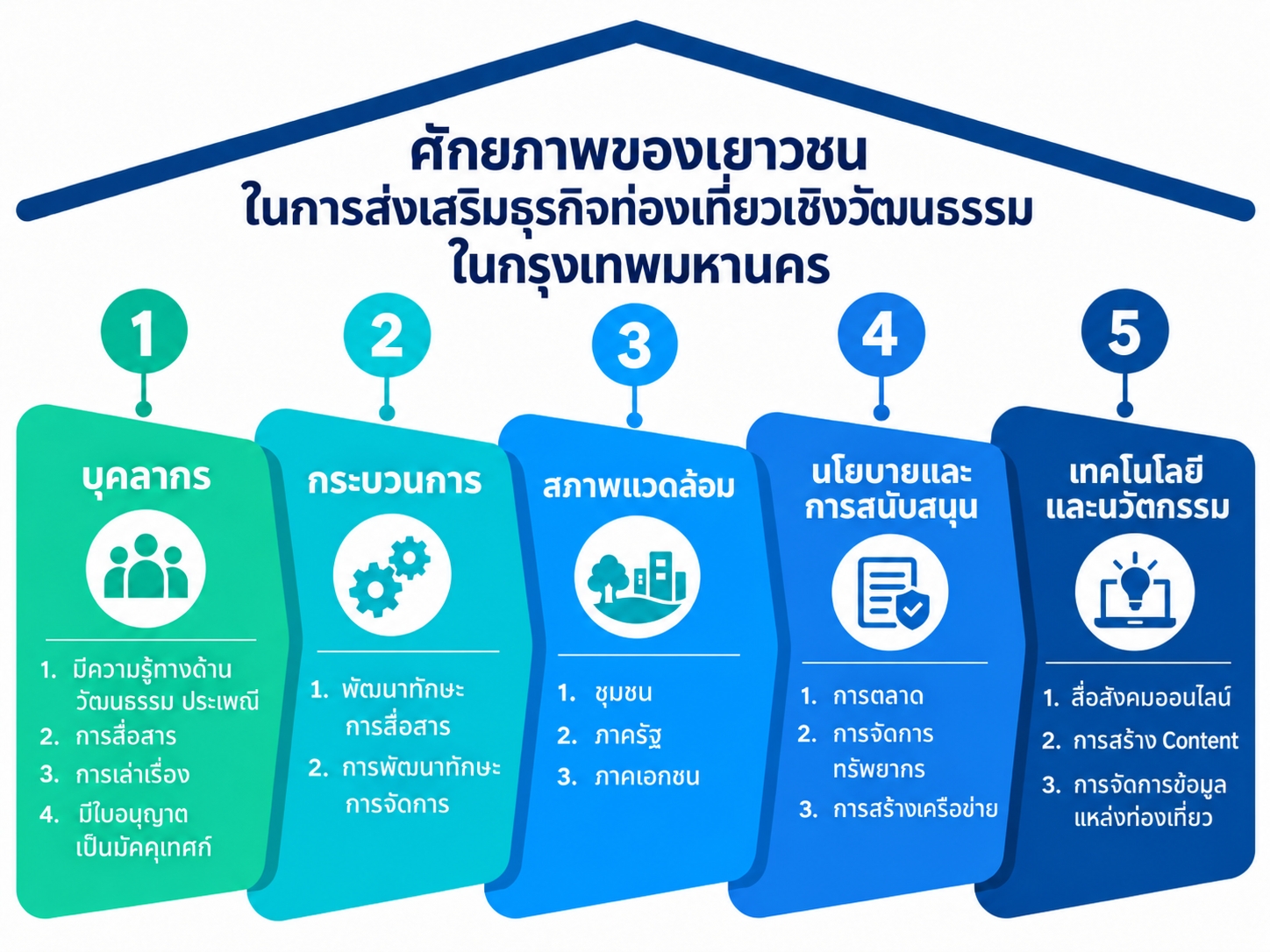
3. The guidelines for enhancing youth potential focus on integrating individual capacity dimensions with driving the 5As tourism ecosystem to fulfill the supply chain as new-generation community enterprise entrepreneurs and content creators. The new body of knowledge indicates that success stems from integrating five-dimensional factors: personnel, development process, environment, policy, and technology. Policy acts as the primary bottleneck needing structural unlocking, while technology serves as a vital catalyst through the application of data management platforms, virtual tour applications, and digital media for interpretation to drive cultural tourism businesses in Bangkok efficiently and sustainably.
Article Details

This work is licensed under a Creative Commons Attribution-NonCommercial-NoDerivatives 4.0 International License.
เพื่อให้เป็นไปตามกฎหมายลิขสิทธิ์ ผู้นิพนธ์ทุกท่านต้องลงลายมือชื่อในแบบฟอร์มใบมอบลิขสิทธิ์บทความ ให้แก่วารสารฯ พร้อมกับบทความต้นฉบับที่ได้แก้ไขครั้งสุดท้าย นอกจากนี้ ผู้นิพนธ์ทุกท่านต้องยืนยันว่าบทความ ต้นฉบับที่ส่งมาตีพิมพ์นั้น ได้ส่งมาตีพิมพ์เฉพาะในวารสาร วิชาการธรรม ทรรศน์ เพียงแห่งเดียวเท่านั้น หากมีการใช้ ภาพหรือตารางของผู้นิพนธ์อื่นที่ปรากฏในสิ่งตีพิมพ์อื่นมาแล้ว ผู้นิพนธ์ต้องขออนุญาตเจ้าของลิขสิทธิ์ก่อน พร้อมทั้ง แสดงหนังสือที่ได้รับการยินยอมต่อบรรณาธิการ ก่อนที่บทความจะได้รับการตีพิมพ์References
กระทรวงการท่องเที่ยวและกีฬา. (2567). สถิตินักท่องเที่ยวและรายได้จากการท่องเที่ยวรายจังหวัด ปี 2566. เข้าถึงได้จาก https://mots.go.th
กระทรวงแรงงาน. (2566). รายงานผลการวิเคราะห์ข้อมูลอุปสงค์และอุปทานแรงงาน กรุงเทพมหานคร ปี 2566. กรุงเทพฯ: กองวิจัยตลาดแรงงาน กรมการจัดงาน กระทรวงแรงงาน.
เกวลิน งามพิริยกร, สุวิชาน พัฒนาไพรวัลย์ และวัฒนชัย ขวาลําธาร. (2567). การพัฒนารูปแบบการจัดการเรียนรู้การท่องเที่ยวเชิงวัฒนธรรมด้วยยุวมัคคุเทศก์โดยชุมชนมีส่วนร่วมของ. วารสารสังคมศาสตร์และวัฒนธรรม, 8(12), 198-210. https://so06.tci-thaijo.org/index.php/JSC/article/view/278990
คณะกรรมการนโยบายการท่องเที่ยวแห่งชาติ. (2566). แผนพัฒนาการท่องเที่ยวแห่งชาติ ฉบับที่ 3 (พ.ศ. 2566-2570). กรุงเทพฯ: สำนักงานปลัดกระทรวงการท่องเที่ยวและกีฬา.
ชณัฎฐ์ พงศ์ธราธิก, สุมนรตรี นิ่มเนติพันธ์ และอนันต์ มาลารัตน์. (2564). การพัฒนากลยุทธ์การท่องเที่ยวเชิงวัฒนธรรมในจังหวัดประจวบคีรีขันธ์. วารสาร มจร พุทธปัญญาปริทรรศน์, 6(3), 77-91. https://so03.tci-thaijo.org/index.php/jmbr/article/view/256405
นริศรา เกตวัลห์. (2563). ปัญหาในการพัฒนาทักษะภาษาไทยของมัคคุเทศก์เยาวชนเพื่อการสื่อสารอัตลักษณ์วัฒนธรรมและส่งเสริมการท่องเที่ยวเชิงวัฒนธรรม: กรณีศึกษาโรงเรียนวัดบัวโรย. วารสารวิจัยและวิชาการทางศิลปศาสตร์, 20(1), 40-51. https://doi.org/10.14456/arjla.2025.3
บังอร ทองสุข, ศิริกมล นาคะ และประดิษฐ์ สุวรรณรัตน์. (2565). การพัฒนาสมรรถนะมัคคุเทศก์ผ่านการฝึกอบรมการท่องเที่ยวโดยชุมชนจังหวัดเชียงใหม่. วารสารวิชาการท่องเที่ยวและอุตสาหกรรมการบริการ, 4(1), 45-58.
บุญเลิศ จิตตั้งวัฒนา. (2548). การพัฒนาการท่องเที่ยวแบบยั่งยืน. กรุงเทพฯ: ศูนย์วิชาการท่องเที่ยวแห่งประเทศไทย.
ปรียานันท์ โพธิ์ศิรวัฒน์ และชะลอรัตน์ ศิริเขตรกรณ์ (2567) รูปแบบการจัดการท่องเที่ยวเชิงวัฒนธรรมโดยการมีส่วนร่วมของชุมชนลุ่มแม่น้ำสะแกกรัง จังหวัดอุทัยธานี. วารสารดุษฎีบัณฑิตทางสังคมศาสตร์, 14(1), 160-175. https://so05.tci-thaijo.org/index.php/phdssj/article/view/267516
เพียงกานต์ นามวงศ์, ศิริขวัญ ปัญญาเรียน และอนุพงษ์ ฉัตรสูงเนิน. (2567). การวิจัยเชิงปฏิบัติการแบบมีส่วนร่วมเพื่อพัฒนาทุนวัฒนธรรมด้วยเศรษฐกิจสร้างสรรค์
สู่การเชื่อมโยงการท่องเที่ยวชุมชนวัฒนธรรมในย่านเมืองเก่านครลำปาง. วารสารมนุษย์กับสังคม, 10(2), 45-70. https://so06.tci-thaijo.org/index.php/husocjournal/article/view/272947
สุภาพร จันทร์ประเสริฐ, พงศ์พาณิชย์ ศรีสุข และวุฒิชัย พรหมศรี. (2564). การเสริมสร้างทักษะการบริการและมนุษยสัมพันธ์ของผู้นำเที่ยวในจังหวัดพระนครศรีอยุธยา: การบูรณาการทฤษฎีและการปฏิบัติ. วารสารนวัตกรรมการโรงแรมและการท่องเที่ยว, 5(2), 54-70.
Jujia, S., Somwang, C., & Sulaim, S. (2025). Enhancing the potential of creative community-based tourism to develop the area based on the local identity of the Si Ayutthaya group. Humanities, Arts and Social Sciences Studies, 25(1), 102-113. https://doi.org/10.69598/hasss.25.1.266080
Mastercard. (2023). Global Destination Cities Index 2023. Retrieved from https://newsroom.mastercard.com
