
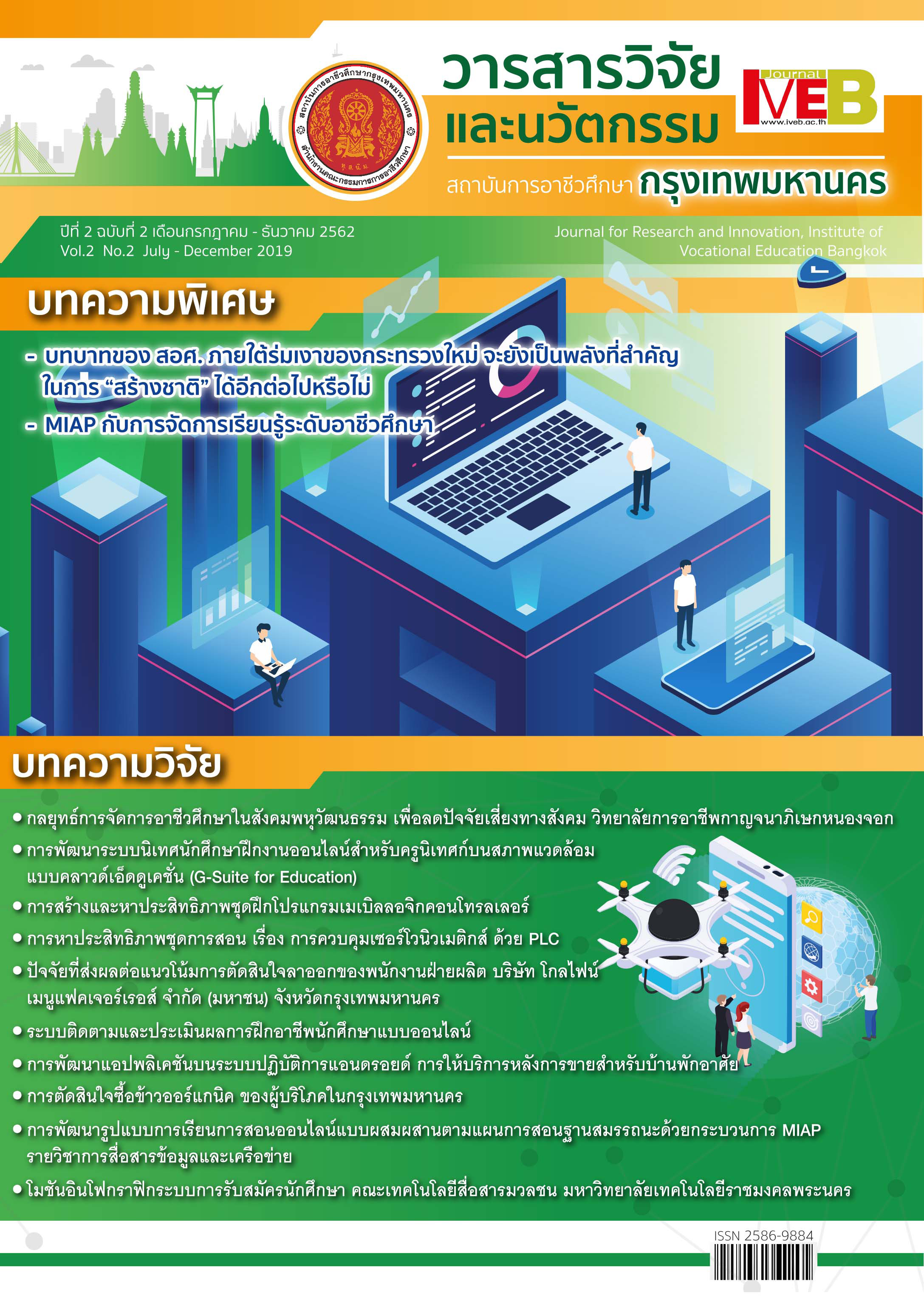
The Management Strategies of Vocational Education in a Multi-Cultural Society to Reduce Social Risk Factors, Kanchanaphisek Nong Chok Industrial and Community Education College
Article Sidebar
Main Article Content
Abstract
The purposes of the research were (1) to study the circumstances of vocational education management in multi-cultural society in order to reduce risk factors in Kanchanaphisek Nong Chok Industrial and Community Education College, and (2) to create a strategy on vocational education management in multi-cultural society in order to reduce risk factors in Kanchanaphisek Nong Chok Industrial and Community Education College. In this study, the researcher used mixed methods of quantitative research and qualitative research. The sample used for quantitative data collection was comprised of 63 administrators, teachers, and entrepreneurs obtained by purposive sampling. The research instrument for data collection was a questionnaire. The statistics used for data analysis included percentage, mean, and standard deviation. On the other hand, the research instrument used for qualitative data was a focus group. The collected data was analyzed by means of content analysis. After that, the researcher created a strategy and used Delphi technique for the approval of the strategy.
The research results were as followed:
1. Circumstances in Kanchanaphisek Nong Chok Industrial and Community Education College were not satisfactory since the college lacked integrated learning management
aiming to help students in problem solving and in application of knowledge in their future careers. Apart from that, learning and teaching activities lacked the promotion of morality
and desirable characteristics in the aspect of love and unity, leadership, forgiving, and sacrificing. In addition, the students lacked the use of appropriate and positive communication
skills and, consequently, could not solve conflicts.
2. The strategy on vocational education management in multi-cultural society in order to reduce risk factors in Kanchanaphisek Nong Chok Industrial and Community Education College was comprised of 4 minor strategies, namely: (1) the strategy on collaboration of all related parties, (2) the strategy on students value increasing, (3) the strategy on learning management, and, (4) the strategy on the creation of environment in which the students could learn efficiently and happily. The main strategy and its 4 minor strategies were approved by experts as an appropriate and applicable one.
Article Details
References
[2] ฝ่ายพัฒนากิจการนักเรียนนักศึกษา. (2557) สรุปผลการสำารวจพฤติกรรมเสี่ยงของผู้เรียนวิทยาลัยการอาชีพกาญจนาภิเกษกหนองจอก ปีการศึกษา 2557. มปพ.
[3] ชลัยพร อมรวัฒนา. (2551). โครงการศึกษาวิจัยนวัตกรรมทางสังคมเพื่อการพัฒนาเมืองและชนบทที่ยั่งยืน. กรุงเทพฯ: สำานักงานคณะกรรมการวิจัยแห่งชาติ.
[4] ปรัชญา กมลเพชร. (2558). ปัจจัยในการสร้างแรงจูงใจในการเรียนของนักเรียนเตรียมทหารสังกัดกระทรวงกลาโหม. วิทยานิพนธ์ศึกษาศาสตร์มหาบัณฑิต สาขาวิชาบริหารการศึกษาบัณฑิต วิทยาลัย มหาวิทยาลัยรังสิต.
[5] สุริยะ พุ่มเฉลิม. (2558). การพัฒนารูปแบบระบบสารสนเทศเพื่อจัดการการศึกษาแบบบูรณาการการเรียนการทำางานของสถาบันอุดมศึกษาเอกชนในประเทศไทย. วารสารวิชาการมหาวิทยาลัยฟาร์อีสเทอร์น, 9 (2-4), 76-78.
[6] สานิลักษณ์ พรหมฮวด. (2558). แนวทางพัฒนาการจัดสภาพแวดล้อมที่เอื้อต่อการเรียนรู้ของสถานศึกษาที่ต้องการพัฒนา สำานักงานเขตพื้นที่การศึกษากำาแพงเพชร เขต 2. วิทยานิพนธ์ครุศาสตร์มหาบัณฑิต บัณฑิตวิทยาลัย. มหาวิทยาลัยราชภัฏกำาแพงเพชร.
