
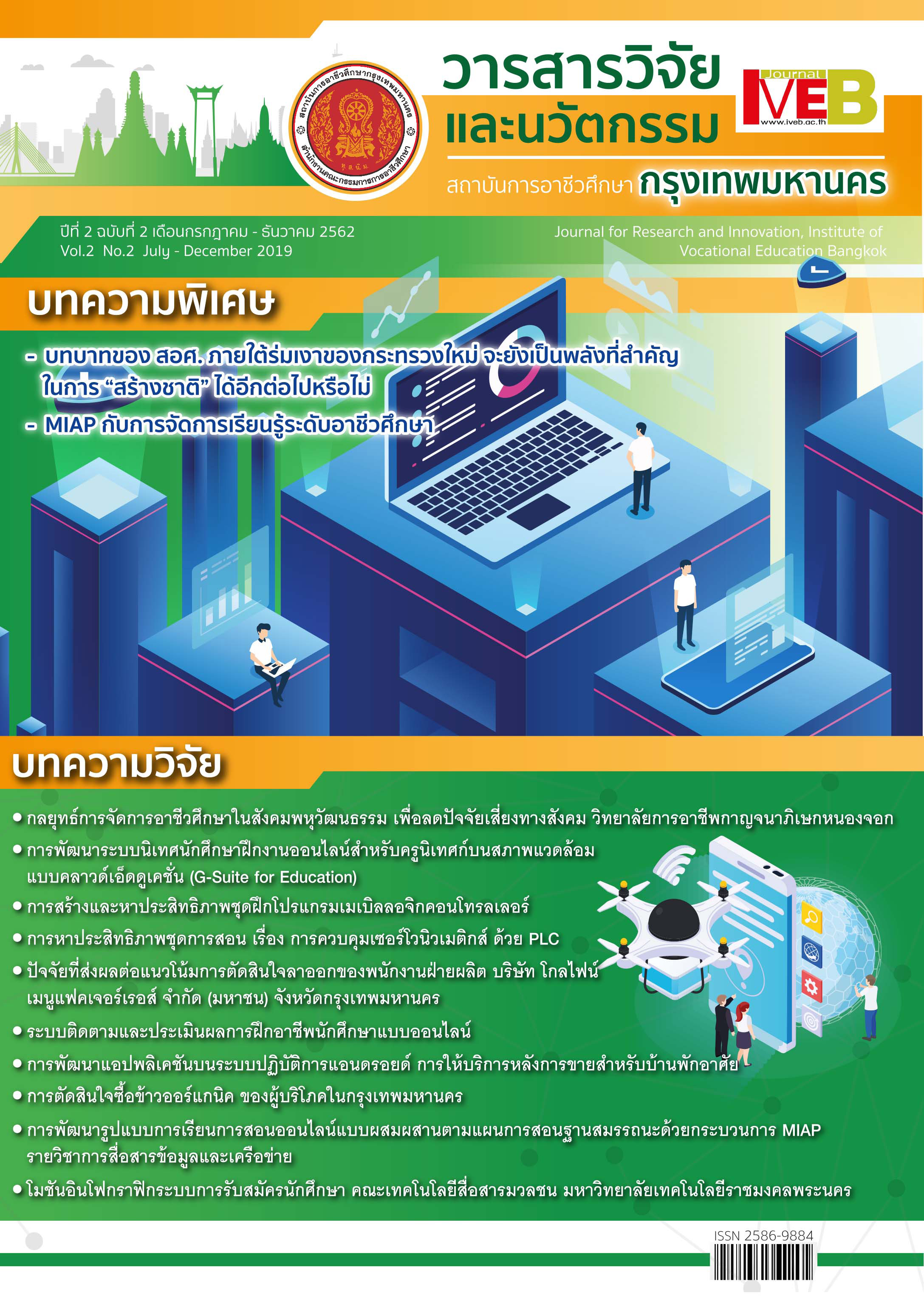
The Development of Blended Learning Model on Competency-Based Lesson Plan by Using MIAP Process for Data Communication and Network Course
Article Sidebar
Main Article Content
Abstract
The purposes of this research were 1) to develop blended learning model based on competency plan by using MIAP process of High Vocational Certificate students, 2) to evaluate if the learning model meets Meguigans efficiency criterion, 3) to compare learning achievements of learners before and after studying by the developed learning model; and, 4) to study satisfaction of the students. The sample group of study were 28 first-year High Vocational Certificate who registered in the second semester of academic year 2018, major in Business Computer at Nakhon Pathom Vocational College. The research tools included the competency lesson plan blended with Data Communication and Network course, learning
management system Schoology, a quality assessment of contents, teaching and learning methods on the web and a questionnaire of satisfaction. Applied statistic tools included mean
(X –), standard deviation (S.D.) ,Meguigans efficiency value and t-test. Research findings showed that 1) the evaluation of designed learning pattern was matched at high level, 2) the efficiency of developed learning model was at 1.44 which higher than the Meguigans’s standard value at 1.00, 3) post-test learning achievement was statistically significant higher than pre-test at .05; and, 4) there were satisfied with learning model in high level.
Article Details
References
ชวลิต โพธิ์นคร. (2560). การศึกษาไทยในยุคไทยแลนด์ 4.0. สืบค้นจาก https://km.li.m a h i d o l . a c . t h / t h a i - s t u d i e s - i n -thailand-4-0/
ปรัชญนันท์ นิลสุข และปณิตา วรรณพิรุณ.(2556). การจัดการเรียนรู้แบบผสมผสาน :สัดส่วนการผสมผสาน. วารสารพัฒนาเทคนิคศึกษา, 25 (85), 31-36.
TeachThought Staff. (2018). Find The Model That Works For You: 12 Types Of Blended Learning. สืบค้นจาก https://www.teachthought.com/ learning/12-types-ofblended-learning/
ภาสกร เรืองรอง,รุจโรจน์ แก้วอุไร,วินัย ปานโท้, ยุทธนา พันธ์มี, วสันต์ ศรีหิรัญ,พันธุ์ทิพย์ ลิมปะพันธุ์, รัตนาภรณ์ ลอสวัสดิ์ และเพ็ญภรณ์ เหลี่ยวเจริญวัฒน์. (2557). “Blended Learning กับการพัฒนาคุณภาพการศึกษาไทยในศตวรรษที่ 21” สืบค้นจาก http://nueducation2556. blogspot.com/2014/02/blendedlearning-21.html /
Asif Irshad Khan, Noor-ul-Qayyum, Mahaboob Sharief Shaik, Abdullah Maresh Ali, & Ch. Vijaya Bebi. (2012). Study of Blended Learning Process in Education Context. I.J.Modern Education and Computer Science, 2012, 9, 23-29. Retrieved from http://www.mecs-press. org/)DOI: 10.5815/ijmecs. 2012.09.03
ถนอมพร เลาหจรัสแสง. (2545). Design e-learning หลักการออกแบบและการสร้างเว็บเพื่อการเรียนการสอน. กรุงเทพมหานคร: อรุณการพิมพ์.
สุริยาวุธ เสาวคนธ์ และโกเมศ กาบแก้ว. (2561) การศึกษาผลการเรียนรู้วิชาการวิเคราะห์ไฟฟ้า 1 เรื่องพื้นฐานวงจรไฟฟ้าของผู้เรียนที่เรียนด้วยกระบวนการเรียนรู้แบบ MIAP. การประชุมวิชาการระดับชาติ ครั้งที่ 6 ราชภัฎหมู่บ้านจอมบึงวิจัย, 1 มีนาคม 2561. หน้า 676-686.
Jon Ord. (2012). John Dewey and Experiential Learning: Developing the theory of youth work. Retrieved from https://www.researchgate.net/publication/270338098_John_Dewey_and_Experiential_Learning_Devel oping_the_theory_of_youth_work
เพ็ญพร ใจเย็น และธันว์รัชต์ สินธนะกุล. (2556) การพัฒนาบทเรียนคอมพิวเตอร์ช่วยสอนบนระบบเครือข่ายอินเทอร์เน็ตแบบสาธิตเรื่องหนังสือราชการประเภทต่าง ๆ วิชาโปรแกรมประมวลผลคำาประยุกต์. วารสารวิชาการและวิจัย มทร.พระนคร, ฉบับพิเศษ, 32-44.
เกรียงวุธ นีละคุปต์. (2559). การพัฒนารูปแบบการออกแบบระบบการจัดการเรียนรู้แบบอีเลิร์นนิงโดยใช้ส่วนประสมการตลาด. ปริญญานิพนธ์การศึกษาดุษฎีบัณฑิต สาขาวิชาเทคโนโลยีเทคนิคศึกษา ภาควิชาครุศาสตร์
เทคโนโลยี บัณฑิตวิทยาลัย มหาวิทยาลัยเทคโนโลยีพระจอมเกล้าพระนครเหนือ.
