
Thai The Development of Student Care System Using the Participatory Management at Rajasitharam Technical College
Article Sidebar
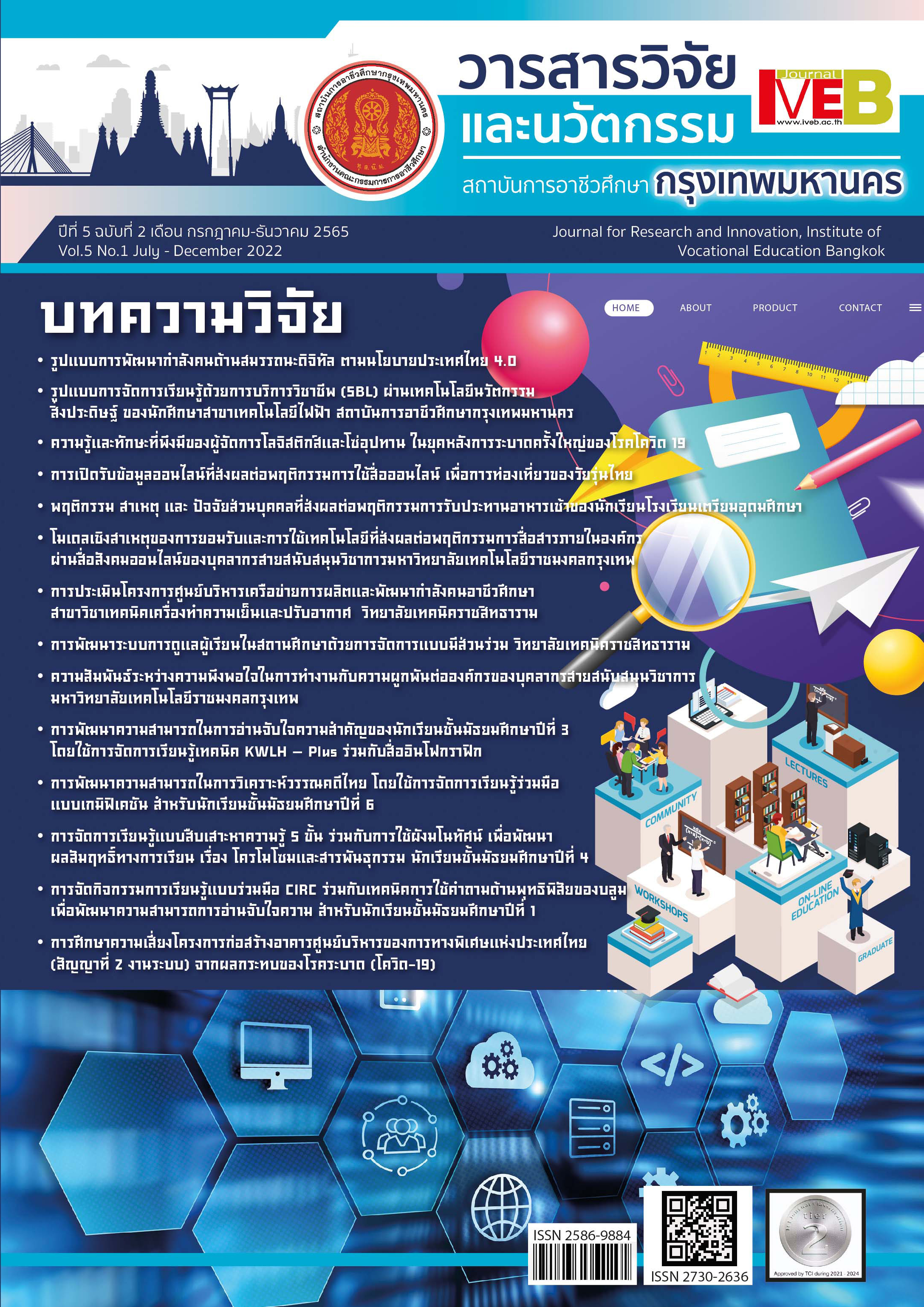
Main Article Content
Abstract
The objectives of the research were 1) to investigate the conditions of the problems on student care system in the college using the participatory management at Rajasitharam Technical College; and, to develop and find out the suitability of the manual of student care system in the college using the participatory management at Rajasitharam Technical College student care system in the college using the participatory management at Rajasitharam Technical College. The 19 samples were drawn from administrators, teachers, workplaces, police, communities, parents, alumni, and high-risk students by using the purposive sampling. The statistics used included the percentage, the mean, and the standard deviation (S.D.). The content analysis was used for the interview and were divided into 3 aspects: social and environment aspect, teenager behavior aspect, and, family status aspect.
The findings were as follows:
- Concerning the opinions towards the current condition and student quarrel, it was found that in overall it was at the high level (= 4.07). When considering each aspect, it was found that all the three aspects were at the high level respectively as follows: social and environment aspect (= 4.35), teenager behavior aspect (= 4.13), and, family status aspect (= 3.72).
- Towards the suitability of the manual develop, it was at the most level (= 4.67) in which it could be used as a student care system in the college.
Article Details

This work is licensed under a Creative Commons Attribution-NonCommercial-NoDerivatives 4.0 International License.
References
พระราชบัญญัติการอาชีวศึกษา พ.ศ.2551. (2551,มีนาคม 5). ราชกิจจานุเบกษา,125 (43 ก), 1-24.
สำนักงานเลขาธิการสภาการศึกษา. (2558). เส้นทางการศึกษาด้านอาชีวศึกษาและเทคโนโลยี. กรุงเทพมหานคร : สำนักงานเลขาธิการสภาการศึกษา กระทรวงศึกษาธิการ.
เสถียร อุตวัต. (2560). ปัญหาการทะเลาะวิวาทนักเรียนนักศึกษาอาชีวศึกษา. [สืบค้นเมื่อวันที่ 8 ธันวาคม 2563]. จาก https://www.gotoknow.org/ posts/566591.
สุเทพ ชิตยะวงศ์. (2560). ยกระดับการเฝ้าระวัง ป้องกันและแก้ไขปัญหาการก่อเหตุทะเลาะวิวาทนักเรียนนักศึกษาอาชีวศึกษา. [สืบค้นเมื่อวันที่15 มีนาคม 2564]. จาก http://www.vec.go.th/A7/tabid/103/ArticleId/15849 /language/enUS/Default.aspx.
Likert, Rensis. (1967). “The Method of Constructing and Attitude Scale”, Fishbeic, Matin, Ed. New York : Wiley & Son.
บุญชม ศรีสะอาด. (2556). วิธีการทางสถิติสำหรับการวิจัย เล่ม 1 (พิมพ์ครั้งที่ 5). กรุงทพมหานคร : สุวีริยาสาส์น.
อุดม บุตตะ. (2558). การศึกษาปัญหาและแนวทางแก้ไขการทะเลาะวิวาทของนักเรียนอาชีวศึกษาเขตบางกะปิกรุงเทพมหานคร : สถาบันพัฒนาครู คณาจารย์และบุคลากรทางการศึกษา สำนักงานปลัดกระทรวงศึกษาธิการกระทรวงศึกษาธิการ.
ปกรณ์ มณีปกรณ์. (2554). ปัจจัยด้านครอบครัวที่นำไปสู่การใช้หรือไม่ใช้ยาเสพติดของวัยรุ่นในเขตจังหวัดชลบุรี. ชลบุรี : คณะรัฐศาสตร์และนิติศาสตร์ มหาวิทยาลัยบูรพา.
สำนักงานปลัดกระทรวงศึกษาธิการ. (2547). รายงานผลการปฏิบัติงานออกตรวจดูแลป้องกันการทะเลาะวิวาทของนักเรียน นักศึกษา ในเขตกรุงเทพมหานครและปริมณฑล. กรุงเทพมหานคร : สำนักงานปลัดกระทรวงศึกษาธิการ.
