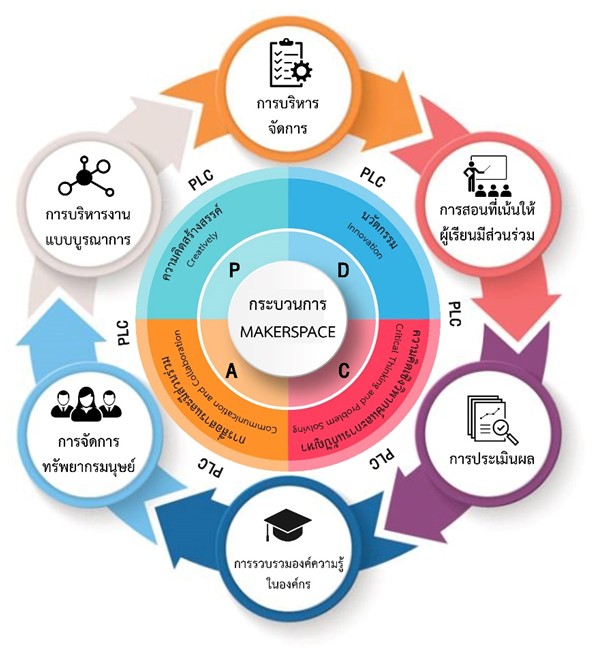
นวัตกรรมการบริหารสถานศึกษาผ่านกระบวนการ Makerspace
คำสำคัญ:
นวัตกรรมการบริหารสถานศึกษา, กระบวนการ Makerspaceบทคัดย่อ
บทความวิชาการนี้นำเสนอเกี่ยวกับกระบวนการ Makerspace หรือพื้นที่ส่งเสริมการเรียนรู้ ซึ่งถือเป็นเรื่องค่อนข้างใหม่และเป็นปรากฎการณ์ที่สำคัญที่นำไปสู่การพัฒนาการบริหารสถานศึกษาให้เป็นนวัตกรรมด้วยการเพิ่มประสิทธิภาพการบริหารจัดการสถานศึกษาภายใต้ระบบคุณภาพ PDCA (Plan-Do-Check-Act) ซึ่งมีองค์ประกอบของการเพิ่มประสิทธิภาพการบริหารจัดการสถานศึกษา คือ การบริหารจัดการ การสอนที่เน้นให้ผู้เรียนมีส่วนร่วม การประเมินผล การรวบรวมองค์ความรู้ที่มีอยู่ในองค์กร การจัดการทรัพยากรมนุษย์ และการบริหารงานแบบบูรณาการในการจัดพื้นที่ส่งเสริมการเรียนรู้ ร่วมกันผลิตนวัตกรรมใหม่ เป็นนวัตกรรมการศึกษาซึ่งมุ่งให้ผู้เรียนสร้างความรู้ได้ด้วยตนเอง เป็นการส่งเสริมทักษะนวัตกรรมของผู้เรียน 3 ด้าน คือ ด้านความคิดสร้างสรรค์และนวัตกรรม ด้านความคิดเชิงวิพากษ์และการแก้ไขปัญหา และด้านการสื่อสารและการมีส่วนร่วม เพื่อมุ่งหวังการเรียนรู้ด้วยการลงมือทำและแนวคิดการเรียนรู้ที่มีนักเรียนเป็นศูนย์กลาง ส่งเสริมให้ผู้เรียนได้พัฒนาทักษะนวัตกรรม พัฒนาทักษะการสื่อสาร และการมีส่วนร่วมในการทำงาน รวมถึงการจัดการเรียนรู้ของครูในรูปแบบใหม่ที่เป็นผู้อำนวยความสะดวกในการเรียนรู้ ซึ่งเป็นนวัตกรรมในการบริหารสถานศึกษาผ่านกระบวนการ Makerspace
เอกสารอ้างอิง
กฤษดาพร นทีนันทน์. (2564). การเพิ่มประสิทธิภาพการบริหารจัดการสถานศึกษาภายใต้ระบบคุณภาพ PDCA. เข้าถึงได้จาก https://www.kroobannok.com>news_file
คัทลียา วิเลปะนะ. (2565). แนวทางการพัฒนาพื้นที่ส่งเสริมการเรียนรู้ (Makerspace) เพื่อพัฒนาทักษะนวัตกรรมของผู้เรียน. เข้าถึงได้จาก https://ir.swu.ac.th/jspui/handle/123456789/27984
สมพงค์ พรมสะอาด, อภินันท์ เอื้ออังกูร และสานิตย์ ศรีชูเกียรติ. (2564). การจัดการแหล่งเรียนรู้เพื่อการสร้างสรรค์สำหรับการสร้างนวัตกรรมและผู้ประกอบการ. สงขลา: สำนักงานสภานโยบายการอุดมศึกษาวิทยาศาสตร์ วิจัยและนวัตกรรมแห่งชาติ โดยมหาวิทยาลัยทักษิณ.
สำนักงานเลขาธิการสภาการศึกษา กระทรวงศึกษาธิการ. (2564). นวัตกรรมการบริหารจัดการสถานศึกษาในประเทศไทยและประเทศที่คัดสรรเพื่อพัฒนาผู้เรียนสู่ศตวรรษที่ 21. กรุงเทพฯ: 21 เซ็นจูรี่ จำกัด.
สุวิมล โพธิ์กลิ่น. (2564). นวัตกรรมการบริหารสถานศึกษายุคใหม่. วารสาร มจร.อุบลปริทรรศน์, 6(3), 975-984.
Becker A. S., et al. (2016). NMC/CoSN Horizon Report: 2016 K-12 Edition. Austin, Texas: The New Media Consortium.
Han S. Y., et al. (2016). Understanding makerspace continuance A self-determination perspective. Telematics and Information, 34(2017), 184-195.
Niaros, V., Kostakis, V., & Drechsler, W. (2017). Making (in) the smart city: The emergence of makerspaces. Telematics and Informatics, 34(7), 1143-1152.
Oliver, K. M. (2016). Professional development considerations for makerspace leaders, part one: Addressing “what?” and “why?”. Tech Trends, 60(3), 211-217.
Peterson, R. E., et al. (2017). The genetic architecture of major depressive disorder in Han Chinese women. JAMA psychiatry, 74(2), 162-168.
Starfish Labz. (2024). ทักษะการเป็นผู้บริหารผ่านกระบวนการ Makerspace. เข้าถึงได้จาก https://www.starfishlabz.com/blog/1351
TDRI. (2023). สถาบันวิจัยเพื่อการพัฒนาประเทศไทย (ทีดีอาร์ไอ). เข้าถึงได้จาก https://tdri.or.th>wp-content>uplodes>2023/11
The KOMMON. (2021). เมกเกอร์สเปซเพื่อการศึกษาพื้นที่เรียนรู้เพื่อการค้นพบตัวเอง. เข้าถึงได้จาก https://www.thekommon.co/makerspace-for-education/