
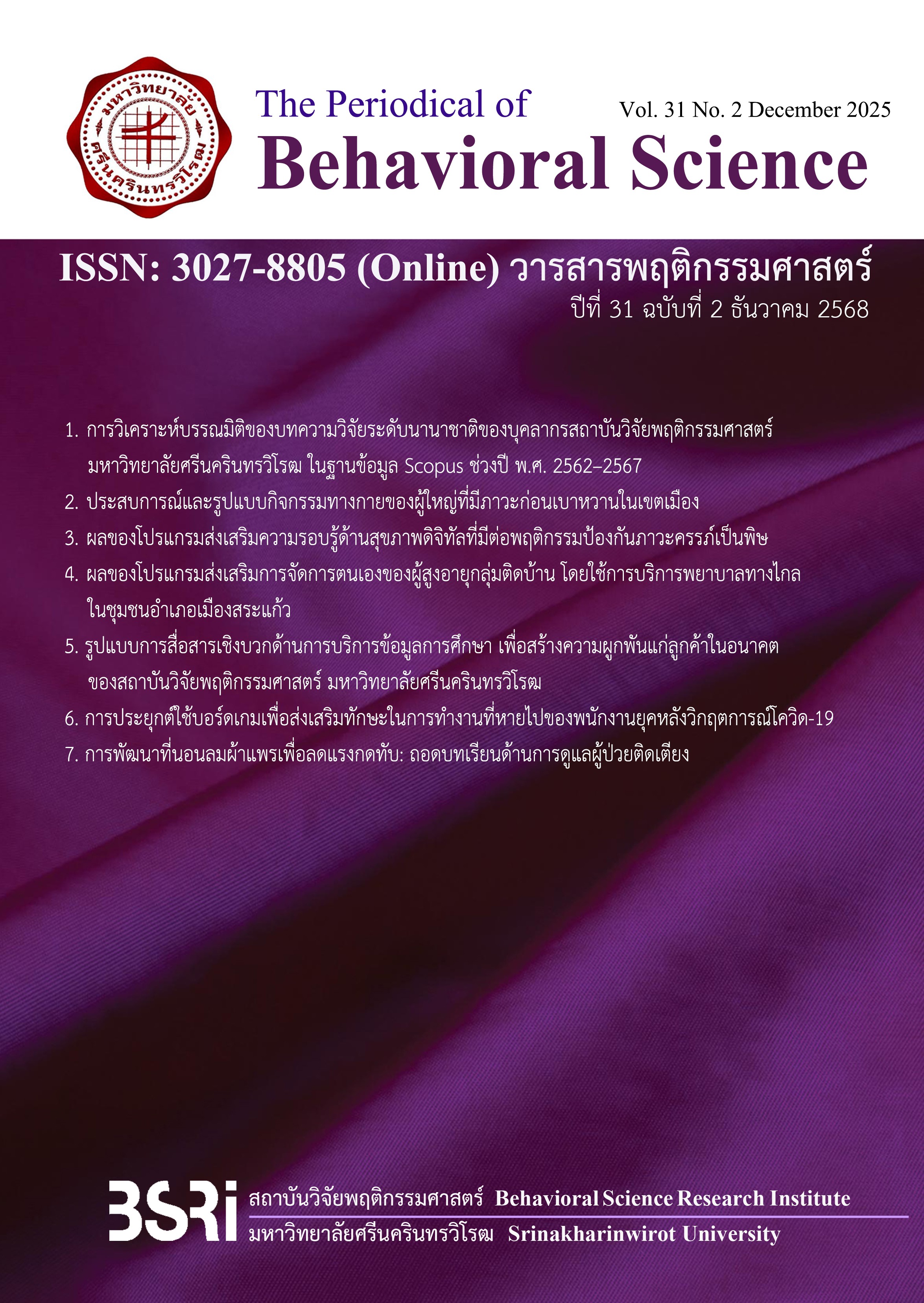
A Bibliometric Analysis of International Research Publications by Academic Staff of the Behavioral Science Research Institute, Srinakharinwirot University in Scopus (2019–2024)
Keywords:
Bibliometric analysis, Scopus, SciVal, International articlesAbstract
The objective of this study was to analyze internationally published research articles indexed in the Scopus database between 2019 and 2024, authored by the academic staff at the Behavioral Science Research Institute (BSRI), Srinakharinwirot University. A total of 92 articles were included in the analysis, which examined the subject areas of the publications, the journals in which they were published, journal quality based on quartile rankings, the extent of national and international research collaborations, and citation metrics based on data retrieved from Scopus and SciVal. The analysis revealed that the majority of publications (40 articles) were classified under the subject area of social sciences. Most articles were published in Quartile 2 ranked journals, with 30 articles (34.48%) meeting this quality criterion. Regarding research collaboration, 20 articles (21.74%) involved international co-authors, with 12 of these involving collaborators from six Asian countries. National collaborations accounted for 33 articles (35.87%). In terms of citation impact, 48 articles had been cited, with a total of 216 citations in Scopus. The most frequently cited topic clusters were “Social Media,” “Health Literacy,” and “COVID-19,” with a Prominence Percentile of 88.489, reflecting high visibility and recognition in the international research landscape. The study findings reflect key policy recommendations: the fact that most publications are in Q2 journals represents a strength of the institution that should be promoted and maintained. In contrast, the relatively low level of international collaboration highlights an opportunity to enhance the institution’s capacity for global academic cooperation. This insight can inform the development of concrete institutional policies or initiatives aimed at improving the quality and advancement of future research output.
Downloads
References
Behavioral Science Research Institute. (2024). Annual report 2024. https://drive.google.com/file/d/1r2YA8ldtMct23d5PiE9HSvLP15bM8HVa/view [in Thai]
Bornmann, L., Ye, A., & Ye, F. (2018). Identifying landmark publications in the long run using field-normalized citation data. Journal of Documentation, 74(2), 278–288. https://doi.org/10.1108/JD-07-2017-0108
Brase, G. L. (2014). Behavioral science integration: A practical framework of multi-level converging evidence for behavioral science theories. New Ideas in Psychology, 33, 8–20. https://doi.org/10.1016/j.newideapsych.2013.11.001
ElseVier. (2024, August 15). What is field-weighted citation impact (FWCI)?. https://service.elsevier.com/app/answers/detail/a_id/14894/supporthub/scopus/~/what-is-field-weighted-citation-impact-%28fwci%29%3F/
Gazni, A., Sugimoto, C. R., & Didegah, F. (2012). Mapping world scientific collaboration: Authors, institutions, and countries. Journal of the American Society for Information Science and Technology, 63(2), 323–335. https://doi.org/10.1002/asi.21688
Getahun, D. A., Hammad, W., & Robinson-Pant, A. (2021). Academic writing for publication: Putting the ‘international’ into context. Research in Comparative and International Education, 16(2), 160–180. https://doi.org/10.1177/17454999211009346
Glanz, K., & Bishop, D. B. (2010). The role of behavioral science theory in development and implementation of public health interventions. Annual Review of Public Health, 31, 399–418. https://doi.org/10.1146/annurev.publhealth.012809.103604
Hanisch, S., & Eirdosh, D. (2023). Behavioral science and education for sustainable development: Towards metacognitive competency. Sustainability, 15(9), 7413. https://doi.org/10.3390/su15097413
Linnenluecke, M. K., Marrone, M., & Singh, A. K. (2019). Conducting systematic literature reviews and bibliometric analyses. Australian Journal of Management, 45(2), 175–194. https://doi.org/10.1177/0312896219877678
Newton, C. R. (2020). Research and open access from low- and middle-income countries. Developmental Medicine and Child Neurology, 62(5), 537. https://doi.org/10.1111/dmcn.14513
Ruggeri, K., Stock, F., Haslam, S. A., Capraro, V., Boggio, P., Ellemers, N., Cichocka, A., Douglas, K. M., Rand, D. G., van der Linden, S., Cikara, M., Finkel, E. J., Druckman, J. N., Wohl, M. J. A., Petty, R. E., Tucker, J. A., Shariff, A., Gelfand, M., Packer, D., Jetten, J., … Willer, R. (2024). A synthesis of evidence for policy from behavioural science during COVID-19. Nature, 625(7993), 134–147. https://doi.org/10.1038/s41586-023-06840-9
Purkayastha, A., Palmaro, E., Falk-Krzesinski, H. J., & Baas, J. (2019). Comparison of two article-level, field-independent citation metrics: Field-weighted citation impact (FWCI) and relative citation ratio (RCR). Journal of Informetrics, 13(2), 635–642. https://doi.org/10.1016/j.joi.2019.03.012
Salager-Meyer, F. (2008). Scientific publishing in developing countries: Challenges for the future. Journal of English for Academic Purposes, 7(2), 121–132. https://doi.org/10.1016/j.jeap.2008.03.009
Srinakharinwirot University. (2023). Action plan for the fiscal Years (B.E. 2566–2570). Srinakharinwirot University. https://www.swu.ac.th/information/plan/SWU_Action_plan2023_2027.pdf
Waltman, L., & van Eck, N. J. (2015). Field-normalized citation impact indicators and the choice of an appropriate counting method. Journal of Informetrics, 9(4), 872–894. https://doi.org/10.1016/j.joi.2015.08.001
Wattanasiri, P., & Chansanam, W. (2024). An analysis research output on global library and information science: A bibliometric and altmetric analysis. Journal of the Thai Library Association, 17(1), 76–92. https://so06.tci-thaijo.org/index.php/tla_research/article/view/271281 [in Thai]
Downloads
Published
How to Cite
Issue
Section
License
Copyright (c) 2025 The Periodical of Behavioral Science

This work is licensed under a Creative Commons Attribution-NonCommercial-NoDerivatives 4.0 International License.
Behavioral Science Research Institute, SWU
114 Sukhumvit 23, Bangkok 10110, Thailand.
Tel.02-649-5000 # 17600


