
ปัจจัยที่มีอิทธิพลต่อพฤติกรรมการป้องกันโรคหลอดเลือดสมองในผู้ป่วยความดันโลหิตสูง ตำบลข้าวเม่า จังหวัดพระนครศรีอยุธยา
Article Sidebar
Main Article Content
บทคัดย่อ
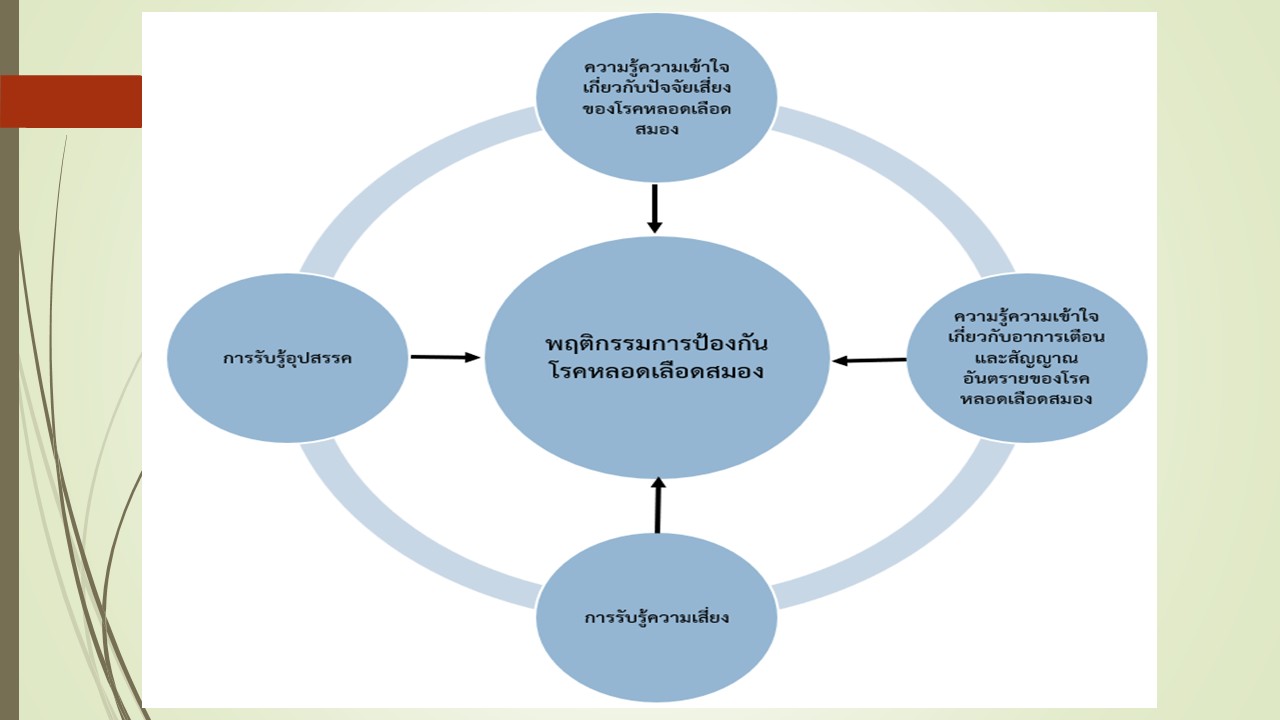
การวิจัยครั้งนี้เป็นการวิจัยเชิงปริมาณ (Quantitative Research) เพื่อศึกษาปัจจัยที่มีอิทธิพลต่อพฤติกรรมการป้องโรคหลอดเลือดสมองในผู้ป่วยความดันโลหิตสูง ตำบลข้าวเม่า จังหวัดพระนครศรีอยุธยา โดยอิงกรอบแนวคิด Health Belief Model (HBM) กลุ่มตัวอย่างคือผู้ป่วยโรคความดันโลหิตสูงอายุ 35 ปีขึ้นไป ที่ขึ้นทะเบียนในโรงพยาบาลส่งเสริมสุขภาพตำบลข้าวเม่า จังหวัดพระนครศรีอยุธยา จำนวน 260 คน เครื่องมือที่ใช้คือแบบสอบถาม ค่า IOC ระหว่าง 0.67–1.00 และทดสอบความเชื่อมั่นด้วย Cronbach’s Alpha เท่ากับ 0.89 การวิเคราะห์ข้อมูลใช้ด้วยสถิติเชิงพรรณนา ได้แก่ ความถี่ ร้อยละ ค่าเฉลี่ย ส่วนเบี่ยงเบนมาตรฐาน และสถิติเชิงอนุมานได้แก่ การวิเคราะห์ถดถอยเชิงพหุ ผลการวิจัยพบว่า ระดับความรู้เกี่ยวกับโรคหลอดเลือดสมอง การรับรู้ด้านสุขภาพ และพฤติกรรมการป้องกันอยู่ในระดับมากทุกด้าน โดยเฉพาะการควบคุมอาหาร การออกกำลังกาย และการรับประทานยาอย่างสม่ำเสมอ ผลการวิเคราะห์ปัจจัยที่มีอิทธิพลต่อพฤติกรรมการป้องกันโรคหลอดเลือดสมองในผู้ป่วยโรคความดันโลหิตสูง ตำบลข้าวเม่า จังหวัดพระนครศรีอยุธยา พบว่า ตัวแปรที่มีอิทธิพลเชิงบวกและมีนัยสำคัญทางสถิติ ได้แก่ (1) ความรู้ความเข้าใจเกี่ยวกับปัจจัยเสี่ยงของโรคหลอดเลือดสมอง (B = .171, p = .004) (2) ความรู้ความเข้าใจเกี่ยวกับอาการเตือนและสัญญาณอันตรายของโรคหลอดเลือดสมอง (B = .128, p = .007) (3) การรับรู้ความเสี่ยง (B = .070, p = .018) และ (4) การรับรู้อุปสรรค (B = .135, p < .001) แสดงให้เห็นว่าผู้ที่มีความรู้เกี่ยวกับโรคมากขึ้น รวมทั้งตระหนักถึงความเสี่ยงและอุปสรรคในการป้องกันโรค จะมีแนวโน้มแสดงพฤติกรรมการป้องกันโรคได้ดีกว่าผู้ที่มีความรู้และการรับรู้น้อยกว่า
คำสำคัญ: พฤติกรรมการป้องโรค, โรคหลอดเลือดสมอง, ความดันโลหิตสูง
Article Details

อนุญาตภายใต้เงื่อนไข Creative Commons Attribution-NonCommercial-NoDerivatives 4.0 International License.
เอกสารอ้างอิง
จตุพงษ์ พันธ์วิไล, และ นิรมัย มณีรัตน์. (2565). ความสัมพันธ์ระหว่างความรู้ ความเชื่อด้านสุขภาพ และ พฤติกรรมการป้องกันการเกิดโรคหลอดเลือดสมองในผู้สูงอายุที่มีภาวะเสี่ยง. วารสารศูนย์อนามัยที่ 9 นครราชสีมา, 16(3), 882–895. สืบค้นจาก https://he02.tci- thaijo.org/index.php/RHPC9Journal/article/download/258882/176938
ภาสิกา กิมหงษ์. (2566). ผลของโปรแกรมดูแลผู้ป่วยโรคหลอดเลือดสมองระยะเปลี่ยนผ่านต่อความพร้อมและ ภาระในการดูแลของญาติผู้ดูแล [วิทยานิพนธ์ปริญญาพยาบาลศาสตรมหาบัณฑิต, วิทยาลัยพยาบาล บรมราชชนนี นพรัตน์วชิระ].
Aekplakorn, W., Chariyalertsak, S., Kessomboon, P., et al. (2024). Trends in hypertension prevalence, awareness, treatment, and control in the Thai population, 2004 to 2020. BMC Public Health, 24, 3149. https://doi.org/10.1186/s12889-024-20643-1
Department of Disease Control. (2566). สถานการณ์โรคหลอดเลือดสมองในประเทศไทย ปี 2566. สืบค้นจาก https://www.hfocus.org/content/2023/10/28741
Ellis, C., Breland, H. L., & Egede, L. E. (2017). Knowledge and beliefs about stroke among African Americans: Results from the REACH US Risk Factor Survey. Journal of Stroke and Cerebrovascular Diseases, 26(5), 1043–1050. https://doi.org/10.1016/j.jstrokecerebrovasdis.2016.12.006
Gochman, D. S. (1982). Labels, systems, and motives: Some perspectives for future research and programs. Health Education Quarterly, 9(2-3), 263–270. https://doi.org/10.1177/109019818200900213
Green lW, Kreuter MW. (2005). Health program planning: An educational and ecological approach. 4th ed. New York: Emily Barrosse.
Juhong, J., Kim, H., & Lee, S. (2022). Effectiveness of an online educational video intervention to improve knowledge and change health behaviors. Heliyon, 8(10), e11276. https://doi.org/10.1016/j.heliyon.2022.e11276
Khomkham, P., Tiyapongpattana, W., & Tiyapongpattana, C. (2024). Effectiveness of the Protection Motivation Theory-based education program on knowledge, motivation, and preventive behaviors among persons at risk for stroke. Princess of Naradhiwas University Journal of Nursing and Health Sciences, 15(2), 45–59. สืบค้นจาก https://he02.tci-thaijo.org/index.php/PRIJNR/article/download/264945/181809
Mackenzie, A. E., Perry, L., Lockhart, E., Cottee, M., Cloud, G., & Mann, H. (2011). Family carers of stroke survivors: Needs, knowledge, satisfaction and competence in caring. Disability and Rehabilitation, 33(2), 106–116. https://doi.org/10.3109/09638288.2010.488711
Panwilai, J., Fongkaew, W., Soiwong, P., & Chaiard, J. (2022). Family caregivers’ perceptions regarding stroke prevention for family members at risk: A qualitative study. Princess of Naradhiwas University Journal of Nursing and Health Sciences, 14(2), 63–78. สืบค้น จาก https://he02.tci-thaijo.org/index.php/PRIJNR/article/download/255278/173428
Pitchalard, K., Moonpanane, K., Wimolphan, P., Singkhorn, O., & Wongsuraprakit, S. (2022). Implementation and evaluation of the peer-training program for village health volunteers to improve chronic disease management among older adults in rural Thailand. International Journal of Nursing Sciences, 9(3), 328–333. https://doi.org/10.1016/j.ijnss.2022.06.011
Sakurai, K., Tokuda, Y., Takahashi, O., Ohde, S., & Shimbo, T. (2014). Knowledge of stroke symptoms and risk factors among adults in Japan: A national survey. Journal of Stroke and Cerebrovascular Diseases, 23(5), 1041–1049. https://doi.org/10.1016/j.jstrokecerebrovasdis.2013.08.015
Stretcher, V. J., & Rosenstock, I. M. (1997). The Health Belief Model. In K. Glanz, F. M. Lewis, & B.K. Rimer (Eds). Health behavior and health education: Theory, research, and practice (2nd ed., pp.41-59). SanFrancisco, CA: Jossey-Bass.
Walsh, S., & Bruce, J. (2023). Health Belief Model of Behavior Change. In StatPearls. StatPearls Publishing. Retrieved from https://www.ncbi.nlm.nih.gov/books/NBK606120/
