
Factors Influencing Stroke Prevention Behaviors in Hypertensive Patients in Khao Mao Subdistrict, Phra Nakhon Si Ayutthaya Province
Article Sidebar
Main Article Content
Abstract
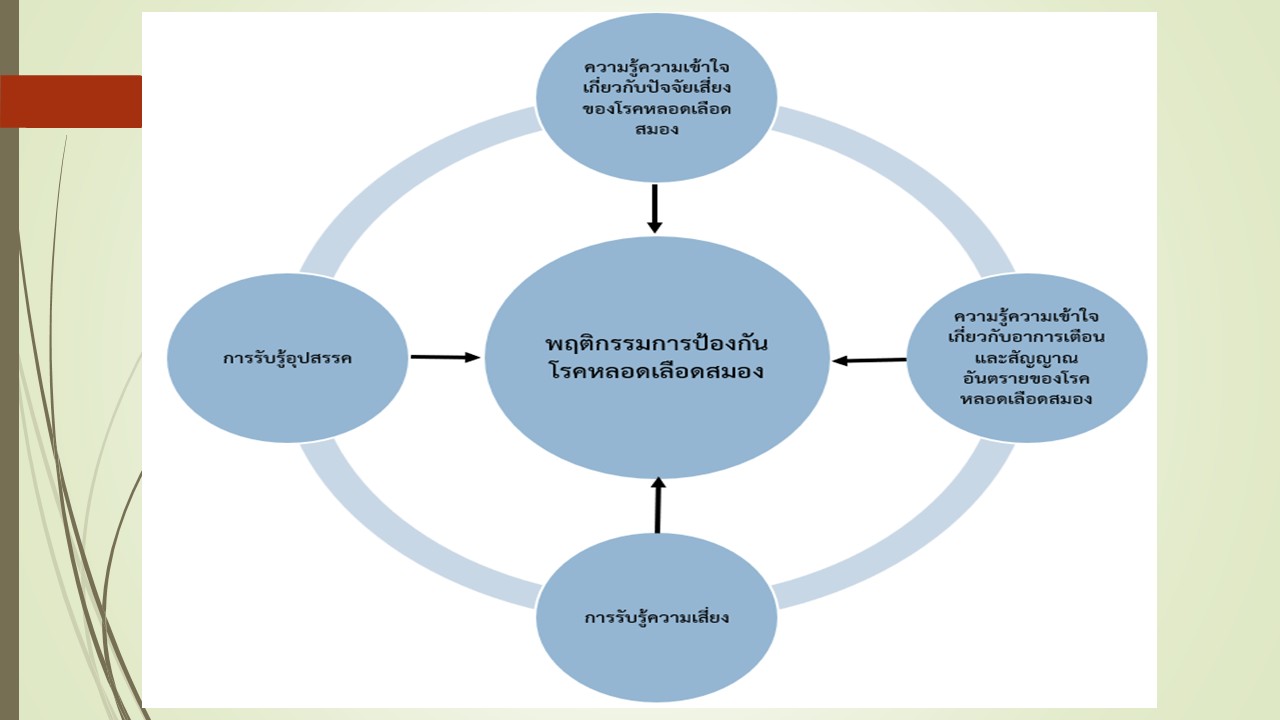
This quantitative research aimed to examine factors influencing stroke prevention behaviors among hypertensive patients in Khao Mao Subdistrict, Phra Nakhon Si Ayutthaya Province, based on the Health Belief Model (HBM). The sample consisted of 260 hypertensive patients aged 35 years and older registered at Khao Mao Subdistrict Health Promoting Hospital, Phra Nakhon Si Ayutthaya Province. The instrument used was a questionnaire with an IOC between 0.67 and 1.00, and a reliability test of 0.89 with a Cronbach's Alpha. Data were analyzed using descriptive statistics, including frequency, percentage, mean, and standard deviation. Inferential statistics include multiple regression analysis. The study's results revealed that the knowledge level about stroke, health perception, and preventive behaviors was generally high in all aspects, particularly in areas such as diet control, exercise, and medication adherence. The analysis of factors influencing stroke prevention behaviors in hypertensive patients in Khao Mao Subdistrict, Phra Nakhon Si Ayutthaya Province, found that the variables with positive and statistically significant influences were (1) knowledge and understanding of stroke risk factors (B = .171, p = .004), (2) knowledge and understanding of warning symptoms and danger signs of stroke (B = .128, p = .007), (3) risk perception (B = .070, p = .018), and (4) perceived barriers (B = .135, p < .001). This suggests that individuals with greater knowledge about the disease, as well as awareness of the risks and barriers to disease prevention, tend to exhibit more effective disease prevention behaviors than those with less knowledge and awareness.
Keywords: Disease Prevention Behavior, Stroke, High Blood Pressure
Article Details

This work is licensed under a Creative Commons Attribution-NonCommercial-NoDerivatives 4.0 International License.
References
จตุพงษ์ พันธ์วิไล, และ นิรมัย มณีรัตน์. (2565). ความสัมพันธ์ระหว่างความรู้ ความเชื่อด้านสุขภาพ และ พฤติกรรมการป้องกันการเกิดโรคหลอดเลือดสมองในผู้สูงอายุที่มีภาวะเสี่ยง. วารสารศูนย์อนามัยที่ 9 นครราชสีมา, 16(3), 882–895. สืบค้นจาก https://he02.tci- thaijo.org/index.php/RHPC9Journal/article/download/258882/176938
ภาสิกา กิมหงษ์. (2566). ผลของโปรแกรมดูแลผู้ป่วยโรคหลอดเลือดสมองระยะเปลี่ยนผ่านต่อความพร้อมและ ภาระในการดูแลของญาติผู้ดูแล [วิทยานิพนธ์ปริญญาพยาบาลศาสตรมหาบัณฑิต, วิทยาลัยพยาบาล บรมราชชนนี นพรัตน์วชิระ].
Aekplakorn, W., Chariyalertsak, S., Kessomboon, P., et al. (2024). Trends in hypertension prevalence, awareness, treatment, and control in the Thai population, 2004 to 2020. BMC Public Health, 24, 3149. https://doi.org/10.1186/s12889-024-20643-1
Department of Disease Control. (2566). สถานการณ์โรคหลอดเลือดสมองในประเทศไทย ปี 2566. สืบค้นจาก https://www.hfocus.org/content/2023/10/28741
Ellis, C., Breland, H. L., & Egede, L. E. (2017). Knowledge and beliefs about stroke among African Americans: Results from the REACH US Risk Factor Survey. Journal of Stroke and Cerebrovascular Diseases, 26(5), 1043–1050. https://doi.org/10.1016/j.jstrokecerebrovasdis.2016.12.006
Gochman, D. S. (1982). Labels, systems, and motives: Some perspectives for future research and programs. Health Education Quarterly, 9(2-3), 263–270. https://doi.org/10.1177/109019818200900213
Green lW, Kreuter MW. (2005). Health program planning: An educational and ecological approach. 4th ed. New York: Emily Barrosse.
Juhong, J., Kim, H., & Lee, S. (2022). Effectiveness of an online educational video intervention to improve knowledge and change health behaviors. Heliyon, 8(10), e11276. https://doi.org/10.1016/j.heliyon.2022.e11276
Khomkham, P., Tiyapongpattana, W., & Tiyapongpattana, C. (2024). Effectiveness of the Protection Motivation Theory-based education program on knowledge, motivation, and preventive behaviors among persons at risk for stroke. Princess of Naradhiwas University Journal of Nursing and Health Sciences, 15(2), 45–59. สืบค้นจาก https://he02.tci-thaijo.org/index.php/PRIJNR/article/download/264945/181809
Mackenzie, A. E., Perry, L., Lockhart, E., Cottee, M., Cloud, G., & Mann, H. (2011). Family carers of stroke survivors: Needs, knowledge, satisfaction and competence in caring. Disability and Rehabilitation, 33(2), 106–116. https://doi.org/10.3109/09638288.2010.488711
Panwilai, J., Fongkaew, W., Soiwong, P., & Chaiard, J. (2022). Family caregivers’ perceptions regarding stroke prevention for family members at risk: A qualitative study. Princess of Naradhiwas University Journal of Nursing and Health Sciences, 14(2), 63–78. สืบค้น จาก https://he02.tci-thaijo.org/index.php/PRIJNR/article/download/255278/173428
Pitchalard, K., Moonpanane, K., Wimolphan, P., Singkhorn, O., & Wongsuraprakit, S. (2022). Implementation and evaluation of the peer-training program for village health volunteers to improve chronic disease management among older adults in rural Thailand. International Journal of Nursing Sciences, 9(3), 328–333. https://doi.org/10.1016/j.ijnss.2022.06.011
Sakurai, K., Tokuda, Y., Takahashi, O., Ohde, S., & Shimbo, T. (2014). Knowledge of stroke symptoms and risk factors among adults in Japan: A national survey. Journal of Stroke and Cerebrovascular Diseases, 23(5), 1041–1049. https://doi.org/10.1016/j.jstrokecerebrovasdis.2013.08.015
Stretcher, V. J., & Rosenstock, I. M. (1997). The Health Belief Model. In K. Glanz, F. M. Lewis, & B.K. Rimer (Eds). Health behavior and health education: Theory, research, and practice (2nd ed., pp.41-59). SanFrancisco, CA: Jossey-Bass.
Walsh, S., & Bruce, J. (2023). Health Belief Model of Behavior Change. In StatPearls. StatPearls Publishing. Retrieved from https://www.ncbi.nlm.nih.gov/books/NBK606120/
