
ปัจจัยเชิงสาเหตุที่มีผลต่อการบริหารความเสี่ยงทางการเงินของผู้ประกอบการรุ่นใหม่ในภาวะเศรษฐกิจถดถอยของประเทศไทย
Article Sidebar
Main Article Content
บทคัดย่อ
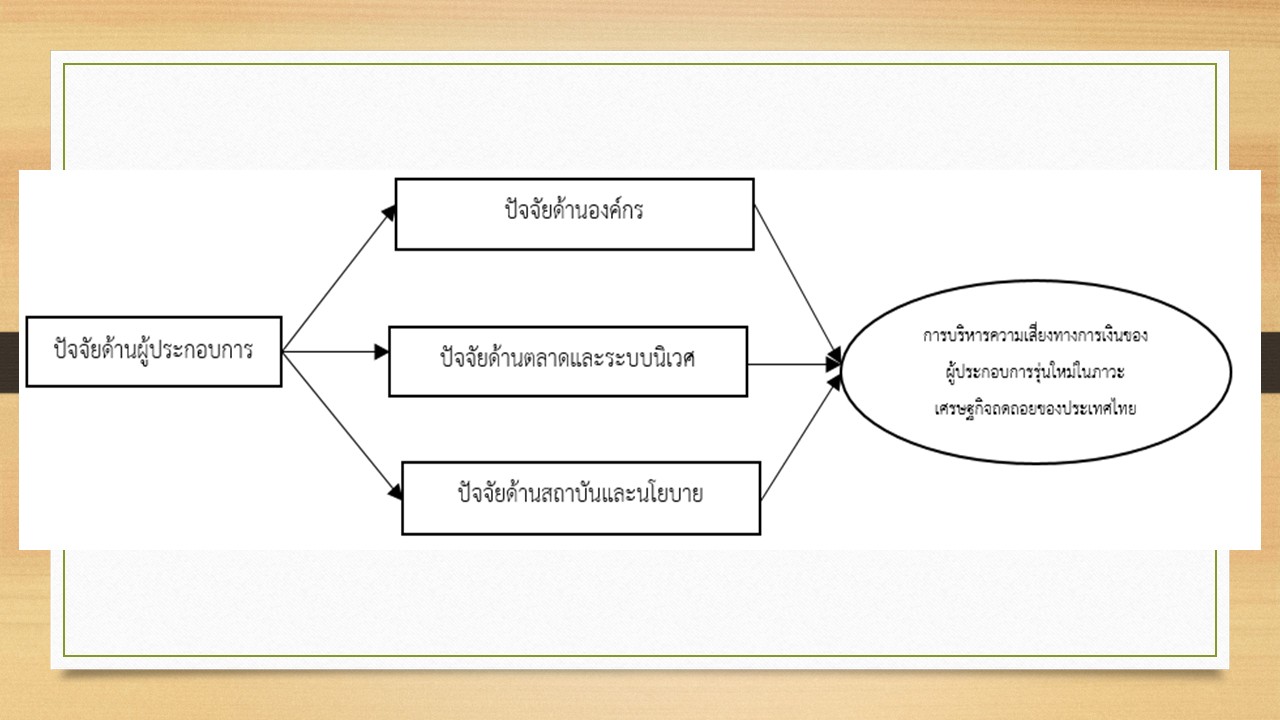
การวิจัยครั้งนี้มีวัตถุประสงค์เพื่อ (1) ศึกษาระดับการบริหารความเสี่ยงทางการเงินของผู้ประกอบการรุ่นใหม่ในภาวะเศรษฐกิจถดถอยของประเทศไทย และ (2) วิเคราะห์ปัจจัยเชิงสาเหตุที่มีผลต่อการบริหารความเสี่ยงทางการเงิน กลุ่มตัวอย่างเป็นผู้ประกอบการรุ่นใหม่ที่ดำเนินธุรกิจขนาดเล็กและขนาดกลาง จำนวน 300 คน เครื่องมือที่ใช้ได้แก่ แบบสอบถามผ่านการตรวจสอบความตรงเชิงเนื้อหาโดยผู้เชี่ยวชาญ (IOC ≥ .50) และความเชื่อมั่น (Cronbach’s alpha ≥ .70) วิเคราะห์ข้อมูลด้วยสถิติเชิงพรรณนา การวิเคราะห์องค์ประกอบเชิงยืนยัน (CFA) และการวิเคราะห์สมการโครงสร้าง (SEM) ผลการวิจัยเชิงพรรณนา พบว่า ผู้ตอบมีความคิดเห็นต่อทุกปัจจัยอยู่ในระดับมากที่สุด ผลการทดสอบโมเดลการวัดรายตัวแปรมีค่าดัชนีความสอดคล้องอยู่ในเกณฑ์ที่ยอมรับได้ การวิเคราะห์ปัจจัยเชิงสาเหตุที่มีผลต่อการบริหารความเสี่ยงทางการเงิน พบว่า ปัจจัยด้านผู้ประกอบการส่งผลเชิงบวกต่อปัจจัยด้านองค์กร (β = .74) ด้านตลาดและระบบนิเวศ (β = .54) และด้านสถาบันและนโยบาย (β = .78) ขณะที่อิทธิพลโดยตรงต่อการบริหารความเสี่ยงทางการเงินสูงสุดคือปัจจัยด้านตลาดและระบบนิเวศ (β = .44) รองลงมาคือปัจจัยด้านองค์กร (β = .30) และปัจจัยด้านสถาบันและนโยบาย (β = .14) สะท้อนว่าความพร้อมของระบบนิเวศตลาดและความเข้มแข็งของโครงสร้างองค์กรเป็นกลไกหลักในการลดความเสี่ยงทางการเงินของผู้ประกอบการรุ่นใหม่ ส่วนปัจจัยด้านผู้ประกอบการทำหน้าที่ขับเคลื่อนผ่านอิทธิพลทางอ้อมไปยังสองปัจจัยดังกล่าว ผลการวิจัยชี้ว่าการพัฒนาศักยภาพผู้ประกอบการควบคู่กับการยกระดับระบบบริหารภายในและการเชื่อมโยงเครือข่ายตลาด เป็นยุทธศาสตร์สำคัญในการเสริมความทนทานทางการเงินของธุรกิจรุ่นใหม่ในภาวะเศรษฐกิจถดถอย พร้อมทั้งแนะให้ภาครัฐออกแบบมาตรการที่เข้าถึงง่ายและสอดคล้องกับบริบท SMEs มากยิ่งขึ้น
คำสำคัญ: การบริหารความเสี่ยง, การเงิน, ผู้ประกอบการรุ่นใหม่, ภาวะเศรษฐกิจถดถอย
Article Details

อนุญาตภายใต้เงื่อนไข Creative Commons Attribution-NonCommercial-NoDerivatives 4.0 International License.
เอกสารอ้างอิง
ทิบดี ทัฬหกรณ์. (2560). การสร้างผู้ประกอบการรุ่นใหม่ในยุคไทยแลนด์ 4.0. RMUTT Global Business and Economics Review, 12(2): 107-122. https://he02.tci-thaijo.org/index.php/Veridian-E-Journal/article/view/118555/90906
ธีนทัต โกศัลวิตร. (2564). การพยากรณ์ความล้มเหลวทางการเงินของบริษัทในตลาดหลักทรัพย์แห่งประเทศไทย. วารสารบริหารศาสตร์ มหาวิทยาลัยอุบลราชธานี, 10(2), 41–56. https://so03.tci-thaijo.org/index.php/jms_ubu/article/view/243837.
มุกดาฉาย แสนเมือง. (2567). การจัดการความเสี่ยงของวิสาหกิจขนาดกลางและขนาดย่อม กรณีศึกษา ภาคบริการในเขตกรุงเทพและปริมณฑล เพื่อนําไปสู่ความยั่งยืนขององค์กร. วารสารนวัตกรรมและการจัดการ, 9(2): 35-53. https://so03.tci-thaijo.org/index.php/journalcim/article/view/281063/186872.
สุนันท์ เพ่งจินดา. (2567). การบัญชีบริหารและการบริหารความเสี่ยงที่ส่งผลต่อประสิทธิผลองค์การของการค้าสมัยใหม่ในยุคดิจิทัลกรณีศึกษา: วิสาหกิจขนาดกลางและขนาดย่อมในกรุงเทพมหานคร (ธุรกิจ SMEs). วารสารรัชภาคต์, 18(58): 132-149. https://so05.tci-thaijo.org/index.php/RJPJ/article/view/270808/182611
Agung Probohudono Greg Tower Rusmin Rusmin, (2013). Risk disclosure during the global financial crisis. Social Responsibility Journal 9(1). DOI:10.1108/17471111311307859
Bunea-Bontaş, Cristina Aurora (2009): Basic Principles of Hedge Accounting. Published in: Economy. Transdisciplinarity. Cognition, 12(1): 172-181. https://mpra.ub.uni-muenchen.de/17072/1/MPRA_paper_17072.pdf
Jong Ho Hwang. (2014). A proposal for an open-source financial risk model. Journal of Financial Regulation and Compliance, 22(3) DOI:10.1108/JFRC-08-2013-0027.
Kortana, T. (2019). The Effectiveness of Risk Management and Business Performance: SMEs in Bangkok, Thailand. International Journal of Supply Chain Management, 8(5). https://ojs.excelingtech.co.uk/index.php/IJSCM/article/download/3653/1945?utm_
Loetnithat, C., Vajragupta, Y., & Chaimadee, T. (2025). SMEs need ecosystems, not just support. Thailand Development Research Institute (TDRI). Retrieved from https://tdri.or.th/en/2025/10/smes-need-ecosystems-not-just-support/
Phattanan Boonyanuphong. (2021). Financing Constraints of Small and Medium Enterprises: cases study of Southern border provinces of Thailand. Chiang Mai University Journal of Economics, 25(1): 38-61.
Sandmaung, M. (24). Risk Management of Small and Medium Enterprises: A Case Study of the Service Sector in Bangkok and Metropolitan Areas to Achieve Organizational Sustainability. Journal of Innovation and Management, 9(2), 35–53. retrieved from https://so03.tci-thaijo.org/index.php/journalcim/article/view/281063
Sakulkijkarn, W., & Khanthong, J. (2023). The factors affecting effectiveness of risk management of small and medium enterprises in Thailand. Journal of Namibian Studies: History Politics Culture, 33, 75-89. Retrieved from https://namibian-studies.com/index.php/JNS/article/view/1578
Zainuddin SA, Abdullah B, Nasir NAM, Abdullah T, Nawi NC, Patwary AK, Hashim NAAN. Sustainable risk management practice in the organization: a Malaysian case study. Environ Sci Pollut Res Int. 2023 Feb;30(9):24708-24717. doi: 10.1007/s11356-022-23897-7. Epub 2022 Nov 8. PMID: 36344894; PMCID: PMC9640835
