
Factors Affecting Teachers’ Educational Innovation Competency in Private Universities in Shaanxi Province: Effect of Salient Model
Article Sidebar
Main Article Content
บทคัดย่อ
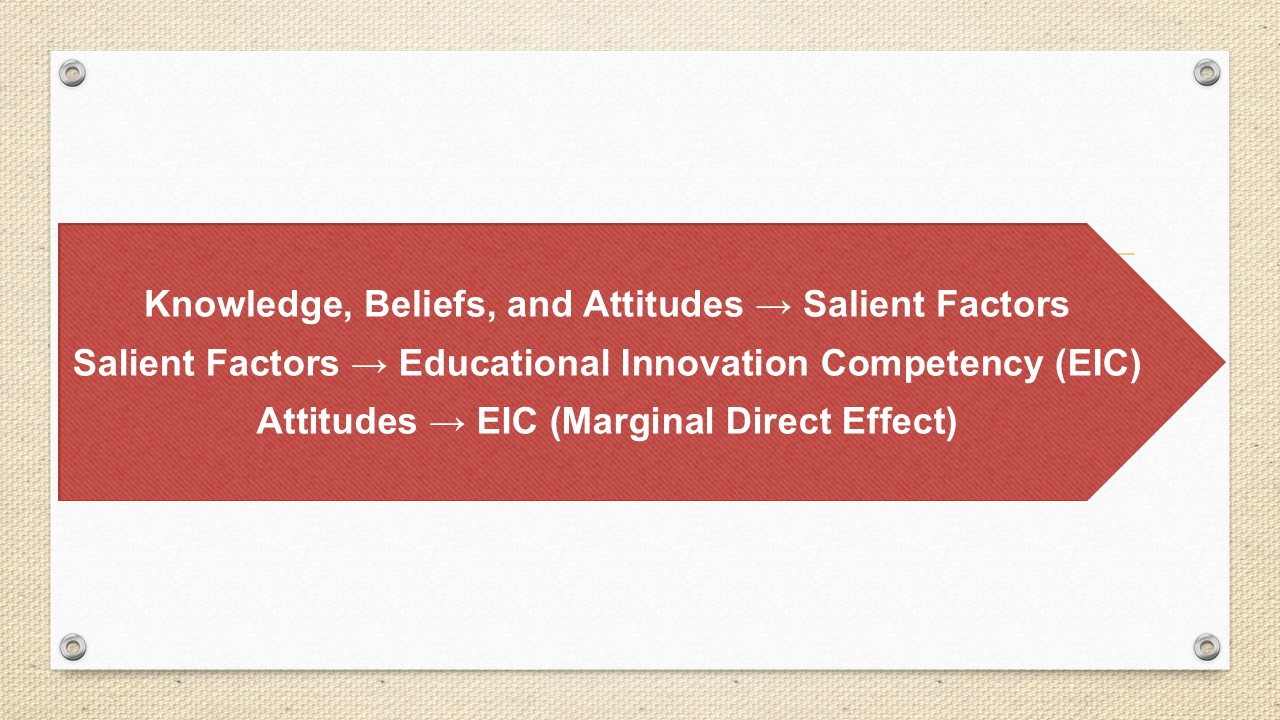
The objectives of this research were: (1) To examine the influence of knowledge, beliefs, and attitudes on educational innovation competency; (2) To investigate the impact of knowledge, beliefs, and attitudes on salient factors in educational innovation competency contexts; and (3) To determine whether salient factors mediate the relationship between knowledge, beliefs, attitudes, and educational innovation competency. The research methodology was quantitative research. It selected 486 teachers from 10 private universities in Shaanxi as subjects. Using a multistage sampling method, data were collected through IOC tools and five-point scale questionnaires. The questionnaire response rate was 100% and all were valid. Data analysis was conducted using descriptive statistics, CFA, and SEM to examine how knowledge, beliefs, and attitudes affect educational innovation competency among private universities in Shaanxi Province. The research findings revealed that: (1) Knowledge and belief factors did not have a significant direct effect on educational innovation competency, while attitude factors showed a marginally significant direct effect, suggesting limited direct influence of these personal factors on innovation competency; (2) Knowledge, belief, and attitude factors all had significant direct effects on salient factors, indicating that these underlying variables strongly shape the contextual elements relevant to educational innovation; and (3) Salient factors had a substantial and significant direct effect on educational innovation competency and significantly mediated the relationships between knowledge, belief, and attitude factors and educational innovation competency, highlighting their central role in linking individual dispositions with innovation capacity.
Article Details

อนุญาตภายใต้เงื่อนไข Creative Commons Attribution-NonCommercial-NoDerivatives 4.0 International License.
เอกสารอ้างอิง
Ajzen, I. (1991). The theory of planned behavior. Organizational Behavior and Human Decision Processes, 50(2), 179–211.
Ajzen, I. (2020). The theory of planned behavior: Frequently asked questions. Human Behavior and Emerging Technologies, 2(4), 314–324.
Anderson, J. C., & Gerbing, D. W. (1988). Structural equation modeling in practice: A review and recommended two-step approach. Psychological Bulletin, 13(3), 411–423.
Bandura, A. (1986). Social foundations of thought and action: A social cognitive theory. Prentice Hall.
Baron, R. M., & Kenny, D. A. (1986). The moderator–mediator variable distinction in social psychological research: Conceptual, strategic, and statistical considerations. Journal of Personality and Social Psychology, 51(6), 1173–1182.
Chen, H., & Zheng, Y. (2021). Private higher education development in China. Higher Education Research, 42(3), 45–58.
Davis, F. D. (1989). Perceived usefulness, perceived ease of use, and user acceptance of information technology. MIS Quarterly, 13(3), 319–340.
Fadel, C., Bialik, M., & Trilling, B. (2015). Four-dimensional education: The competencies learners need to succeed. Center for Curriculum Redesign.
Faul, F., Erdfelder, E., Lang, A.-G., & Buchner, A. (2009). G*Power 3: A flexible statistical power analysis program for the social, behavioral, and biomedical sciences. Behavior Research Methods, 41(4), 1149–1160.
Fazio, R. H. (1990). Multiple processes by which attitudes guide behavior: The MODE model as an integrative framework. Advances in Experimental Social Psychology, 23, 75–109.
Fornell, C., & Larcker, D. F. (1981). Evaluating structural equation models with unobservable variables and measurement error. Journal of Marketing Research, 18(1), 39–50.
Fullan, M. (2007). The new meaning of educational change (4th ed.). Teachers College Press.
Guskey, T. R. (2000). Evaluating professional development. Corwin Press.
Hair, J. F., Black, W. C., Babin, B. J., & Anderson, R. E. (2019). Multivariate data analysis (8th ed.). Cengage Learning.
Hayes, A. F. (2018). Introduction to mediation, moderation, and conditional process analysis: A regression-based approach (2nd ed.). Guilford Press.
Kline, R. B. (2016). Principles and practice of structural equation modeling (4th ed.). Guilford Press.
Koehler, M. J., & Mishra, P. (2009). What is technological pedagogical content knowledge? Contemporary Issues in Technology and Teacher Education, 9(1), 60–70.
Li, Y., & Wang, J. (2023). Challenges and development strategies for private universities in Western China. Higher Education Research, 44(3), 56–64.
Liu, Q., Zhang, L., & Huang, Y. (2020). Recognition and innovation in higher education: A psychological perspective. Teaching and Teacher Education, 95, 103138.
Ministry of Education. (2017). Education modernization 2035. Beijing: Author.
Mishra, P., & Koehler, M. J. (2006). Technological pedagogical content knowledge: A framework for teacher knowledge. Teachers College Record, 108(6), 1017–1054.
Mishra, P., & Koehler, M. J. (2006). Technological pedagogical content knowledge: A framework for teacher knowledge. Teachers College Record, 108(6), 1017–1054.
OECD. (2018). The future of education and skills: Education 2030. OECD Publishing.
Rogers, E. M. (2003). Diffusion of innovations (5th ed.). Free Press.
Sun, W., & Liu, H. (2021). Organizational support, role identity, and teacher innovation: Evidence from Chinese universities. Asia Pacific Education Review, 22(2), 289–302.
Wang, S., & Xu, F. (2022). Factors influencing teachers’ innovative teaching practices in higher education. Journal of Educational Research, 115(4), 453–467.
Zhang, Q. (2020). Education and the Belt and Road Initiative. China Education Review, 12(4), 22–30.
Zhang, X., Chen, L., & Zhao, J. (2021). Leadership and faculty innovation in Chinese universities: A multi-level analysis. Studies in Higher Education, 46(6), 1085–1101.
Zhao, J., & Chen, H. (2022). Educational innovation competency: A conceptual framework for higher education. Teaching Innovations, 35(2), 11–19.
Zhu, Y., & Zhang, L. (2018). Education inequality and innovation capacity. Asian Education Studies, 6(2), 15–28.
JianFeng, L., & Worapongpat, N. (2024). Rural head teachers' leadership in local education curriculum under the perspective of educational modernization in Xi'an Province. Journal of Interdisciplinary Social Development, 2(3), 1–25. https://so12.tci-thaijo.org/index.php/JISDIADP/article/view/1140
Makjod, S., Worapongpat, N., Kangpheng, S., & Bhasabutr, P. (2025). Academic administration of the opportunity expansion school under the Prachinburi Primary Educational Service Area Office 1. Journal of Education and Learning Reviews, 2(5), 85–94. https://so19.tci-thaijo.org/index.php/JELS/article/view/963
Pintong, A., & Worapongpat, N. (2024). The relationship between transformational leadership of educational institution administrators and being a learning organization: The school expands educational opportunities under the jurisdiction of Nakhon Pathom Primary Educational Service Area Office. Art and Science Great Mekong Subregion Research Journal, Khon Kaen University [OAS Journal], 32(2), 52–67. https://li01.tci-thaijo.org/index.php/oasjournal/article/view/262673
Worapongpat, N. (2025a). Leadership in the decision-making behavior of educational institution administrators at Guangdong Open University. Journal of Management, Administration, and Sustainable Development, 3(1), 51–68. https://so15.tci-thaijo.org/index.php/jamsd/article/view/1477
Worapongpat, N. (2025b). Integrating interdisciplinary workshop design to advance life skills and leadership among graduate students at private universities in Thailand. Liberal Arts and Social Studies International Journal (LAASSIJ), 1(2), 55–71. https://so18.tci-thaijo.org/index.php/laassij/article/view/1133
Worapongpat, N., & Arunyakanon, P. (2025). Transformational leadership and change management competency in response to sudden disruptions among administrators of Jiangling Town Central High School, DaZhou City. Journal of Education and Learning Reviews, 2(2), 47–58. https://doi.org/10.60027/jelr.2025.913
Worapongpat, N., & Kangpheng, S. (2025). Transformational leadership skills for executives in the digital age, China Polytechnic College. Journal of Education and Learning Reviews, 2(5), 27–44. https://doi.org/10.60027/jelr.2025.931
Worapongpat, N., Heebnga, N., Hadtapranit, P., Rueangsri, P., & Sirijon, S. (2023). A development of lesson plan by teaching the cooperative learning group STAD technique: Writing program by Python language in computing science subject of secondary 2 education students at Wat-Aiyikaram School. Journal of MBU Humanities, 15(2), 1–13. https://so06.tci-thaijo.org/index.php/JoMbuHu/article/view/261743
Worapongpat, N., Waranya, T., Sarawut, T., Chotivungso, P. P. B., & Saikham, S. (2023). The creative leadership and school administration of school administrators under the Office of Pathom Dvaravati. Rattanakosin Journal of Social Sciences and Humanities, 5(3), 25–40. https://so05.tci-thaijo.org/index.php/RJSH/article/view/264138
Worapongpat, N., & Viphoouparakhot, V. (2024). Design and development of integrated training systems to enhance leadership skills in educational administration and principles of leadership in the relationship of educational institutions with communities in Ratchaburi Province for education of graduate students at private universities in the Bangkok area. Journal of Management, Administration, and Sustainable Development, 2(3), 577–590. https://so15.tci-thaijo.org/index.php/jamsd/article/view/837
Xie, H. X., & Ma, J. T. (2021). Research on the moral legitimacy and exemplary behavior of private university leaders in transitional China. Journal of Higher Education Development, 42(3), 45–52.
Zhao, X., & Liu, Y. (2020). Vision-driven leadership in private university governance. Research on Higher Education in China, 12, 45–68.
