
องค์ประกอบภาวะผู้นำเชิงระบบของผู้บริหารสถานศึกษา
Article Sidebar
Main Article Content
บทคัดย่อ
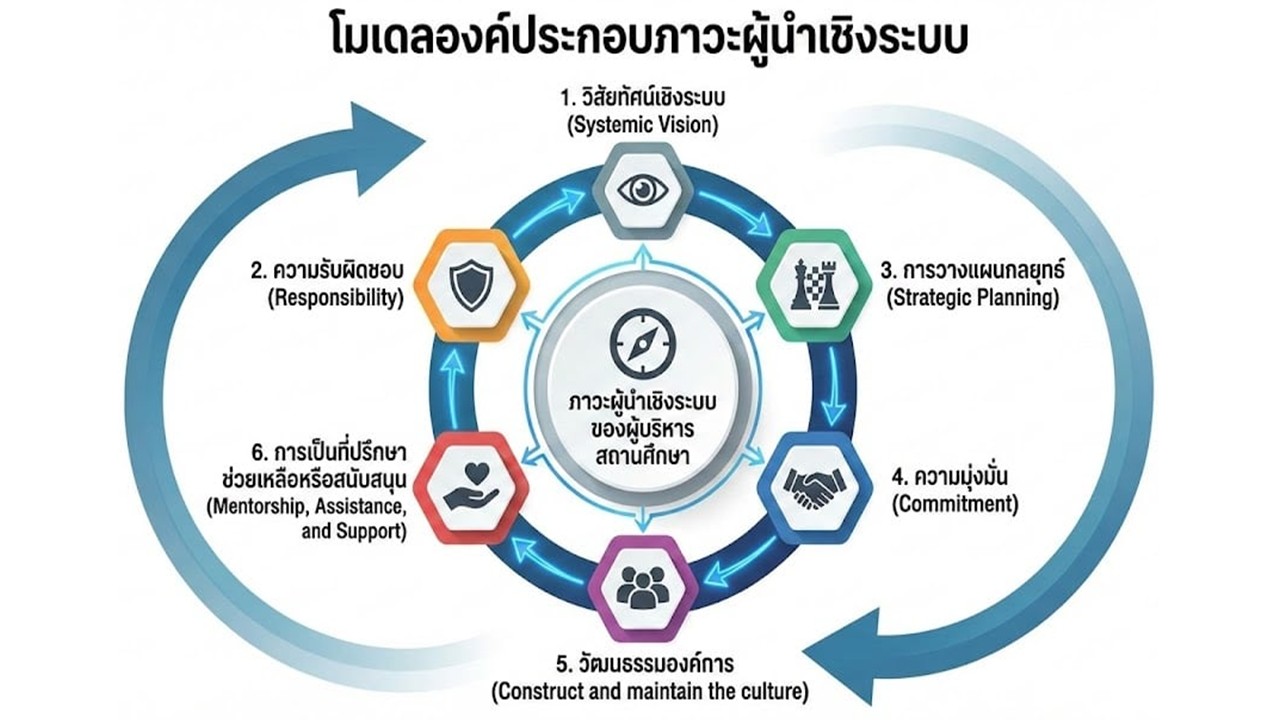
การวิจัยครั้งนี้มีวัตถุประสงค์เพื่อศึกษาองค์ประกอบภาวะผู้นำเชิงระบบของผู้บริหารสถานศึกษา โดยใช้ระเบียบวิธีวิจัยแบบผสมผสาน โดยแบ่งออกเป็น 3 ขั้นตอน ได้แก่ (1) การศึกษาองค์ประกอบจากเอกสารวิชาการและงานวิจัยจำนวน 10 แหล่ง เพื่อสังเคราะห์องค์ประกอบภาวะผู้นำเชิงระบบ (2) การสัมภาษณ์ผู้ทรงคุณวุฒิ จำนวน 5 คน เกี่ยวกับองค์ประกอบภาวะผู้นำเชิงระบบ และ (3) ตรวจสอบความเหมาะสมและความเป็นไปได้ขององค์ประกอบโดยผู้ทรงคุณวุฒิจำนวน 5 คน เครื่องมือที่ใช้ในการวิจัยประกอบด้วย แบบวิเคราะห์เอกสาร แบบสัมภาษณ์กึ่งโครงสร้าง และแบบสอบถามมาตราส่วนประมาณค่า 5 ระดับ การวิเคราะห์ข้อมูลใช้สถิติเชิงพรรณนา ได้แก่ ค่าเฉลี่ย และส่วนเบี่ยงเบนมาตรฐาน ผลการวิจัยพบว่า องค์ประกอบภาวะผู้นำเชิงระบบของผู้บริหารสถานศึกษา ประกอบด้วย 6 ด้าน ได้แก่ 1) วิสัยทัศน์เชิงระบบ 2) ความรับผิดชอบ 3) การวางแผนกลยุทธ์ 4) ความมุ่งมั่น 5) วัฒนธรรมองค์การ และ 6) การเป็นที่ปรึกษาช่วยเหลือ สนับสนุน มีความเหมาะสมและความเป็นไปได้อยู่ในระดับมากที่สุด
คำสำคัญ: ภาวะผู้นำ, ภาวะผู้นำเชิงระบบ, ผู้บริหารสถานศึกษา
Article Details

อนุญาตภายใต้เงื่อนไข Creative Commons Attribution-NonCommercial-NoDerivatives 4.0 International License.
เอกสารอ้างอิง
กรัณฑรัตน์ จำเนียรพันธุ์ พระมหาญาณวัฒน์ ฐิตวฑฺฒโน และเผด็จ จงสกุลศิริ. (2566). ภาวะผู้นำเชิงระบบตามหลักปาปณิกธรรมสำหรับผู้บริหารสถานศึกษาในยุค VUCA WORLD. วารสารบวรสหการศึกษาและมนุษยสังคมศาสตร์, 4(1), 46–53. สืบค้น จาก https://so03.tci-thaijo.org/index.php/JOB_EHS/article/view/269727
บุญชม ศรีสะอาด. (2560). การวิจัยเบื้องต้น (พิมพ์ครั้งที่ 10; ฉบับปรับปรุง). สุวีริยาสาส์น.
สุดารัตน์ พรหมสิงห์ & ปารย์พิชชา ก้านจักร. (2568). โมเดลสมการโครงสร้างภาวะผู้นำเชิงระบบของผู้บริหารสถานศึกษาที่ส่งผลต่อองค์การ สมรรถนะสูงของสถานศึกษา สังกัดสำนักงานเขตพื้นที่การศึกษาประถมศึกษาขอนแก่น. HRD Journal, 16(1), 111–126. สืบค้น จาก https://so01.tci-thaijo.org/index.php/HRDJ/article/view/280538
Boeskens, L., & Meyer, K. (2025). Policies for the digital transformation of school education: Evidence from the Policy Survey on School Education in the Digital Age (OECD Education Working Papers). OECD Publishing.
Creswell, J.W. (2022). A Concise Introduction to Mixed Methods Research (2nd ed.). Thousand Oaks, CA: SAGE.
Hancell, R., Jones, C., & Miller, O. (2022). School leadership for resilient education systems: What is the role of professional networks in effective response to crisis? (Think piece). UNESCO International Institute for Educational Planning (IIEP) & Education Development Trust.
Harris, A., Jones, M., & Hashim, N. (2021). System leaders and system leadership: Exploring the contemporary evidence base. School Leadership & Management, 41(4–5), 387–408. https://doi.org/10.1080/13632434.2021.1889492
Loor, G., & DiMartino, C. (2023). Systems thinking as an approach to technology integration at the K-12 school level. Journal for Leadership and Instruction, Fall 2023, 32–36. https://eric.ed.gov/?q=source%3A%22Journal+for+Leadership+and+Instruction%22&pg=2&id=EJ1419976
Mitchell, R., Agbaire, J., Paulson, J., & Tikly, L. (2025). Endogenous systems leadership of education provision during crises in low- and middle-income countries: A conceptual framework. Prospects. https://doi.org/10.1007/s11125-025-09732-0
Organisation for Economic Co-operation and Development. (2025). Results from TALIS 2024: The state of teaching. OECD Publishing. https://doi.org/10.1787/90df6235-en
RISE Programme. (2021). Applying systems thinking to education: The RISE Systems Framework (RISE Insights). Research on Improving Systems of Education (RISE).
Silberstein, J., & Spivack, M. (2023). Applying systems thinking to education: Using the RISE Systems Framework to diagnose education systems (RISE Insight Note 2023/051). Foreign, Commonwealth & Development Office / RISE Programme. https://doi.org/10.35489/BSG-RISE-RI_2023/051
Spivack, M., Silberstein, J., & Hwa, Y.-Y. (2023). The RISE Education Systems Diagnostic Toolkit. Research on Improving Systems of Education (RISE). https://doi.org/10.35489/BSG-RISE-Misc_2023/09
UNESCO. (2024). Global education monitoring report 2024/5: Leadership in education: Lead for learning. UNESCO. https://doi.org/10.54676/EFLH5184
