
Components of systemic leadership of school administrators
Article Sidebar
Main Article Content
Abstract
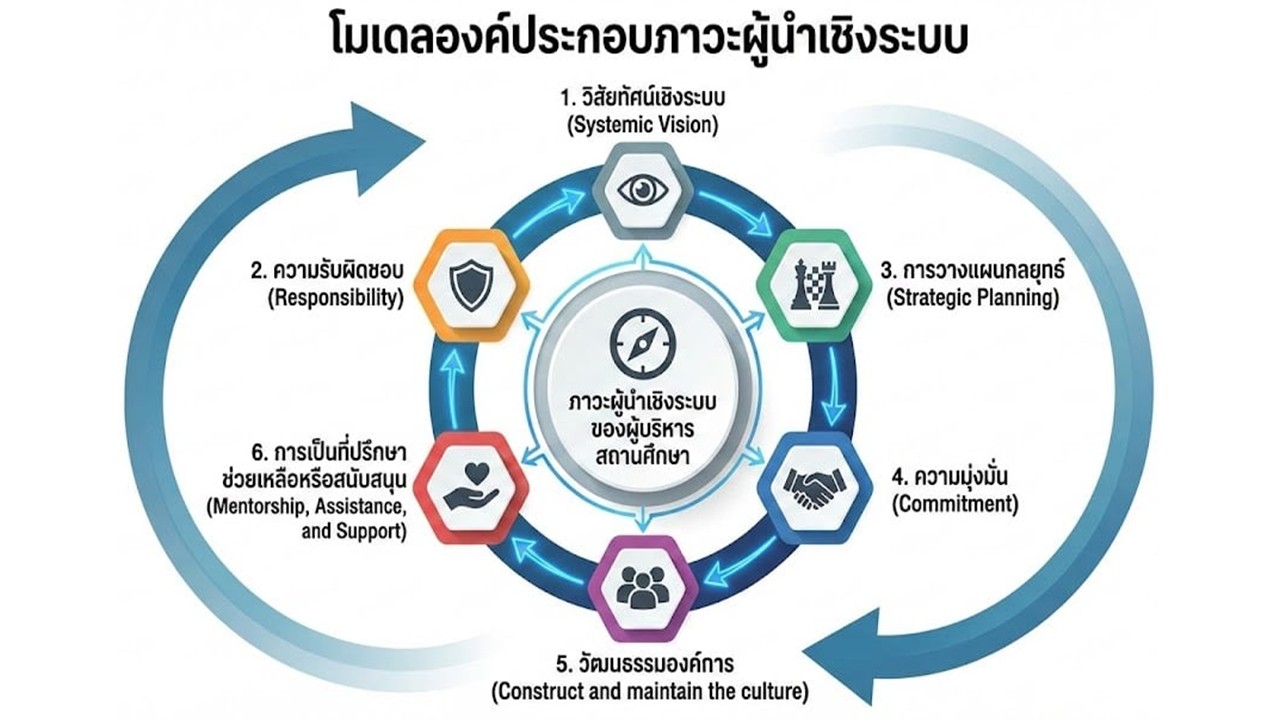
This study aimed to examine the components of systems leadership among school administrators using a mixed-methods approach. The research was conducted in three stages: (1) identifying components through a review of academic documents and research studies from 10 sources to synthesize systems leadership components; (2) conducting interviews with five experts regarding the proposed components; and (3) having five experts evaluate the appropriateness and feasibility of the components. The research instruments included a document analysis form, a semi-structured interview guide, and a five-point Likert-scale questionnaire. Data were analyzed using descriptive statistics, namely mean and standard deviation. The findings indicated that systems leadership components of school administrators comprise six dimensions: (1) Systemic vision, (2) responsibility, (3) strategic planning, (4) commitment, (5) Construct and maintain the culture, and (6) Mentorship, Assistance, and Support. Overall, these components were rated highest in both appropriateness and feasibility.
Keywords: Leadership, Systems Leadership, School Administrators
Article Details

This work is licensed under a Creative Commons Attribution-NonCommercial-NoDerivatives 4.0 International License.
References
กรัณฑรัตน์ จำเนียรพันธุ์ พระมหาญาณวัฒน์ ฐิตวฑฺฒโน และเผด็จ จงสกุลศิริ. (2566). ภาวะผู้นำเชิงระบบตามหลักปาปณิกธรรมสำหรับผู้บริหารสถานศึกษาในยุค VUCA WORLD. วารสารบวรสหการศึกษาและมนุษยสังคมศาสตร์, 4(1), 46–53. สืบค้น จาก https://so03.tci-thaijo.org/index.php/JOB_EHS/article/view/269727
บุญชม ศรีสะอาด. (2560). การวิจัยเบื้องต้น (พิมพ์ครั้งที่ 10; ฉบับปรับปรุง). สุวีริยาสาส์น.
สุดารัตน์ พรหมสิงห์ & ปารย์พิชชา ก้านจักร. (2568). โมเดลสมการโครงสร้างภาวะผู้นำเชิงระบบของผู้บริหารสถานศึกษาที่ส่งผลต่อองค์การ สมรรถนะสูงของสถานศึกษา สังกัดสำนักงานเขตพื้นที่การศึกษาประถมศึกษาขอนแก่น. HRD Journal, 16(1), 111–126. สืบค้น จาก https://so01.tci-thaijo.org/index.php/HRDJ/article/view/280538
Boeskens, L., & Meyer, K. (2025). Policies for the digital transformation of school education: Evidence from the Policy Survey on School Education in the Digital Age (OECD Education Working Papers). OECD Publishing.
Creswell, J.W. (2022). A Concise Introduction to Mixed Methods Research (2nd ed.). Thousand Oaks, CA: SAGE.
Hancell, R., Jones, C., & Miller, O. (2022). School leadership for resilient education systems: What is the role of professional networks in effective response to crisis? (Think piece). UNESCO International Institute for Educational Planning (IIEP) & Education Development Trust.
Harris, A., Jones, M., & Hashim, N. (2021). System leaders and system leadership: Exploring the contemporary evidence base. School Leadership & Management, 41(4–5), 387–408. https://doi.org/10.1080/13632434.2021.1889492
Loor, G., & DiMartino, C. (2023). Systems thinking as an approach to technology integration at the K-12 school level. Journal for Leadership and Instruction, Fall 2023, 32–36. https://eric.ed.gov/?q=source%3A%22Journal+for+Leadership+and+Instruction%22&pg=2&id=EJ1419976
Mitchell, R., Agbaire, J., Paulson, J., & Tikly, L. (2025). Endogenous systems leadership of education provision during crises in low- and middle-income countries: A conceptual framework. Prospects. https://doi.org/10.1007/s11125-025-09732-0
Organisation for Economic Co-operation and Development. (2025). Results from TALIS 2024: The state of teaching. OECD Publishing. https://doi.org/10.1787/90df6235-en
RISE Programme. (2021). Applying systems thinking to education: The RISE Systems Framework (RISE Insights). Research on Improving Systems of Education (RISE).
Silberstein, J., & Spivack, M. (2023). Applying systems thinking to education: Using the RISE Systems Framework to diagnose education systems (RISE Insight Note 2023/051). Foreign, Commonwealth & Development Office / RISE Programme. https://doi.org/10.35489/BSG-RISE-RI_2023/051
Spivack, M., Silberstein, J., & Hwa, Y.-Y. (2023). The RISE Education Systems Diagnostic Toolkit. Research on Improving Systems of Education (RISE). https://doi.org/10.35489/BSG-RISE-Misc_2023/09
UNESCO. (2024). Global education monitoring report 2024/5: Leadership in education: Lead for learning. UNESCO. https://doi.org/10.54676/EFLH5184
