
ผลสะท้อนประสบการณ์การเรียนรู้ของผู้เรียนจากการใช้บอร์ดเกมจำลองเหตุการณ์กราดยิง
Article Sidebar
Main Article Content
บทคัดย่อ
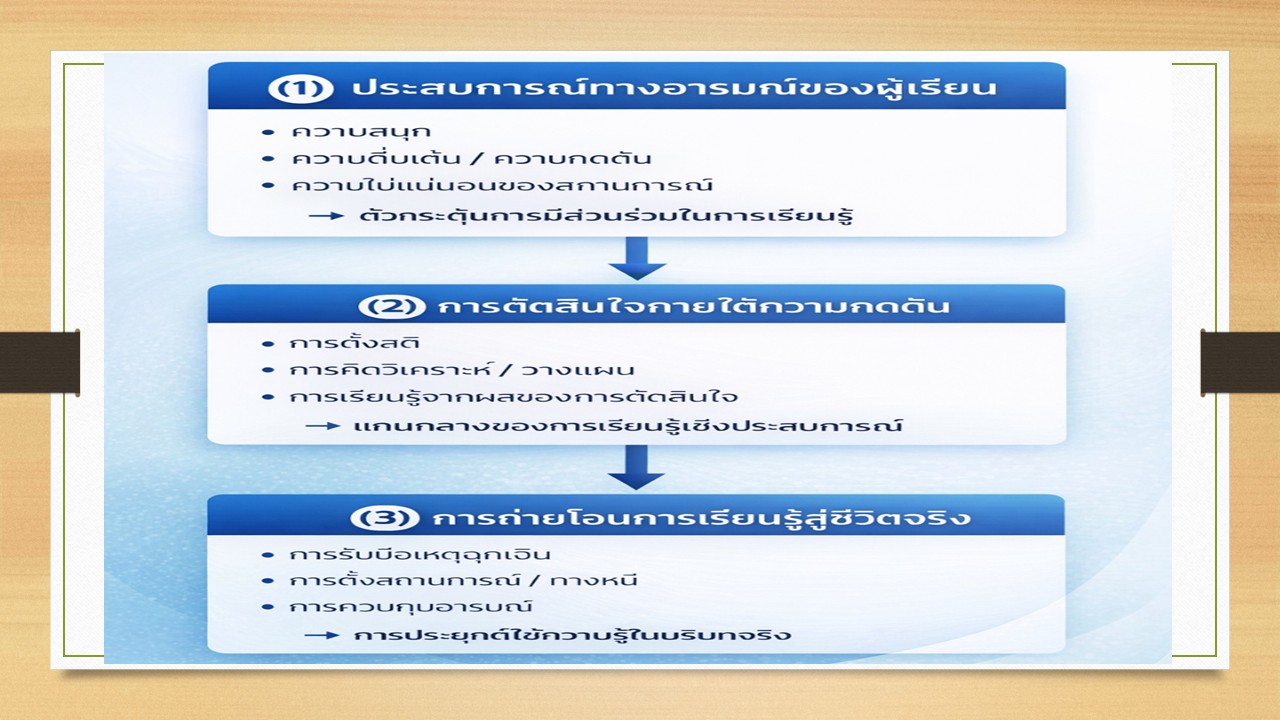
การวิจัยครั้งนี้มีวัตถุประสงค์เพื่อศึกษาผลสะท้อนประสบการณ์การเรียนรู้ของผู้เรียนจากการใช้บอร์ดเกมจำลองเหตุการณ์กราดยิง โดยใช้การวิจัยเชิงคุณภาพ วิเคราะห์ข้อมูลทุติยภูมิจากผลสะท้อนของผู้เรียนที่เก็บรวบรวมผ่านกระดานออนไลน์ Padlet เพื่อวิเคราะห์ข้อมูลเชิงแก่นสาร ผลการวิจัยพบว่า ประสบการณ์การเรียนรู้ของผู้เรียนสามารถสังเคราะห์ออกเป็น 3 ด้าน ได้แก่ (1) ประสบการณ์ทางอารมณ์และการมีส่วนร่วมในการเรียนรู้ ซึ่งผู้เรียนสะท้อนความรู้สึกสนุก ตื่นเต้น และกดดันจากความไม่แน่นอนของสถานการณ์จำลอง (2) กระบวนการเรียนรู้เชิงประสบการณ์ผ่านการตัดสินใจและการตั้งสติภายใต้สถานการณ์กดดัน และ (3) การถ่ายโอนการเรียนรู้สู่การนำไปใช้ในชีวิตจริง โดยเฉพาะการตั้งสติ การสังเกตสถานการณ์ และการรับมือกับเหตุการณ์ฉุกเฉิน ผลการวิจัยสะท้อนให้เห็นว่าบอร์ดเกมจำลองเหตุการณ์กราดยิงสามารถส่งเสริมการเรียนรู้เชิงประสบการณ์และการนำความรู้ไปประยุกต์ใช้ในชีวิตจริงได้อย่างมีความหมาย
คำสำคัญ: บอร์ดเกม, การเรียนรู้โดยใช้เกมเป็นฐาน, การสะท้อนคิด
Article Details

อนุญาตภายใต้เงื่อนไข Creative Commons Attribution-NonCommercial-NoDerivatives 4.0 International License.
เอกสารอ้างอิง
กองสารนิเทศ สํานักงานตํารวจแห่งชาติ. (2565). ตร. ตีแผ่ “หนี ซ่อน สู้” หลักสากลในการเอาชีวิตรอด
ในเหตุกราดยิง (Active Shooter), 5 สิงหาคม 2565. https://www.facebook.com/photo.php?fbid=5631665150216976
&id=1045264755523728&set=a.1047112478672289&locale=th_TH
จำเนียร จวงตระกูล, อรพินท์ บุญสิน, จารุกัญญา อุดานนท์ และลัดดาวัลย์ สําราญ. 2567. การวิเคราะห์ข้อมูล
การวิจัยเชิงคุณภาพแบบการวิเคราะห์แก่นสาร: แนวทางปฏิบัติสําหรับนักวิจัยใหม่. วารสารสมาคม
รัฐประศาสนศาสตร์แห่งประเทศไทย, 6(2), 15-29.
เมธี ธรรมวัฒนา และปานเพชร ร่มไทร. 2568. การพัฒนาบอร์ดเกมเพื่อการเรียนรู้การเอาชีวิตรอดใน
เหตุการณ์กราดยิง: ด้านการหนี, วารสารครุศาสตร์ปัญญา, 4(4), 397-409.
Cook et al., (2011). Technology-enhanced simulation for health professions education:
a systematic review and meta-analysis. JAMA. 306(9), 978-988.
Cowan, K. C., Vaillancourt, K., Rossen, E., & Pollitt, K. (2023). Addressing the psychological
impacts of school safety drills and violence prevention practices. School Psychology
Review, 52(1), 1–15
Csikszentmihalyi, M. (1990). Flow: The psychology of optimal experience. New York, NY:
Harper & Row.
Gee, J. P. (2007). What video games have to teach us about learning and literacy (2nd ed.).
New York, NY: Palgrave Macmillan.
Hamari, J., Koivisto, J., & Sarsa, H. (2014). Does gamification work? A literature review of
empirical studies on gamification. Proceedings of the 47th Hawaii International Conference on System Sciences, 3025–3034.
Kapp, K. M. (2012). The gamification of learning and instruction: Game-based methods and
strategies for training and education. San Francisco, CA: Pfeiffer.
Krejcie, R. V., & Morgan, D. W. (1970). Determining sample size for research activities.
Educational and Psychological Measurement, 30(3), 607–610.
https://doi.org/10.1177/001316447003000308
Kolb, D. A. (1984). Experiential learning: Experience as the source of learning and
development. Englewood Cliffs, NJ: Prentice Hall.
Lateef, F. (2010) Simulation-Based Learning: Just Like the Real Thing. Journal of Emergencies,
Trauma and Shock, 3, 348-352.
Nicholson, S. (2018). Reframing gamification: A meaningful gamification framework. In T. Reiners & L. C. Wood (Eds.), Gamification in education and business (pp. 223–238). Cham: Springer.
Perkins, D. N., & Salomon, G. (1992). Transfer of learning. International Encyclopedia of
Education (2nd ed., pp. 6452–6457). Oxford: Pergamon Press.
Peterson, R. L., Densley, J. A., & Erickson, D. (2021). School safety strategies: Research-based
approaches to preventing school violence. American Psychological Association.
Salen, K., & Zimmerman, E. (2004). Rules of play: Game design fundamentals. Cambridge,
MA: MIT Press.
Schön, D. A. (1983). The reflective practitioner: How professionals think in action. New York,
NY: Basic Books.
Whitton, N. (2012). Learning with digital games: A practical guide to engaging students in higher education. New York, NY: Routledge.
