
Learners’ Reflections on Learning Experiences through a Mass Shooting Simulation Board Game
Article Sidebar
Main Article Content
Abstract
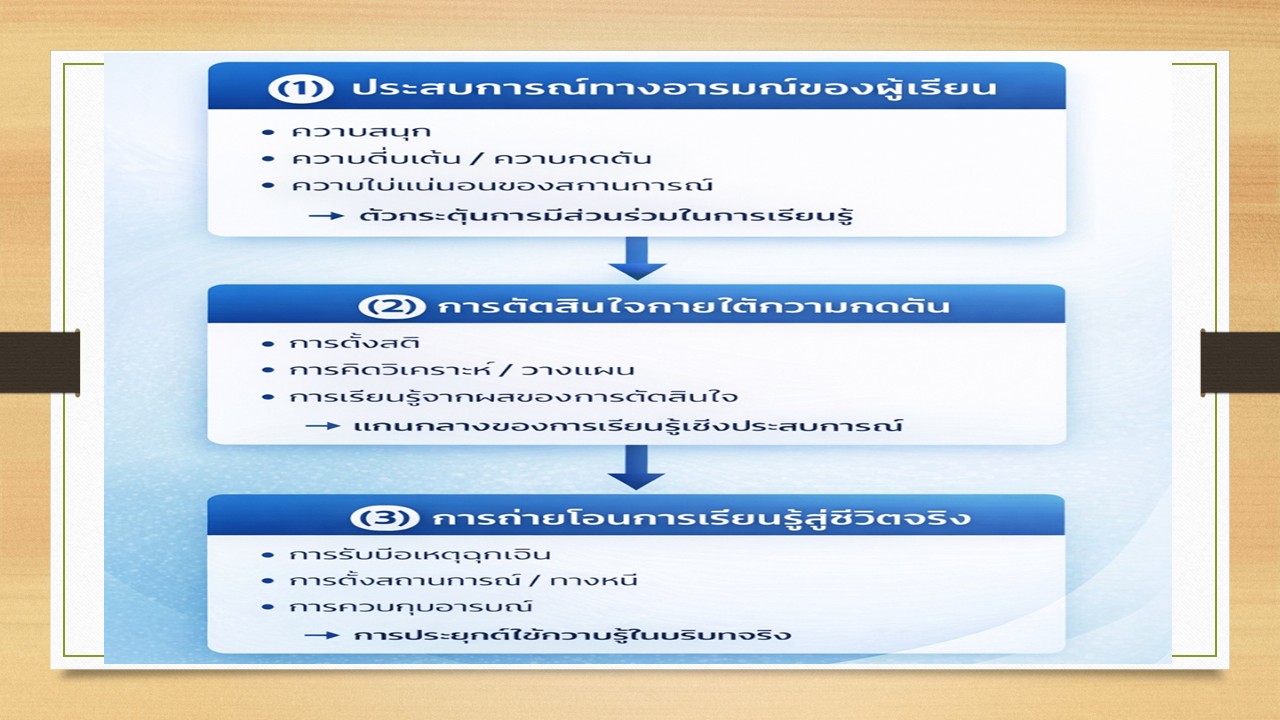
The purpose of this study was to examine learners’ reflections on their learning experiences using a board game simulating a mass shooting incident, focusing on emotional responses, learning processes, and real-life applications. This study employed a qualitative research approach using secondary data analysis. The data consisted of learners’ reflective responses collected via Padlet and were analyzed using thematic analysis. The findings revealed three main themes: (1) emotional experiences and learning engagement, in which learners reported feelings of enjoyment, excitement, and pressure arising from the uncertainty of the simulated situation; (2) experiential learning processes through decision-making and maintaining composure under pressure; and (3) transfer of learning to real-life situations, particularly in terms of staying calm, situational awareness, and responding to emergency situations. The results indicate that the mass shooting simulation board game promotes learner engagement, supports experiential learning, and facilitates meaningful transfer of learning to real-life contexts.
Keywords: Board Game, Game-Based Learning, Reflection
Article Details

This work is licensed under a Creative Commons Attribution-NonCommercial-NoDerivatives 4.0 International License.
References
กองสารนิเทศ สํานักงานตํารวจแห่งชาติ. (2565). ตร. ตีแผ่ “หนี ซ่อน สู้” หลักสากลในการเอาชีวิตรอด
ในเหตุกราดยิง (Active Shooter), 5 สิงหาคม 2565. https://www.facebook.com/photo.php?fbid=5631665150216976
&id=1045264755523728&set=a.1047112478672289&locale=th_TH
จำเนียร จวงตระกูล, อรพินท์ บุญสิน, จารุกัญญา อุดานนท์ และลัดดาวัลย์ สําราญ. 2567. การวิเคราะห์ข้อมูล
การวิจัยเชิงคุณภาพแบบการวิเคราะห์แก่นสาร: แนวทางปฏิบัติสําหรับนักวิจัยใหม่. วารสารสมาคม
รัฐประศาสนศาสตร์แห่งประเทศไทย, 6(2), 15-29.
เมธี ธรรมวัฒนา และปานเพชร ร่มไทร. 2568. การพัฒนาบอร์ดเกมเพื่อการเรียนรู้การเอาชีวิตรอดใน
เหตุการณ์กราดยิง: ด้านการหนี, วารสารครุศาสตร์ปัญญา, 4(4), 397-409.
Cook et al., (2011). Technology-enhanced simulation for health professions education:
a systematic review and meta-analysis. JAMA. 306(9), 978-988.
Cowan, K. C., Vaillancourt, K., Rossen, E., & Pollitt, K. (2023). Addressing the psychological
impacts of school safety drills and violence prevention practices. School Psychology
Review, 52(1), 1–15
Csikszentmihalyi, M. (1990). Flow: The psychology of optimal experience. New York, NY:
Harper & Row.
Gee, J. P. (2007). What video games have to teach us about learning and literacy (2nd ed.).
New York, NY: Palgrave Macmillan.
Hamari, J., Koivisto, J., & Sarsa, H. (2014). Does gamification work? A literature review of
empirical studies on gamification. Proceedings of the 47th Hawaii International Conference on System Sciences, 3025–3034.
Kapp, K. M. (2012). The gamification of learning and instruction: Game-based methods and
strategies for training and education. San Francisco, CA: Pfeiffer.
Krejcie, R. V., & Morgan, D. W. (1970). Determining sample size for research activities.
Educational and Psychological Measurement, 30(3), 607–610.
https://doi.org/10.1177/001316447003000308
Kolb, D. A. (1984). Experiential learning: Experience as the source of learning and
development. Englewood Cliffs, NJ: Prentice Hall.
Lateef, F. (2010) Simulation-Based Learning: Just Like the Real Thing. Journal of Emergencies,
Trauma and Shock, 3, 348-352.
Nicholson, S. (2018). Reframing gamification: A meaningful gamification framework. In T. Reiners & L. C. Wood (Eds.), Gamification in education and business (pp. 223–238). Cham: Springer.
Perkins, D. N., & Salomon, G. (1992). Transfer of learning. International Encyclopedia of
Education (2nd ed., pp. 6452–6457). Oxford: Pergamon Press.
Peterson, R. L., Densley, J. A., & Erickson, D. (2021). School safety strategies: Research-based
approaches to preventing school violence. American Psychological Association.
Salen, K., & Zimmerman, E. (2004). Rules of play: Game design fundamentals. Cambridge,
MA: MIT Press.
Schön, D. A. (1983). The reflective practitioner: How professionals think in action. New York,
NY: Basic Books.
Whitton, N. (2012). Learning with digital games: A practical guide to engaging students in higher education. New York, NY: Routledge.
