
กลยุทธ์การบริหารงานวิชาการในยุคดิจิทัลสำหรับโรงเรียนมัธยมศึกษา เขตภาคเหนือ
Article Sidebar
Main Article Content
บทคัดย่อ
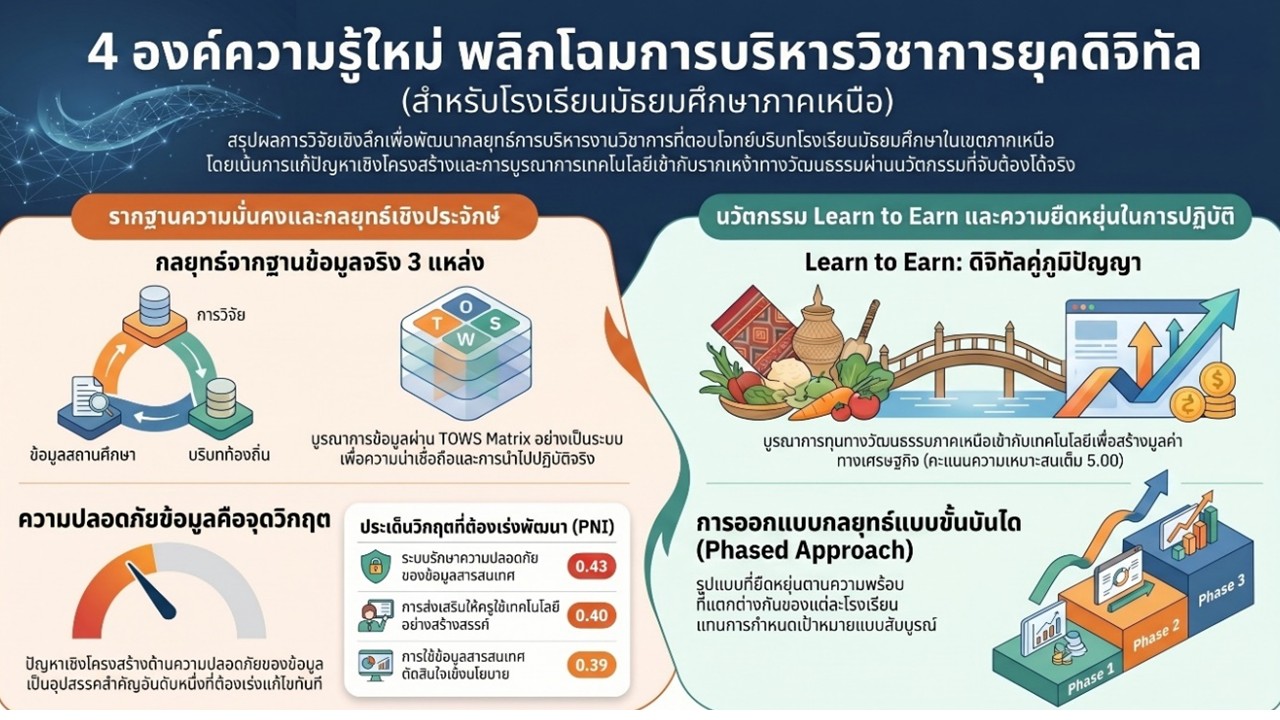
การวิจัยครั้งนี้มีวัตถุประสงค์เพื่อ 1) ประเมินความต้องการจำเป็นของการบริหารงานวิชาการในยุคดิจิทัลสำหรับโรงเรียนมัธยมศึกษา เขตภาคเหนือ 2) สร้างกลยุทธ์การบริหารงานวิชาการในยุคดิจิทัล และ 3) ประเมินความเหมาะสมและความเป็นไปได้ของกลยุทธ์ ใช้ระเบียบวิธีวิจัยแบบผสมผสานเชิงอธิบายเป็นลำดับ (Explanatory Sequential Mixed Method Design) ดำเนินการ 3 ระยะ ระยะที่ 1 ประเมินความต้องการจำเป็นจากกลุ่มตัวอย่างผู้บริหารสถานศึกษา 210 คน ซึ่งสุ่มแบบแบ่งชั้นจากประชากร 459 คน ใน 17 จังหวัดภาคเหนือ วิเคราะห์ด้วยค่าดัชนี PNImodified และ SWOT Analysis ระยะที่ 2 สร้างกลยุทธ์โดยการสัมภาษณ์เชิงลึกผู้บริหารสถานศึกษาที่มีวิธีปฏิบัติที่เป็นเลิศจากโรงเรียนรางวัล OBECQA จำนวน 7 คน วิเคราะห์ด้วย TOWS Matrix และตรวจสอบโดยผู้เชี่ยวชาญ 9 คน ผ่านการสนทนากลุ่ม ระยะที่ 3 ประเมินกลยุทธ์โดยผู้ทรงคุณวุฒิ 9 คน ด้วยมาตราส่วนประมาณค่า 5 ระดับ ผลการวิจัยพบว่า 1) สภาพปัจจุบันของการบริหารงานวิชาการในยุคดิจิทัลอยู่ในระดับมาก สภาพที่พึงประสงค์อยู่ในระดับมากที่สุด ค่า PNImodified รวมเท่ากับ 0.28 โดยด้านการบูรณาการเทคโนโลยีดิจิทัลและการใช้ข้อมูลเพื่อการตัดสินใจมีความต้องการจำเป็นสูงสุด จุดอ่อนวิกฤตได้แก่ การขาดระบบรักษาความปลอดภัยข้อมูลสารสนเทศ ครูขาดการใช้เทคโนโลยีอย่างสร้างสรรค์ และผู้บริหารมีข้อจำกัดในการใช้ข้อมูลตัดสินใจเชิงนโยบาย 2) กลยุทธ์ที่พัฒนาขึ้นมี 4 กลยุทธ์หลัก ได้แก่ การยกระดับโครงสร้างพื้นฐานดิจิทัลและระบบความปลอดภัยสารสนเทศเพื่อลดความเหลื่อมล้ำ การบูรณาการภาคีเครือข่ายเพื่อสนับสนุนการจัดการศึกษาและการมีส่วนร่วม การพัฒนาระบบบริหารจัดการและประกันคุณภาพเชิงรุกด้วยฐานข้อมูล และการส่งเสริมนวัตกรดิจิทัลและการจัดการเรียนรู้เชิงรุกเพื่อสร้างมูลค่าเพิ่มและทักษะอาชีพ 3) ผลการประเมินยืนยันว่ากลยุทธ์มีความเหมาะสมและความเป็นไปได้อยู่ในระดับมากที่สุด โดยทุกรายการประเมินทั้ง 36 ข้อ ผ่านเกณฑ์ที่กำหนด
คำสำคัญ : กลยุทธ์การบริหารงานวิชาการ, ยุคดิจิทัล, โรงเรียนมัธยมศึกษา, ภาคเหนือ, ความต้องการจำเป็น
Article Details

อนุญาตภายใต้เงื่อนไข Creative Commons Attribution-NonCommercial-NoDerivatives 4.0 International License.
เอกสารอ้างอิง
นงลักษณ์ วิรัชชัย และสุวิมล ว่องวานิช. (2542). การประเมินความต้องการจำเป็นในการบริหาร. สำนักพิมพ์แห่งจุฬาลงกรณ์มหาวิทยาลัย.
บุญชม ศรีสะอาด. (2554). การวิจัยเบื้องต้น (พิมพ์ครั้งที่ 7). สุวีริยาสาส์น.
พฤทธิ์ ศิริบรรณพิทักษ์. (2552). การวางแผนกลยุทธ์: แนวคิดและกรณีศึกษา (พิมพ์ครั้งที่ 7). สำนักพิมพ์จุฬาลงกรณ์มหาวิทยาลัย.
ยุทธศาสตร์ชาติ พ.ศ. 2561–2580. (2561, 13 ตุลาคม). ราชกิจจานุเบกษา, เล่ม 135 ตอนที่ 82 ก, 1–71.
สำนักงานเลขาธิการสภาการศึกษา. (2560). แผนการศึกษาแห่งชาติ พ.ศ. 2560–2579. https://backoffice.onec.go.th/uploaded/Outstand/2017-EdPlan60-79.pdf
Baglama, B., Evcimen, E., Altinay, F., Sharma, R. C., Tlili, A., Altinay, Z., Dagli, G., Jemni, M., Shadiev, R., Yucesoy, Y., & Celebi, M. (2022). Analysis of digital leadership in school management and accessibility of animation-designed game-based learning for sustainability of education for children with special needs. Sustainability, 14(13), 7730. https://doi.org/10.3390/su14137730
Bates, A. W. (2019). Teaching in a digital age: Guidelines for designing teaching and learning (2nd ed.). Tony Bates Associates.
Bryson, J. M. (2018). Strategic planning for public and nonprofit organizations: A guide to strengthening and sustaining organizational achievement (5th ed.). Wiley.
Creswell, J. W., & Creswell, J. D. (2022). Research design: Qualitative, quantitative, and mixed methods approaches (6th ed.). SAGE Publications.
David, F. R. (2017). Strategic management: Concepts and cases (16th ed.). Pearson.
DuFour, R., & Eaker, R. (1998). Professional learning communities at work: Best practices for enhancing student achievement. Solution Tree.
Epstein, J. L. (2011). School, family, and community partnerships: Preparing educators and improving schools (2nd ed.). Westview Press.
Fullan, M. (2020). Leading in a culture of change (2nd ed.). Jossey-Bass.
Harasim, L. (2017). Learning theory and online technologies (2nd ed.). Routledge. https://doi.org/10.4324/9781315716831
Hoy, W. K., & Miskel, C. G. (2007). Educational administration: Theory, research, and practice (8th ed.). McGraw-Hill.
Kolb, D. A. (2015). Experiential learning: Experience as the source of learning and development (2nd ed.). Pearson Education.
Krejcie, R. V., & Morgan, D. W. (1970). Determining sample size for research activities. Educational and Psychological Measurement, 30(3), 607–610. https://doi.org/ 10.1177/001316447003000308
Leithwood, K., Sun, J., & Pollock, K. (Eds.). (2017). How school leaders contribute to student success: The four paths framework. Springer.
Porter, M. E. (1985). Competitive advantage: Creating and sustaining superior performance. Free Press.
Siemens, G. (2013). Learning analytics: The emergence of a discipline. American Behavioral Scientist, 57(10), 1380–1400. https://doi.org/10.1177/0002764213498851
Thompson, A. A., & Strickland, A. J. (2003). Strategic management: Concepts and cases (13th ed.). McGraw-Hill.
Trilling, B., & Fadel, C. (2009). 21st century skills: Learning for life in our times. Jossey-Bass.
UNESCO. (2020). Education in a post-COVID world: Nine ideas for public action. International Commission on the Futures of Education. https://unesdoc.unesco.org/ark:/48223/ pf0000373717
World Bank. (2024). Digital progress and trends report 2023. https://doi.org/10.1596/978-1-4648-2049-6]
