
Strategies for Digital-Era Academic Administration for Secondary Schools in Northern Thailand
Article Sidebar
Main Article Content
Abstract
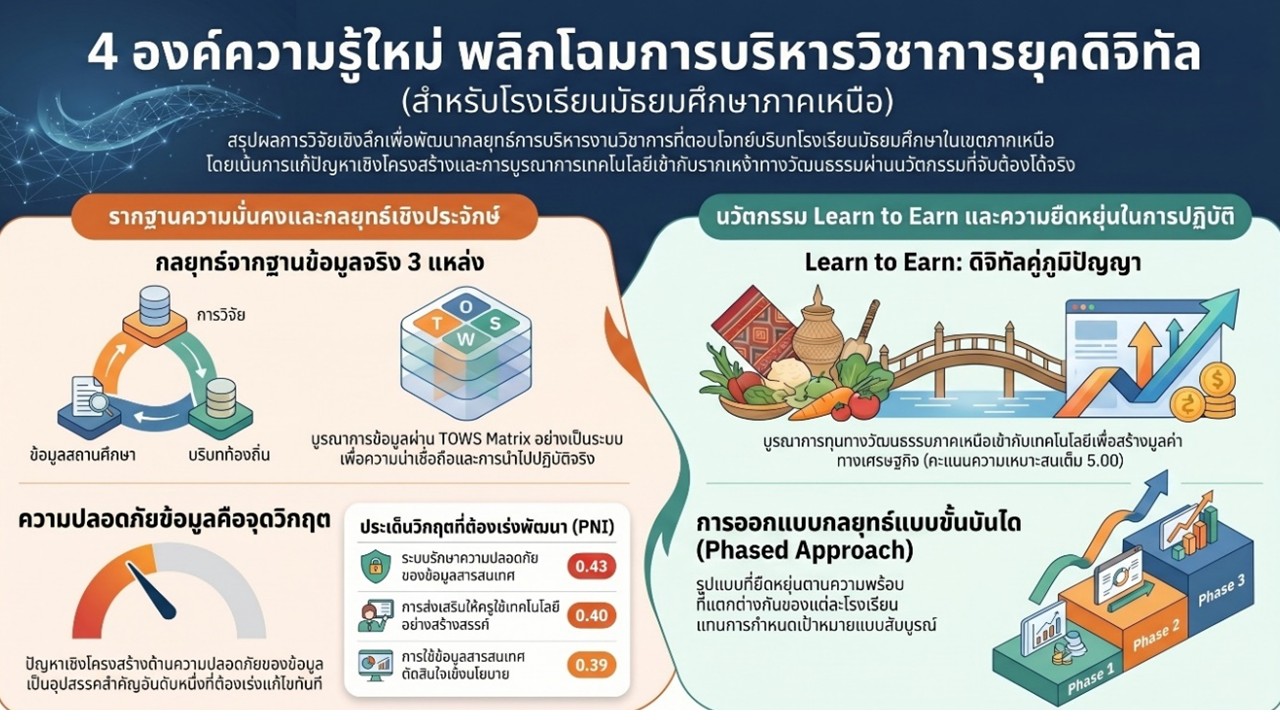
This research aimed to 1) assess the needs for digital-era academic administration in secondary schools in Northern Thailand, 2) develop strategies for such administration, and 3) evaluate the suitability and feasibility of the strategies. An Explanatory Sequential Mixed Method Design was employed in three phases. Phase 1 assessed needs through a questionnaire administered to 210 school administrators, drawn by stratified random sampling from a population of 459 administrators across 17 northern provinces, with data analyzed using the modified Priority Needs Index (PNImodified) and SWOT analysis. Phase 2 developed the strategies through semi-structured interviews with seven administrators of OBECQA award-winning schools, TOWS Matrix analysis, and expert review via a focus group with nine experts. Phase 3 evaluated the strategies through assessment by nine qualified experts using five-level rating scales. The findings were as follows. First, the current state of digital academic administration was at a high level and the desirable state at the highest level, yielding an overall PNImodified of 0.28. The highest-priority need was the integration of digital technology and the use of data for decision making. The critical weaknesses were the lack of information security systems, teachers limited creative use of technology, and administrators' limited use of data for policy decisions. Second, four main strategies were developed: (1) upgrading digital infrastructure and information security to reduce educational inequality; (2) integrating partnership networks to support educational provision and participation; (3) developing data-driven management and proactive quality-assurance systems; and (4) promoting digital innovators and active learning for value creation and vocational skills. Third, expert evaluation confirmed that the strategies were suitable and feasible at the highest level, with all 36 evaluation items meeting the established criteria
.Keywords: Academic Administration Strategies, Digital Era, Secondary Schools, Northern Thailand, Needs Assessment
Article Details

This work is licensed under a Creative Commons Attribution-NonCommercial-NoDerivatives 4.0 International License.
References
นงลักษณ์ วิรัชชัย และสุวิมล ว่องวานิช. (2542). การประเมินความต้องการจำเป็นในการบริหาร. สำนักพิมพ์แห่งจุฬาลงกรณ์มหาวิทยาลัย.
บุญชม ศรีสะอาด. (2554). การวิจัยเบื้องต้น (พิมพ์ครั้งที่ 7). สุวีริยาสาส์น.
พฤทธิ์ ศิริบรรณพิทักษ์. (2552). การวางแผนกลยุทธ์: แนวคิดและกรณีศึกษา (พิมพ์ครั้งที่ 7). สำนักพิมพ์จุฬาลงกรณ์มหาวิทยาลัย.
ยุทธศาสตร์ชาติ พ.ศ. 2561–2580. (2561, 13 ตุลาคม). ราชกิจจานุเบกษา, เล่ม 135 ตอนที่ 82 ก, 1–71.
สำนักงานเลขาธิการสภาการศึกษา. (2560). แผนการศึกษาแห่งชาติ พ.ศ. 2560–2579. https://backoffice.onec.go.th/uploaded/Outstand/2017-EdPlan60-79.pdf
Baglama, B., Evcimen, E., Altinay, F., Sharma, R. C., Tlili, A., Altinay, Z., Dagli, G., Jemni, M., Shadiev, R., Yucesoy, Y., & Celebi, M. (2022). Analysis of digital leadership in school management and accessibility of animation-designed game-based learning for sustainability of education for children with special needs. Sustainability, 14(13), 7730. https://doi.org/10.3390/su14137730
Bates, A. W. (2019). Teaching in a digital age: Guidelines for designing teaching and learning (2nd ed.). Tony Bates Associates.
Bryson, J. M. (2018). Strategic planning for public and nonprofit organizations: A guide to strengthening and sustaining organizational achievement (5th ed.). Wiley.
Creswell, J. W., & Creswell, J. D. (2022). Research design: Qualitative, quantitative, and mixed methods approaches (6th ed.). SAGE Publications.
David, F. R. (2017). Strategic management: Concepts and cases (16th ed.). Pearson.
DuFour, R., & Eaker, R. (1998). Professional learning communities at work: Best practices for enhancing student achievement. Solution Tree.
Epstein, J. L. (2011). School, family, and community partnerships: Preparing educators and improving schools (2nd ed.). Westview Press.
Fullan, M. (2020). Leading in a culture of change (2nd ed.). Jossey-Bass.
Harasim, L. (2017). Learning theory and online technologies (2nd ed.). Routledge. https://doi.org/10.4324/9781315716831
Hoy, W. K., & Miskel, C. G. (2007). Educational administration: Theory, research, and practice (8th ed.). McGraw-Hill.
Kolb, D. A. (2015). Experiential learning: Experience as the source of learning and development (2nd ed.). Pearson Education.
Krejcie, R. V., & Morgan, D. W. (1970). Determining sample size for research activities. Educational and Psychological Measurement, 30(3), 607–610. https://doi.org/ 10.1177/001316447003000308
Leithwood, K., Sun, J., & Pollock, K. (Eds.). (2017). How school leaders contribute to student success: The four paths framework. Springer.
Porter, M. E. (1985). Competitive advantage: Creating and sustaining superior performance. Free Press.
Siemens, G. (2013). Learning analytics: The emergence of a discipline. American Behavioral Scientist, 57(10), 1380–1400. https://doi.org/10.1177/0002764213498851
Thompson, A. A., & Strickland, A. J. (2003). Strategic management: Concepts and cases (13th ed.). McGraw-Hill.
Trilling, B., & Fadel, C. (2009). 21st century skills: Learning for life in our times. Jossey-Bass.
UNESCO. (2020). Education in a post-COVID world: Nine ideas for public action. International Commission on the Futures of Education. https://unesdoc.unesco.org/ark:/48223/ pf0000373717
World Bank. (2024). Digital progress and trends report 2023. https://doi.org/10.1596/978-1-4648-2049-6]
