
Challenge-Based Learning Management to Enhance Digital Literacy Characteristics for Senior High School Students
Article Sidebar
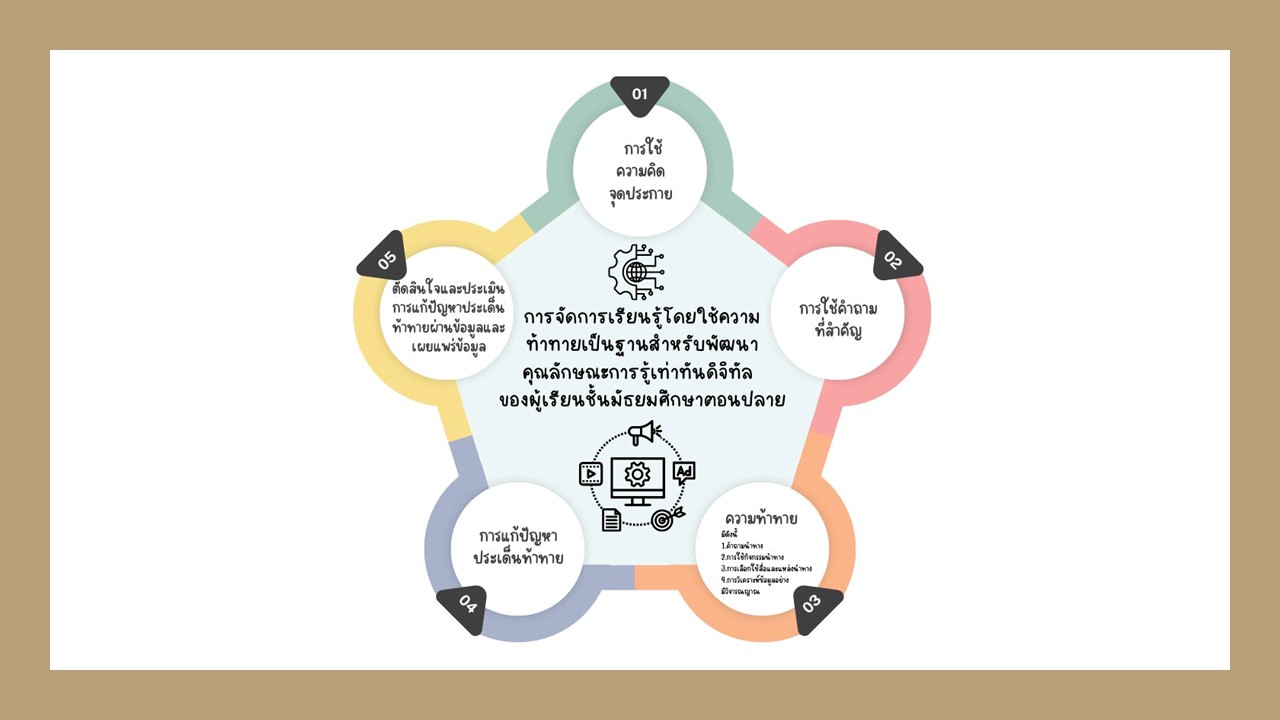
Main Article Content
Abstract
The purpose of this research 1) To strengthen the characteristics of digital literacy through learning management using challenges as the base of high school learners. 2) To study the satisfaction of high school learners who were managed using challenges as the basis. Action Research The sample used in the research is as follows: Secondary students 4/6 Suratthani School 2 1 classroom with 35 students obtained by the specific selection method. The tools used in the research include: 1) Challenge-based learning management plan to strengthen digital literacy attributes. 2) Digital Literacy Assessment and 3) Challenge-based student satisfaction assessment to reinforce digital literacy attributes. The statistics used in the research are as follows: Average Standard Deviation. The statistics used to determine the accuracy of the research instruments used the consistency index. The summary of the research results shows that: 1) Average score of digital literacy attributes after participating in learning management using challenges as a base for high school learners. The overall average score is equal to 4.54 The standard deviation value is equal to 0.66 At the highest level. 2) Average score of satisfaction assessment results of learners who have been managed learning using challenges as a basis to strengthen their digital literacy characteristics. The total average score is equal to 4.89 The standard deviation value is equal to 0.33 at the highest level.
Article Details
References
กาญจนา เดชสม และ รุ่งชัชดาพร เวหะชาติ. (2564). การพัฒนาความเป็นพลเมืองดิจิทัลของนักเรียนในศตวรรษที่ 21. วารสารมหาวิทยาลัยพายัพ, 31(1), 151-163.
จุฑามาส โหย่งไทย. (2561). การพัฒนาทักษะการคิดเชิงวิพากษ์ในศตวรรษที่ 21. วารสารบริหารการศึกษา มหาวิทยาลัยศิลปากร, 9(2), 344-356.
ชนัญสรา อรนพ ณ อยุธยา. (2565). การสื่อสารดิจิทัลระหว่างรุ่นอายุกับการเปลี่ยนแปลงของคุณค่าสู่การเป็นพลเมืองดิจิทัล ภายใต้แผนงานยุทธศาสตร์เป้าหมาย (Spearhead) ด้านสังคม แผนงานคนไทย 4.0 สำนักงานการวิจัยแห่งชาติ (วช.), 6. https://www.khonthai4-0.net/system/resource/file/kpfgo_content_attach_file_333_1.pdf?date=2022-04-26%2013:57:17.1
ชัยวัฒน์ สุทธิรัตน์. (2559). 80 นวัตกรรมการจัดการเรียนรู้ที่เน้นผู้เรียนเป็นสำคัญ (พิมพ์ครั้งที่ 7, [ฉบับพิมพ์ซ้ำ].). ศูนย์หนังสือจุฬาลงกรณ์มหาวิทยาลัย ผู้จัดจำหน่าย.
บุษบา สุธีธร. (2564). ผลกระทบของสื่อสังคมที่มีต่อวัยรุ่น: The impacts of social media on adolescents. วารสารการประชาสัมพันธ์และการโฆษณา, 14(1), 34-48.
วรพจน์ วงศ์กิจรุ่งเรื่อง. (2561). คู่มือพลเมืองดิจิทัล. https://thaidigizen.com/wp- content/uploads/2018/06/Digital Citizenship-Book-ok,pdf
วิภาพรรณ พินลา และวิภาดา พินลา. (2561). การจัดการเรียนรู้สังคมศึกษาในยุคศตวรรษที่ 21 = Learning management social studies in the 21st century (พิมพ์ครั้งที่ 1.). กรุงเทพฯ: สำนักพิมพ์แห่งจุฬาลงกรณ์มหาวิทยาลัย.
สำนักงานคณะกรรมการดิจิทัลเพื่อเศรษฐกิจและสังคมแห่งชาติ. (2562). หลักสูตรการเข้าใจดิจิทัลสำหรับพลเมืองไทย. https://itm.eg.mahidol.ac.th/itm/wp-content/uploads/2020/04/MDES-ONDE-Digital-Literacy-หลักสูตรการเข้าใจดิจิทัลสำหรับพลเมืองไทย.pdf
สุมน อมรวิวัฒน์. (2542). การพัฒนาการเรียนรู้ตามแนวพุทธศาสตร์ : ทักษะกระบวนการเผชิญ สถานการณ์. นนทบุรี : โครงการกิติเมธีสาขาศึกษาศาสตร์ มหาวิทยาลัยสุโขทัยธรรมาธิราช.
สุวัจนา จริตกาย. (2564). การพัฒนาความสามารถในการประยุกต์ใช้โปรแกรม Scratch ด้วยการ จัดการเรียนรู้โดยใช้ความท้าทายเป็นฐาน สำหรับนักเรียนชั้นมัธยมศึกษาปีที่ 1 (วิทยานิพนธ์ ศึกษาศาสตรมหาบัณฑิต, มหาวิทยาลัยธุรกิจบัณฑิต).
อุษา บิ้กกิ้นส์. (2561). ตัวบ่งชี้การรู้เท่าทันสื่อ สารสนเทศ และดิจิทัลระดับบุคคล เพื่อส่งเสริมความเป็นพลเมืองประชาธิปไตย. http://cclickthailand.com/wp-content/uploads/2020/07/ตัวบ่งชี้สสย-ฉบับสมบูรณ์-15-มีนาคม- ดร.อุษา-บิ้กกิ้นส์.pdf
อุษา บิ๊กกิ้นส์. (2563). ตัวบ่งชี้การรู้เท่าทันสื่อ สารสนเทศ และดิจิทัลระดับบุคคล เพื่อส่งเสริมความ เป็นพลเมืองประชาธิปไตย ฉบับสมบูรณ์. https://cclickthailand.com/wp- content/uploads/2020/07/ตัวบ่งชี้สสย-ฉบับสมบูรณ์-15-มีนาคม-ดร.อุษา-บิ๊กกิ้นส์.pdf
Allison, M. (2010). Review: Digital and Media Literacy: A Plan of Action (2010). The Journal of Media Literacy Education. https://doi.org/10.23860/jmle-2-3-7
American Library Association. (2013). Digital literacy, libraries, and public policy: Report of the Office for Information Technology Policy's Digital Literacy 3020460287 Task Force. http://www.districtdispatch.org/wp- content/uploads/2013/01/2012 OITP_diglitreport 1 22 13.pdf
Canada Media Awareness Network. (2010). Digital literacy in Canada: From inclusion to transformation. Canada: The Network.
Chapman, B. (1999). Digital Literacy: By Paul Gilster. New York: John Wiley & Sons, 1997. 276 p. . In Government Information Quarterly, 16(1), 77-78.
Ferari, A. (2012). Digital Competence in practice: An analysis of frameworks. Publications Office of the European Union. https://publications.jrc.ec.europa.eu/repository/handle/JRC68116
Future of Education Technology Conference. (2021). What is digital literacy in schools and why is it important? https://blog.fetc.org/what-is-digital-literacy-in- schools-and-why-is-it-important/
Hartley, J. (2002). Communication, cultural and media studies: the key concepts (3rd , repr..). London: Routledge.
Hobbs, R., & Moore, D. C. (2013). Discovering media literacy: Teaching digital media and popular culture in elementary school. Thousand Oaks, Calif: Corwin.
Johnson, & Adams. (2011). Challenge Based Learning: The Report from the Implementation Project. The New Media Consortium. https://files.eric.ed.gov/fulltext/ED532404.pdf
Kaeophanuek, S., Jaitip, N.-S., & Nilsook, P. (2018). How to Enhance Digital Literacy Skills among Information Sciences Students. International journal of information and education technology, 8(4), 292-297.
Karpati, A. (2011). Digital Literacy in Education. UNESCO Institute for Information Technologies in Education.
Lesley. (2023). Teaching Digital Literacy To Students in 2023. https://elearningindustry.com/teaching-digital-literacy-to-students-in-2023
Nichols, M., & Cator, K. (2008). Challenge Based Learning. Apple. https://www.challengebasedlearning.org/wp-content/uploads/2019/03/CBL_Paper_2008.pdf
Ribble, M. (2020, January 28). Digital citizenship is more important than ever. ISTE. https://www.iste.org/explore/digital-citizenship-more-important-ever?articleid=535
