
The Guidelines of School Administration Based on Corporate Social Responsibility in School under the Udon Thani Primary Education Service Area Office 3
Article Sidebar
Main Article Content
Abstract
The purposes of this research were 1) to study the current state, the desired state, and the essential needs for school administration based on corporate social responsibility 2) to design the guidelines for school administration based on corporate social responsibility and 3) to evaluate the guidelines for school administration based on corporate social responsibility. The research was conducted in three phases using Mixed Methods Research. The first phase involved studying the current state, desired state, and needs in the school administration based on corporate social responsibility. The sample group comprised 332 teachers and school administrators under the Udon Thani Primary Education Service Area Office 3 for the academic year 2023, derived from stratified random sampling. The research instrument used was a questionnaire five rating scales with an index of item objective congruence ranking from 0.60 – 1.00. For the current state, the index of discrimination was between 0.37 - 0.84, with a reliability of 0.97. For the desired state, the index of discrimination was between 0.27 - 0.97, with a reliability of 0.98. Data analysis included finding percentages, means, standard deviations, and the modified priority needs index (PNI Modified). The second phase focused on designing the guidelines for school administration based on social responsibility using semi-structured interviews with five school directors under the Area Office of Udon Thani Primary Education Service Area Office 3, selected through purposive sampling and analysis of the data. The third phase, aimed to evaluate the guidelines for school administration based on corporate social responsibility. The instrument was used to evaluate with five rating scales, including: suitability, possibility, and usefulness.
The results of the research were as follows:
1. The overall current state and desired state were both at a high level. The needs in school administration based on corporate social responsibility were analyzed and sorted from highest to lowest as follows: 1) Humanitarian 2) Legal 3) Economic 4) Environmental and 5) Good Governance.
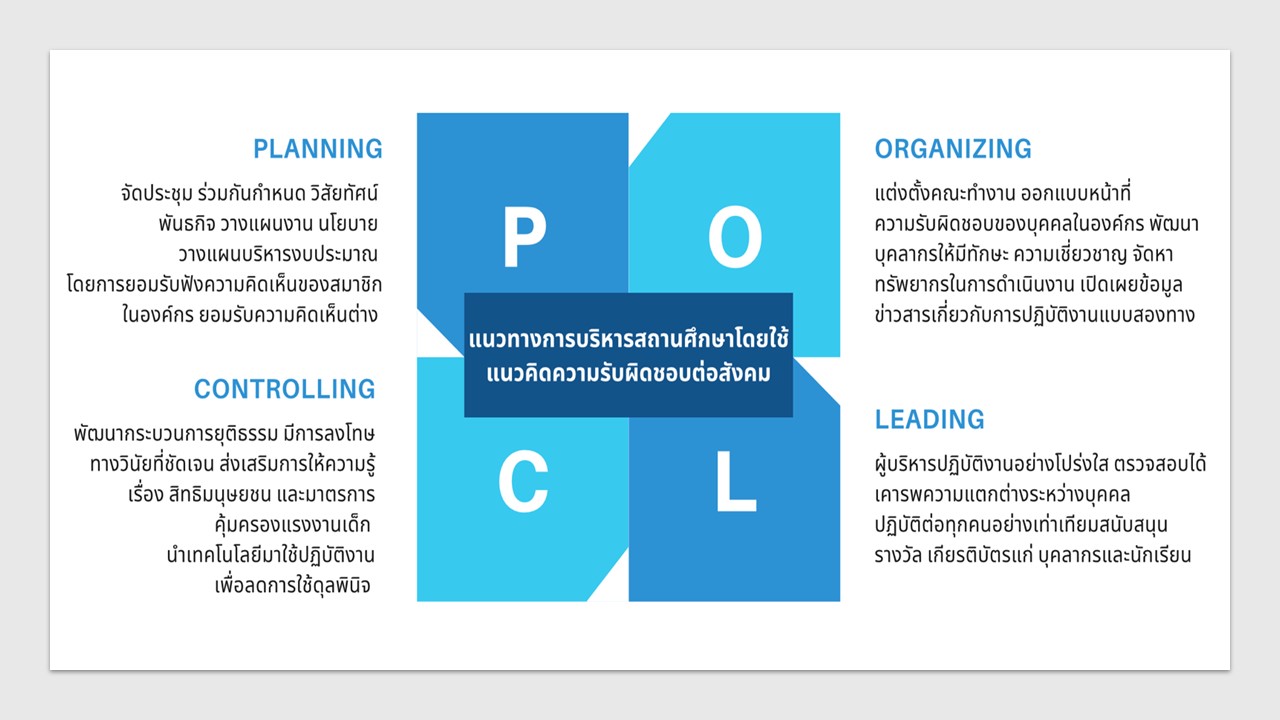
2. The guidelines for school administration based on corporate social responsibility are divided as follows: 1) Economic aspect - 3 practices, 2) Legal aspect - 5 practices, 3) Humanitarian aspect - 4 practices, 4) Environmental aspect - 4 practices, and 5) Good Governance aspect - 7 practices.
3. The evaluation of the guidelines found that overall, they were at the highest level in every aspect. Feasibility, usefulness, and suitability were all rated at the highest level when considering each aspect.
Article Details
References
กระทรวงศึกษาธิการ. (2546). พระราชบัญญัติการศึกษาแห่งชาติพุทธศักราช 2542 แก้ไขเพิ่มเติม (ฉบับที่ 2) พุทธศักราช 2545. กรุงเทพ ฯ: คุรุสภา
กระทรวงศึกษาธิการ. (2554). คู่มือการบริหารสถานศึกษาขั้นพื้นฐานที่เป็นนิติบุคคล. กรุงเทพฯ: โรงพิมพ์
องค์การรับส่งสินค้าและพัสดุภัณฑ์ (ร.ส.พ.).
จอย ทองกล่อมสี. (2555). การพัฒนาตัวบ่งชี้ความรับผิดชอบต่อสังคมของสถาบันอุดมศึกษาไทยตาม
หลักธรรมาภิบาล. วิทยานิพนธ์ครุศาสตรดุษฎีบัณฑิต สาขาวิชาอุดมศึกษาจุฬาลงกรณ์มหาวิทยาลัย.
เกรียงศักดิ์ เจริญวงศ์ศักดิ์. (2547). ยุทธศาสตร์การพัฒนาขีดความสามารถในการแข่งขันของภาคการ
ผลิตไทย. กรุงเทพฯ: วิทยาลัยป้องกันราชอาณาจักร.
จินตนา บุญบงการ. (2558). จริยธรรมทางธุรกิจ. กรุงเทพฯ: จุฬาลงกรณ์มหาวิทยาลัย.
บุญชม ศรีสะอาด. (2560). การวิจัยเบื้องต้น (ฉบับปรับปรุงใหม่). พิมพ์ครั้งที่ 9. กรุงเทพฯ: สุวีริยาสาส์น.
ประเสริฐ ทองบริสุทธิ์. (2559). การพัฒนาตัวบ่งชี้ความรับผิดชอบต่อสังคมของสถานศึกษา สังกัด
สำนักงานเขตพื้นที่การศึกษาประถมศึกษา. วิทยานิพนธ์ครุศาสตรดุษฎีบัณฑิต สาขาวิชาการบริหาร
การศึกษา มหาวิทยาลัยราชภัฏวไลยอลงกรณ์ ในพระบรมราชูปถัมภ์.
ยศสราวดี กรึงไกร. (2560). การพัฒนารูปแบบการบริหารสถานศึกษาด้วยความรับผิดชอบต่อสังคม
ของสถานศึกษาสังกัดองค์กรปกครองส่วนท้องถิ่น. วารสารสันติศึกษาปริทรรศน์ มจร. 6(4), ตุลาคม-
ธันวาคม.
ศิริวรรณ เสรีรัตน์, สมชาย หิรัญกิตติ, ธนวรรธ ตั้งสินทรัพย์ศิริ. (2550). การจัดการและพฤติกรรมองค์การ.
กรุงเทพฯ: ธีระฟิล์มและไซเท็กซ์.
สมพงษ์ ยิ่งเมือง. (2561). การศึกษาตัวบ่งชี้ความรับผิดชอบต่อสังคมของนักเรียน สังกัดองค์การบริหาร
ส่วนตำบลคลองประสงค์ อำเภอเมือง จังหวัดกระบี่. สุราษฎร์ธานี: มหาวิทยาลัยราชภัฏสุราษฎร์ธานี.
สุวิมล ว่องวาณิช. (2550). การวิจัยประเมินความต้องการจำเป็น. กรุงเทพมหานคร: สานักพิมพ์แห่ง
จุฬาลงกรณ์มหาวิทยาลัย.
Bovee, C. L., Thill, J. V., Wood, M. B., & Dovel, G. P. (1993). Management. New York: McGrow-
Hill.
Carroll, A. B. (1991). The Pyramid of Corporate Social Responsibility: Toward the Moral
Management of Organization Stakeholders. Business Horizons. 34(4), 39-48.
Denzin, N.K. (1970). The research act: A theoretical introduction to sociological methods. Chicago: Aldine Publishing Co. อ้างถึงใน สินพันธุ์ พินิจ. (2549). เทคนิคการวิจัยทางสังคมศาสตร์. พิมพ์ครั้งที่ 2. กรุงเทพฯ: วิทยพัฒน์.
Likert, R. (1967). The human organization: Its management and value. New York: McGraw-
Hill.
International Organization for Standardization. The (ISO). (2010). ISO 26000: Guidance on
social Responsibility International Standard. Geneva: Intentional Organization for
Standardization.
Krejcie, R.V., & D.W. Morgan. (1970). “Determining Sample Size for Research Activities”.
Educational and Psychological Measurement. 30(3) : 607 – 610.
Post, J. E., Lawrence, A. T., & Water, J. (2005). Business and Society: Corporate Strategy,
Public Policy, Ethics. Boston: McGraw-Hill/Lrwin.
