
THE GUIDELINES FOR COMPETENCY DEVELOPMENT OF MOTIVATION OF EDUCATION ADMINISTRATORS UNDER LOEI PRIMARY EDUCATIONAL SERVICE AREA
Article Sidebar
Main Article Content
Abstract
The purposes of this research were 1) to study the current condition Desired condition and the necessary needs of developing the motivational competencies of educational institution administrators, 2) to design guidelines for developing the motivational competencies of educational institution administrators, and 3) to evaluate guidelines for developing the motivational competencies of educational institution administrators. The research was conducted in three phases using Mixed Methods Research. The first phase involved studying the current state, desired state, and needs in the internal of developing the motivational competencies of educational institution administrators. The sample group comprised 337 teachers and school administrators under the Area Office of Loei Primary Educational Service, derived from stratified random sampling. The research instrument used was a questionnaire with five rating scales. For the current state, the index of discrimination was between 0.37 - 0.88 with a reliability of 0.96. For the desired state, the index of discrimination was between 0.75 - 0.97, with a reliability of 0.97. Data analysis included finding percentages, means, standard deviations, and the modified priority needs index (PNI Modified). The second phase focused on designing the guidelines using semi-structured interviews. The informant group consisted of directors. with three person each, selected through purposive sampling and analysis of the data. The third phase, aimed to evaluate the guidelines for competency development of motivation of education administrators under Loei primary educational service area. The instrument was used to evaluate with five rating scales, including: suitability, possibility, and usefulness.
The results of the research were as follows:
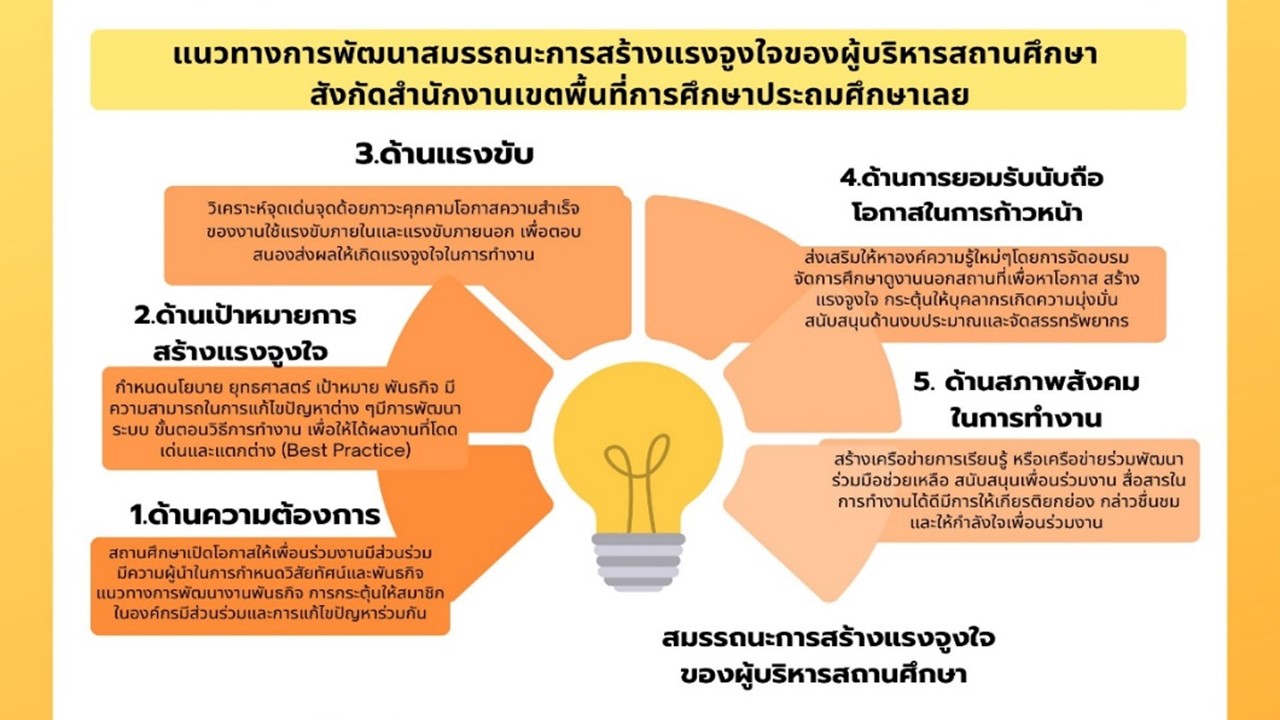
- The current state of development of motivational competencies of educational institution administrators. Overall it is at a high level. and desirable conditions for the development of motivational competencies of educational institution administrators. Overall it is at a high level. and the necessary needs of developing the motivational competencies of educational institution administrators Arrange needs and necessities from highest to lowest as follows: as follows: 1) needs 2) motivational goals 3) driving forces 4) acceptance of advancement opportunities and 5) social working conditions.
- Results of the study of guidelines for developing motivational competencies of educational institution administrators. by semi-structured interviews sample group Educational institution administrators, 5 people, consisting of: as follows: 1) needs 2) motivational goals 3) driving forces 4) acceptance of advancement opportunities and 5) social working conditions.
- Guidelines for developing the motivational competencies of educational institution administrators Overall, it is at the highest level. And when considering each aspect, it was found that 1) Appropriateness is at a high level 2) feasibility at a high level and 3) the aspect of usefulness At the highest level
Keywords: The guidelines, Competency of educational administrators, Motivation
Article Details
References
กระทรวงศึกษาธิการ. (2546). พระราชบัญญัติการศึกษาแห่งชาติ พ.ศ.2542 และที่แก้ไขเพิ่มเติม (ฉบับที่2) พ.ศ. 2545. กรุงเทพฯ: องค์การรับส่งสินค้าและพัสดุภัณฑ์.
________. (2562). พระราชบัญญัติการศึกษาแห่งชาติ พ.ศ. 2542 และที่แก้ไขเพิ่มเติมจนถึง (ฉบับที่ 4) พ.ศ. 2562. กรุงเทพฯ : กระทรวงศึกษาธิการ.
กอบชัย มณีตัน. (2559). ความสัมพันธ์ระหว่างการบริหารแบบมุ่งผลสัมฤทธิ์กับผลสำเร็จในการดำเนินงานตามพันธกิจของสถานศึกษาสังกัดสำนักงานเขตพื้นที่การศึกษาประถมศึกษาเพชรบุรี เขต1. วิทยานิพนธ์ครุศาสตรมหาบัณฑิตสาขาวิชาการบริหารการศึกษา: มหาวิทยาลัยราชภัฏเพชรบุรี.
กิ่งแก้ว ทรัพย์พระวงศ์. (2540). จิตวิทยาทั่วไป. พิมพ์ครั้งที่ 3. กรุงเทพฯ : คณะมนุษยศาสตร์ มหาวิทยาลัยรามคำแหง.
จอมพงศ์ มงคลวนิช. (2554). การศึกษาสู่การพัฒนาที่ยั่งยืน : การบริหารองค์การและบุคลากรทางการศึกษา. กรุงเทพฯ: สถาบันเทคโนโลยีสยาม.
จันทร์ชุ่ม เมืองปัก. (2546). แรงจูงใจและการจูงใจสร้างปาฏิหาริย์. กรุงเทพฯ: ดอกหญ้ากรุ๊ป.
จันทรานี สงวนนาม. (2551), ทฤษฎีและแนวปฏิบัติในการบริหารสถานศึกษา. พิมพ์ครั้งที่ 2,กรุงเทพฯ: บุ๊ค พอยท์.
ธนกฤต อัปกาญจน์. (2553). ลักษณะของงาน ความสนใจของพนักงาน และนโยบายและ เป้าหมายขององค์การที่พยากรณ์แรงจูงใจในการพัฒนาความก้าวหน้าใน สายอาชีพของพนักงาน: ศึกษาเฉพาะกรณีพนักงานของบริษัทริเวอร์แคว อินเตอร์เนชั่นแนล อุตสาหกรรม จํากัด. วิทยานิพนธ์ ศศ.ม. กรุงเทพฯ: มหาวิทยาลัยเทคโนโลยีพระจอมเกล้าพระนครเหนือ.
นงลักษณ์ วิรัชชัย. (2543). พรมแดนความร้ด้านการวิจัยและสถิติ. ชลบุรี : วิทยาลัยการบริหารรัฐกิจ มหาวิทยาลัยบูรพา.
นิธินาถ (สินธเดชะ) เตลาน. (2544). Competency. วารสารเอ็น พี ซี โฟกัส. 10 (52): 8-9.
บุญชม ศรีสะอาด. (2560). การวิจัยเบื้องต้น .พิมพ์ครั้งที่ 7. กรุงเทพฯ: สุวีริยาสาส์น.
เพิ่มสุข อนันต์มั่งคั่ง.(2560). การศึกษาการทำงานเป็นทีมของครูโรงเรียนมารีวิทย์ สังกัดสำนักงานเขตพื้นที่การศึกษาประถมศึกษาชลบุรี เขต 3. วิทยานิพนธ์ปริญญาการศึกษามหาบัณฑิต สาขาวิชาการบริหารการศึกษา มหาวิทยาลัยบูรพา.
วรพจน์ บุษราคัมวดี. (2552). องค์การและการจัดการ. ปทุมธานี : มหาวิทยาลัยราชภัฏไลยลงกรณ์ในพระบรมราชูปถัมภ์.
วรรณี ลิ่มอักษร. (2541). จิตวิทยาการศึกษา, สงขลา : มหาวิทยาลัยทักษิณ.
วรางคนา ชูเชิดรัตนา .(2562). แรงจูงใจในการพัฒนาความก้าวหน้าในสายอาชีพ การรับรู้ความยุติธรรมในองค์กร และความสามารถในการฟันฝ่าอุปสรรคที่ส่งผลต่อความผูกพันต่อองค์กรของพนักงานบริษัทเอกชนในเขตกรุงเทพมหานคร. วิทยานิพนธ์ปริญญา บัณฑิตศึกษา สาขาวิชาการบริหารการศึกษา.มหาวิทยาลัยกรุงเทพ.
วสันต์ เข็มทองคำ.(2559). แนวคิดที่สำคัญเกี่ยวกับการจูงใจ. ttystesgoode.comlesite/psychologymcu5/ kar-cungci-phu-reiyn/4-2-thvsdi-raeng-cungci.
วัชรีพรรณ จันทร์หอม .(2561). พฤติกรรมการบริหารที่ส่งผลต่อวิสัยทัศน์ของผู้บริหารโรงเรียนขยายโอกาส จังหวัดเชียงราย. วิทยนิพนธ์ครุศาสตรมหาบัณฑิต สาขาวิชามนุษยศาสตร์สังคมศาสตร์ และศิลปะ: มหาวิทยาลัยราชภัฎรำไพพรรณี.
สำนักงานคณะกรรมการการศึกษาขั้นพื้นฐาน. (2553). คู่มือและชุดฝึกอบรมการพัฒนาผู้บริหารสถานศึกษาแนวใหม่ ตามแนวปฏิบัติการศึกษาในทศวรรษที่ 2: การอบรมแบบผสมผสาน. กรุงเทพฯ: ชุมชนสหกรณ์การเกษตรแห่งประเทศไทย จำกัด.
สำนักงานปลัดกระทรวงศึกษาธิการ. (2563). แผนปฏิบัติราชการประจำปีงบประมาณ พ.ศ. 2563 ของสำนักงานปลัดกระทรวงศึกษาธิการ(ฉบับปรับปรุงตามงบประมาณที่ได้รับจัดสรร): http://www.bps.moe.go.th/2018/7cat=101
สำนักงานเลขาธิการสภาการศึกษา กระทรวงศึกษาธิการ. (2562). รายงานผลการวิจัยและพัฒนากรอบสมรรถนะผู้เรียนระดับประถมศึกษาตอนต้น สำหรับหลักสูตรการศึกษาขั้นพื้นฐาน. กรุงเทพฯ : 21 เซ็นจูรี่ จำกัด.
สุรางค์ โค้วตระกูล. (2550). จิตวิทยาการศึกษา. พิมพ์ครั้งที่ 7. กรุงเทพฯ: จุฬาลงกรณ์มหาวิทยาลัย.
สุวิมล ว่องวาณิช. (2550). การวิจัยประเมินความต้องการจำเป็น. กรุงเทพฯ: จุฬาลงกรณ์มหาวิทยาลัย.
อรวรรณ ภัทรดำเนินสุข.(2564). ภาวะผู้นำการเปลี่ยนแปลงของผู้บริหารกับแรงจูงใจในการปฏิบัติงานของครูในสังกัดสำนักงานเขตพื้นที่การศึกษาประถมศึกษาสมุทรสงคราม. วิทยานิพนธ์ปริญญาศึกษาศาสตรมหาบัณฑิตสาขาวิชาการบริหารการศึกษา. มหาวิทยาลัยศิลปากร.
Alderfer, C. P. (1972). Existence: Relatedness and growth, human needs in organizational setting. New York: Free Press.
Barnard, C. I.(1974). The Functions of the Executive (30th Anniversary ed.). Cambridge; MA: Harvard University.
Herzberg, Frederick; Mausner, Bernard; and Synderman, Block. (1959). The Motivation to Work. New York: John Wiley.
Krejcie, R. V. and Morgan, D. W. (1970). Determining sample size for research activities. Educational and Psychological Measurement, 30(3), 607–610.
Maslow A.H. (1954). A Theory of Human Motivation. Originally Published in Psychological Review, 50, 370-396.
Mc Clelland, D.C., & et al. (1953). The Achievement Motive. New York: Appleton- Century Croffs.
Northouse, P. G. (2016). Adaptive Leadership in Leadership: Theory and Practice (7th ed.). California: SAGE Publication
Vroom, V. H. (1970). Work and Motivation. New York: John Willey & Son.
