
The Exploratory Factor Analysis of Competencies of Early Childhood Education Students of the Faculty of Education at Sakon Nakhon Rajabhat University
Article Sidebar
Main Article Content
Abstract
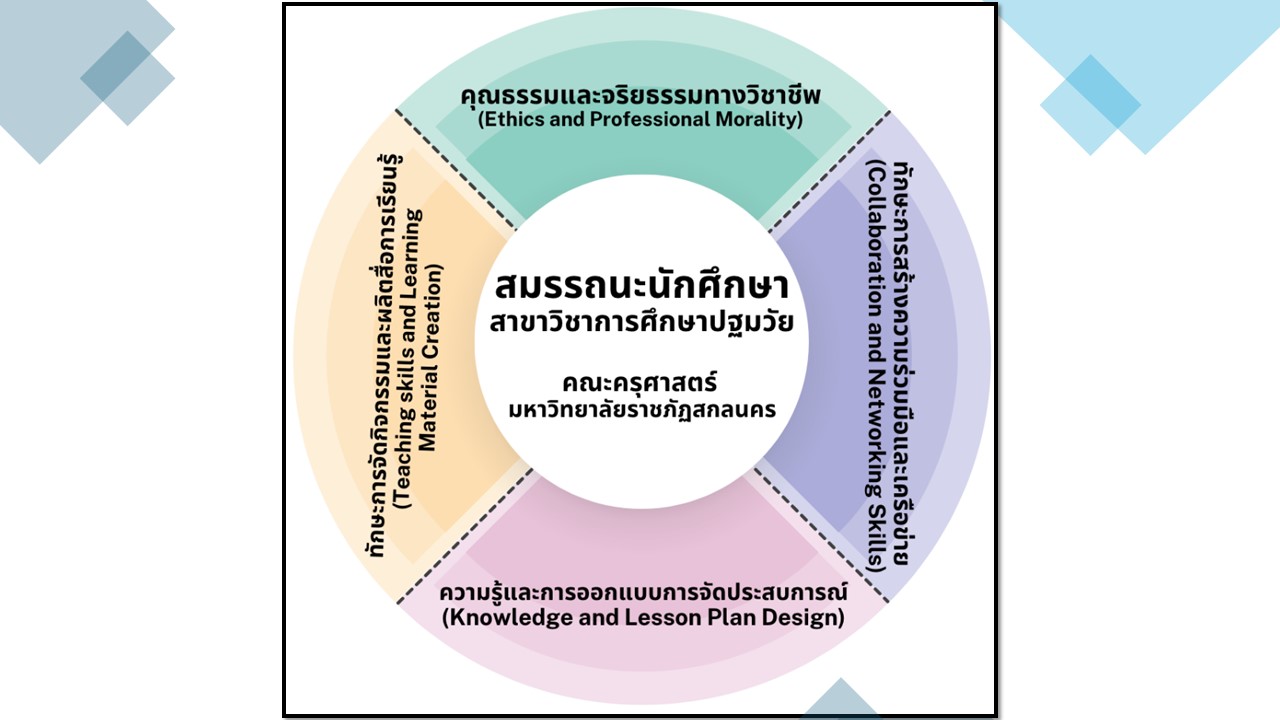
This research analyzed the exploratory components of students’ competencies in the early childhood education program. The sample consisted of 140 students of the early childhood education program in the faculty of education at Sakon Nakhon Rajabhat University. Those were students at all year levels of the second semester of the academic year 2024. The sample was selected using simple random sampling through a lottery method. The research instrument was a questionnaire designed to study students’ competencies in the early childhood education program. The content validity index of the questionnaire ranged from 0.80 to 1.00, the discrimination power ranged from 0.276 to 0.797, and the overall reliability was 0.930. Data was analyzed using exploratory factor analysis with orthogonal rotation through the varimax method. The findings revealed the competency components of early childhood education students consisted of 16 variables that did not form an identity matrix (Bartlett's test: = 2249.032, df = 300, p = .001) and had a KMO value of 0.926. After the varimax rotation, four components were identified, including 1) ethics and professional morality, 2) collaboration and networking skills, 3) knowledge and lesson plan design, and 4) teaching skills and learning material creation. These components collectively accounted for 63.900% of the variance in the competencies of early childhood education students. The professional ethics and morality component was the most significant predictor of competency, accounting for 46.555% of the variance. In contrast, the skills in organizing activities and producing learning materials contributed the least, accounting for 4.256%. Consequently, the development of student competencies, especially in early childhood education, should consider the identified components as a framework for fostering and enhancing their competencies in advance.
Article Details
References
กุญช์ภัสส์ พงษ์พานิชย์. (2561). การวิเคราะห์องค์ประกอบและตัวบ่งชี้สมรรถนะด้านการจัดการเรียนการสอนของครูผู้สอนนักเรียนระดับปฐมวัยที่ใช้ภาษาไทยเป็นภาษาที่สอง. วารสารมหาวิทยาลัยราชภัฏยะลา, 3(1), 1–12.
กุลชาติ พันธุวรกุล. (2562). การจัดการเรียนรู้ที่เน้นผู้เรียนเป็นสำคัญ. วารสารการศึกษาเพื่อพัฒนาทรัพยากรมนุษย์, 15(1), 50–65.
นัยนา พรหมดำ และศิริพร สุวรรณรังษี. (2563). การพัฒนาตัวบ่งชี้สมรรถนะทางวิชาชีพของครูปฐมวัย สังกัดสำนักงานเขตพื้นที่การศึกษาประถมศึกษานครราชสีมา. สิกขา วารสารศึกษาศาสตร์. 7(2), 108–116.
นิภาพร อ่วมแจ้ง, ภัทรพล มหาขันธ์ และวีณา ซุ้มบัณฑิต. (2566). สมรรถนะที่พึงประสงค์ด้านการจัดการเรียนรู้ของครูปฐมวัยในสังกัดสำนักงานเขตพื้นที่การศึกษาประถมศึกษาสมุทรสาคร. วารสารวิชาการมหาวิทยาลัยการกีฬาแห่งชาติ, 15(3), 145–155.
พรรนภา วิระชิด, ประภาพร บุญปลอด และศุภธนกฤษ ยอดสละ. (2567). การวิเคราะห์องค์ประกอบเชิงสำรวจสมรรถนะครูปฐมวัย สังกัดสำนักงานเขตพื้นที่การศึกษาประถมศึกษาบุรีรัมย์ เขต 3. วารสารการบริหารการศึกษาและภาวะผู้นำ มหาวิทยาลัยราชภัฏสกลนคร, 13(49), 214–225.
มยุรี สงวนศักดิ์. (2563). สมรรถนะและบทบาทของครูปฐมวัย. วารสารการพัฒนาวิชาชีพครู. 5(1), 78–95.
ยุทธ ไกรวรรณ. (2556). การบริหารการศึกษาผ่านกระบวนการสร้างสมรรถนะ. กรุงเทพฯ: มหาวิทยาลัยเกษตรศาสตร์.
สำนักงานคณะกรรมการการอุดมศึกษา. (2564). แผนด้านการอุดมศึกษาเพื่อผลิตและพัฒนากำลังคนของประเทศ พ.ศ. 2564 – 2570. https://www.mhesi.go.th.
สำนักส่งเสริมวิชาการและงานทะเบียน มหาวิทยาลัยราชภัฏสกลนคร. (2567). รายงานประจำปีการศึกษา 2567. สกลนคร: มหาวิทยาลัยราชภัฏสกลนคร.
สุภมาส อังศุโชติ, สมถวิล วิจิตรวรรณา และรัชนีกูล ภิญโญภานุวัฒน์. (2552). แนวทางการจัดการเรียนรู้ที่สอดคล้องกับสมรรถนะของครู. วารสารวิชาการครุศาสตร์, 17(3), 123–135.
Cattell, R. B. (1966). The Scree Test for the Number of Factors. Multivariate Behavioral Research, 1(2), 245–276.
Field, A. (2018). Discovering Statistics Using IBM SPSS Statistics (5th ed.). SAGE Publications.
Gorsuch, R. L. (2015). Factor analysis: Classic edition. Routledge.
Hair, J. F., Black, W. C., Babin, B. J., & Anderson, R. E. (2019). Multivariate Data Analysis (8th ed.). Cengage Learning.
Kaiser, H. F. (1958). The Varimax Criterion for Analytic Rotation in Factor Analysis. Psychometrika, 23(3), 187–200.
Kim, J., & Mueller, C. W. (1978). Factor Analysis: Statistical Methods and Practical Issues. Sage Publications.
Krejcie, R. V., & Morgan, D. W. (1970). Determining Sample Size for Research Activities. Educational and Psychological Measurement, 30(3), 607–610.
Liu, Q., & Wu, L. (2020). Enhancing Early Childhood Education Through Context-Based Learning. International Journal of Early Childhood Education, 35(2), 145–160.
NAEYC. (2022). Developmentally Appropriate Practice in Early Childhood Programs. Washington, DC: National Association for the Education of Young Children.
Smith, J., & Smith, R. (2020). The Impact of Teacher Competency on Early Childhood Development. Journal of Education Studies, 45(3), 123–145.
Tabachnick, B. G., & Fidell, L. S. (2019). Using Multivariate Statistics (7th ed.). Pearson.
UNESCO. (2021). Early Childhood Care and Education: The Foundation of Sustainable Development. SP: France.
