
Good Governance under Resource Constraints: Grounded Theory Research
Article Sidebar
Main Article Content
Abstract
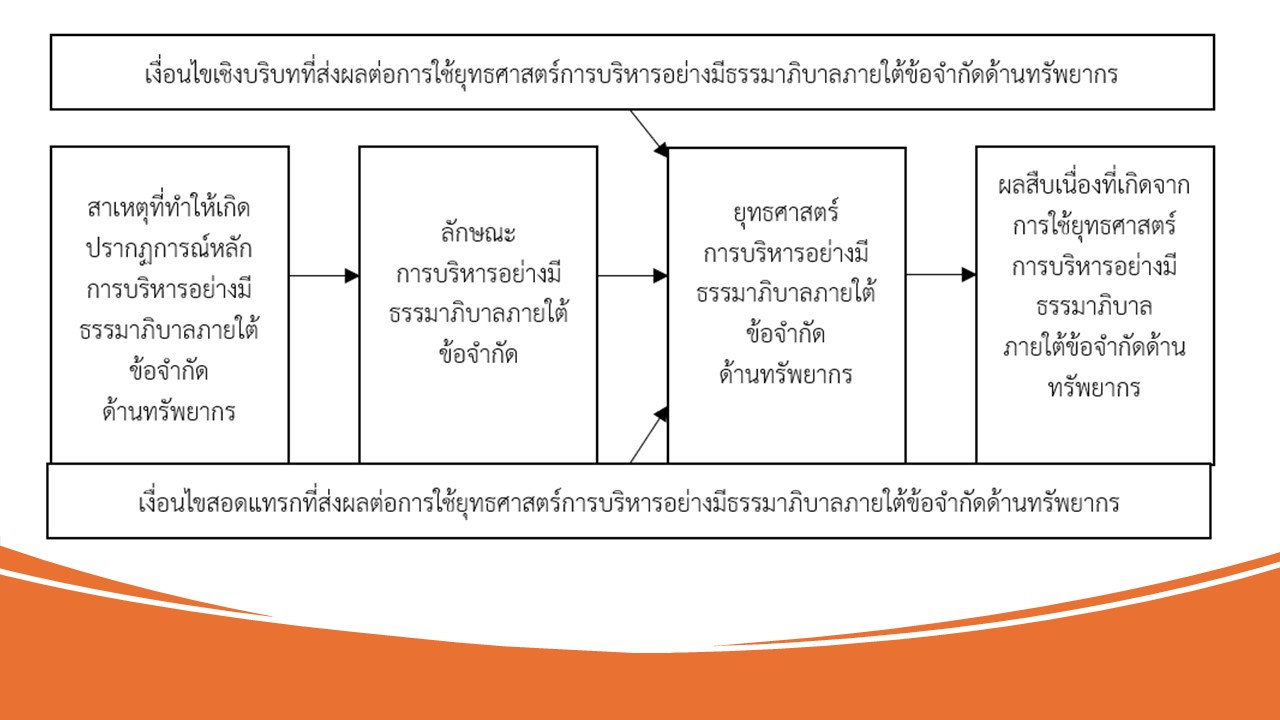
This research aimed to present a theoretical conclusion on good governance under resource constraints, utilizing the grounded theory research method. The study was conducted at Ban Tad Rin Thong School, which is part of the Office of the Primary Educational Service Area, Chaiyaphum Area 2. The researcher developed an instrument that served as a guideline for conducting in-depth interviews. The primary informants included individuals who were closely involved in the main phenomena within the educational institution. In total, 26 participants were interviewed, consisting of 1 school administrator, 5 teachers, 10 students, and 10 parents. Data analysis was performed inductively, following the Strauss and Corbin systematic model, and ultimately led to the development of a theoretical conclusion. The research findings identified the following principles of good governance under resource constraints: 1) Morality Principle: Administrators adhere to ethical standards and serve as role models for school personnel. They actively encourage community involvement in the development of educational institutions. 2) Transparency Principle: Administrators and personnel foster trust among each other by enhancing the organization's operational mechanisms to ensure transparency. 3) Participation Principle: Administrators and staff facilitate community participation, allowing stakeholders to contribute to the school's development plans. 4) Responsibility Principle: Executives and personnel recognize their rights and responsibilities. They are socially accountable, proactively address issues, and willingly accept the consequences of their actions and those of the organization. 5) Value Principle: Executives and staff effectively manage and utilize limited resources to maximize public benefits and ensure sustainability. solving problems, dare to accept the results of their actions and those of the organization, and 5) the principle of value. Executives and personnel in educational institutions manage and use limited resources to maximize the benefits of the public and ensure sustainability.
Article Details
References
กัลยา วานิชย์บัญชา. (2542). การวิเคราะห์สถิติ: สถิติเพื่อการตัดสินใจ. พิมพ์ครั้งที่ 4. กรุงเทพฯ: จุฬาลงกรณ์วิทยาลัย.
ทวีศักดิ์ นพเกสร. (2550). การวิจัยเชิงคุณภาพ. พิษณุโลก: ชมรมพยาบาลชุมชนแห่งประเทศไทย.
นิศา ชูโต. (2545). การวิจัยเชิงคุณภาพ. พิมพ์ครั้งท่ี 2. กรุงเทพฯ: แม็ทส์ปอยท์.
วีระยุทธ พรพจน์ธรมาส. (2562, มกราคม-มิถุนายน). องค์ประกอบของธรรมาภิบาลในโรงเรียน. วารสารนักบริหาร, 34(1), 86.
สถาบันพระปกเกล้า. (2562). บันทึกเรื่องเด่นรางวัลพระปกเกล้า: ท้องถิ่นกับการบริการสาธารณะ. กรุงเทพฯ: สถาบันพระปกเกล้า.
สำนักงานคณะกรรมการข้าราชการพลเรือน. (2546). ระเบียบสำนักนายกรัฐมนตรีว่าด้วยการสร้างระบบบริหารกิจการบ้านเมืองและสังคมที่ดี พ.ศ. 2542. http://www.ocse.go.th./GoodGovernment/ GGH.pdf
Strauss, A., & Corbin, J. (1998). Basics of Qualitative Research: Techniques and Procedures for Developing Grounded Theory. Thousand Oaks, CA: Sage Publications, Inc.
