
Innovative Organizational Culture of School
Article Sidebar
Main Article Content
Abstract
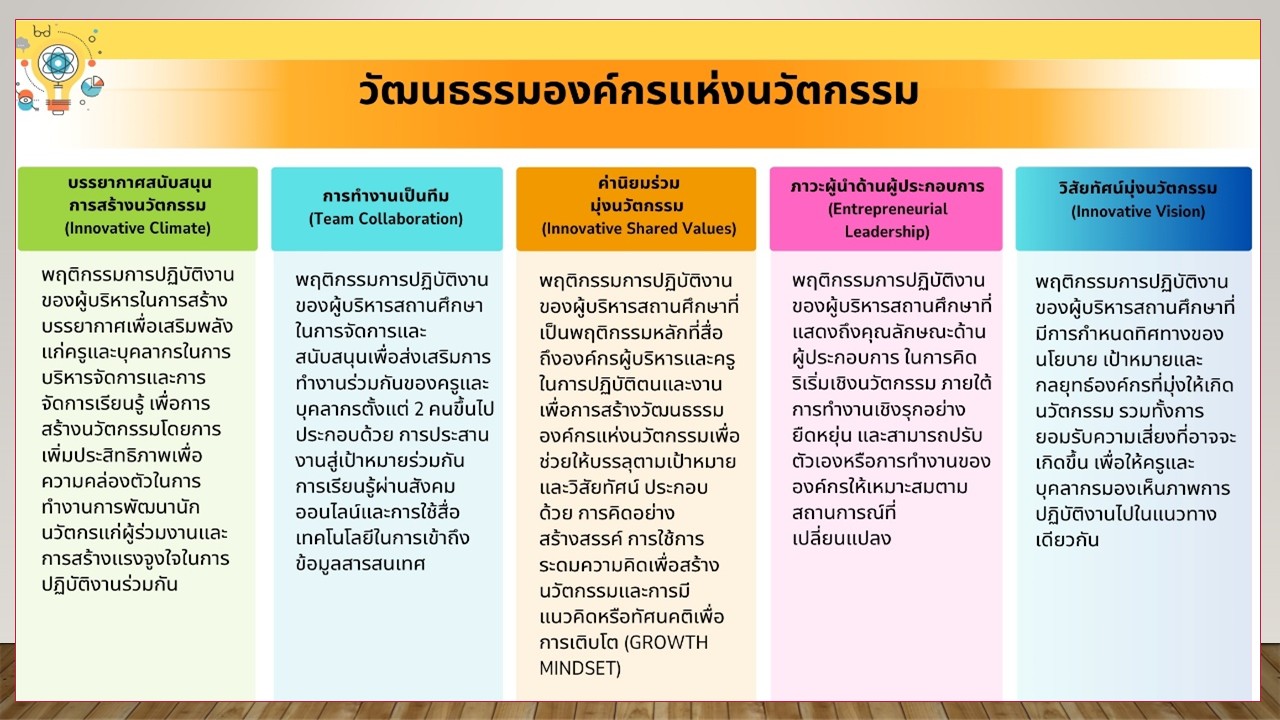
This research aims to study the current state, the desired state, and the necessity of the organizational culture for innovation in educational institutions under the Secondary Educational Service Area Office Bueng Kan, covering 25 schools. The sample group consisted of 19 school administrators and 259 teachers, determined using Krejcie and Morgan's table and stratified random sampling based on school size. The research instrument a five-point Likert scale questionnaire with a reliability coefficient of 0.987. The data were analyzed using frequency, percentage, standard deviation, and the Priority Need Index (PNIModified). The research findings indicate that the current overall state is at a moderate level, while the desired state is at the highest level. In the current state, the two aspects with the highest average scores are teamwork and entrepreneurial leadership, whereas the aspect with the lowest average score is shared values, focusing on innovation. For the desired state, the aspect with the highest average score is an environment that supports innovation, while the aspect with the lowest average score is an innovation-oriented vision. Regarding the necessity index of organizational culture for innovation in educational institutions, the aspect with the highest priority need is an environment that supports innovation (PNIModified = 0.410), whereas the aspect with the lowest priority need is an innovation-oriented vision (PNIModified = 0.398).
Article Details

This work is licensed under a Creative Commons Attribution-NonCommercial-NoDerivatives 4.0 International License.
References
กระทรวงศึกษาธิการ. (2567). นโยบายและจุดเน้นของกระทรวงศึกษาธิการ ประจำปีงบประมาณ พ.ศ.2567 กระทรวงศึกษาธิการ. (2560).
จิติมา วรรณศรี. (2564). การบริหารจัดการศึกษายุคดิจิทัล. พิษณุโลก: โรงพิมพ์รัตนสุวรรณการพิมพ์ครั้งที่ 3.
โชติพงษ์พันธุ์ สุขศิริมหาไพศาล, สิริพัฒถ์ ลาภจิตร และวันชัย สุขตาม. (2562). การพัฒนาองค์การสู่การเป็นองค์การที่ขับเคลื่อนด้วยวัฒนธรรมนวัตกรรมของสถาบันการศึกษาจังหวัดสุรินทร์. วารสารการบริหารการปกครองและนวัตกรรมท้องถิ่น, 3(2), 26-36.
ณัฐปภัสร์ สกุลพัฒน์รดา และจันทรัศม์ ภูติอริยวัฒน์. (2565). การเป็นองค์กรนวัตกรรมทางการศึกษาของโรงเรียนมัธยมศึกษาที่ได้รับรางวัลคุณภาพแห่งสำนักงานคณะกรรมการการศึกษาขั้นพื้นฐาน. วารสารศิลปการจัดการ, 6(4) 1844-1859
ธารารัตน์ โพธิ์ศรีเรือง. (2566). กลไกการพัฒนาวัฒนธรรมนวัตกรรมของสถานศึกษา สังกัดสำนักงานเขตพื้นที่การศึกษามัธยมศึกษาขอนแก่น ตามแนวคิด SIPOC MODEL. วิทยานิพนธ์หลักสูตรปริญญาศึกษาศาสตรมหาบัณฑิต สาขาวิชาการบริหารการศึกษา มหาวิทยาลัยขอนแก่น.
ธวัชชัย วรสถิตย์ และณัฐพันธ์ บัววราภรณ์. (2562). วัฒนธรรมองค์กรที่ส่งผลต่อการพัฒนานวัตกรรมกรณีศึกษาธนาคารอาคารสงเคราะห์ (สำนักงานใหญ่). การประชุมนำเสนอผลงานวิจัยบัณฑิตศึกษาระดับชาติครั้งที่ 14 ปี การศึกษา 2562, มหาวิทยาลัยหอการค้าไทย.
พัชรวรรณ สุทธิรักษ์. (2564) วัฒนธรรมนวัตกรรม. ค้นเมื่อ 25 มิถุนายน 2567, จาก https://www.ftpi.or.th.
มรกต จันทร์กระพ้อ และกฤษดา เชียรวัฒนสุข. (2562). การสร้างองค์การแห่งนวัตกรรมเพื่อขับเคลื่อนสู่ความเป็นเลิศขององค์การ. วารสารนักบริหาร, 39(1), 52-60.
สำนักงานคณะกรรมการการศึกษาขั้นพื้นฐาน. (2567). เรื่อง นโยบายและจุดเน้นของกระทรวงศึกษาธิการ
สุชาติ ไตรภพสกุล และชาคริต พิชญางกูร. (2567). การจัดการนวัตกรรม. กรุงเทพฯ: สำนักพิมพ์จุฬาลงกรณ์มหาวิทยาลัย.
สุธรรม ธรรมทัศนานนท์. (2566). การจัดการสู่องค์การแห่งนวัตกรรมการศึกษา. วารสารสันติศึกษาปริทรรศน์ มจร, 11(4), 1659-1666.
สำนักงานเขตพื้นที่การศึกษามัธยมศึกษาบึงกาฬ. (2566). แผนพัฒนาการศึกษา พ.ศ.2566-2570 นโยบายเพื่อพัฒนาการจัดการศึกษาขั้นพื้นฐานที่สอดคล้องกับยุทธศาสตร์ชาติระยะ 20 ปี
เสาวพรรณ ภูมิอินทร์. (2565). รูปแบบการพัฒนาองค์กรนวัตกรรมในยุคนวัตกรรมพลิกผันของสถานศึกษาสังกัดสำนักงานเขตพื้นที่การศึกษาประถมศึกษาอุดรธานี เขต 1. วิทยานิพนธ์หลักสูตรปริญญาศึกษาศาสตรมหาบัณฑิต สาขาวิชาการบริหารการศึกษา มหาวิทยาลัยขอนแก่น.
สุวิมล ว่องวาณิช. (2558). การวิจัยประเมินความต้องการจำเป็น. กรุงเทพฯ: สำนักพิมพ์แห่งจุฬาลงกรณ์มหาวิทยาลัย.
Aniruth Boonkua, Ampapan Tantinakorngul, and Pariyaporn Tungkunanan. (2019). Innovative Organization of School under the Office of the Basic Education (OBEC): A Second Order Confirmatory Factor Analysis. International Journal of Industrial Education and Technology, 1(1), 67-75.
Cascio, J. (2022). BANI. Retrieved June 28, 2024, from https://thinkinsights.net/leadership/bani/
Carlos, J.R., & Tomàs, M.F. (2020). The organizational culture of innovative schools:The role of the Principal. Journal of Educational Sciences, 42(2), 21-34.
Dobni, B.C. (2008). Measuring Innovation Culture in Organization the Development of a Generalized Innovation Culture Construct Using Exploratory Factor Analysis.European Journal of Innovation Management, 11(4), 539-559.
Robbins, S.P., & Coulter, M. (2018a). Management. (14th ed). Management. Harlow: Pearson Education.
