
The Development of the Program to Enhance Instructional Leadership for English Language Teachers under the Khon Kaen Secondary Educational Service Area Office
Article Sidebar
Main Article Content
Abstract
This research aimed to: (1) study the current conditions, desired conditions, and needs regarding academic leadership of English teachers under the Khon Kaen Secondary Educational Service Area Office, and (2) develop and evaluate a program to enhance the academic leadership of English teachers under the same office. The research was conducted in two phases:
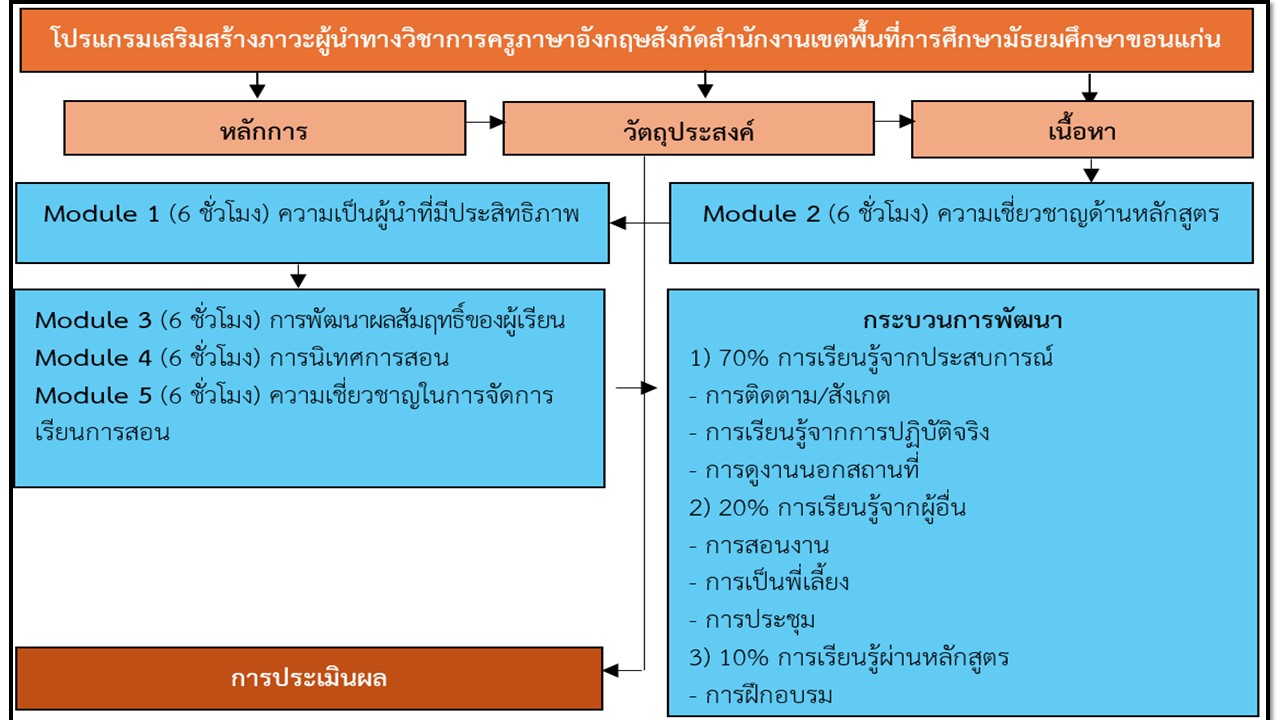
Phase 1 focused on studying the current conditions, desired conditions, and needs for academic leadership. The sample consisted of 217 English teachers. The data collection instrument was a questionnaire. The data were analyzed using frequency, percentage, mean, standard deviation, and the Priority Needs Index (PNI). Phase 2 involved developing a program to enhance academic leadership. The key informants were five experts. The data collection instrument was an evaluation form, and the data were analyzed using mean and standard deviation. The findings were as follows: The overall current condition of academic leadership among English teachers was at a moderate level. When considering each aspect, most were at a low level. The overall desired condition was at the highest level. When considering each aspect, all were at the highest level. The priority needs, ranked from highest to lowest based on the needs index, were: Expertise in instructional management, Improving student achievement, Curriculum expertise, Instructional supervision, and Effective leadership. The program developed to enhance the academic leadership of English teachers under the Khon Kaen Secondary Educational Service Area Office consisted of: (1) principles, (2) program objectives, (3) program content, (4) implementation methods, and (5) program assessment and evaluation. The program content included 5 modules: Module 1: Effective Leadership, Module 2: Curriculum Expertise, Module 3: Improving Student Achievement, Module 4: Instructional Supervision, and Module 5: Instructional Management Expertise. The results of the program evaluation showed that its suitability and feasibility were rated at the highest level.
Article Details

This work is licensed under a Creative Commons Attribution-NonCommercial-NoDerivatives 4.0 International License.
References
กาญจน์ เรืองมนตรี และธรินธร นามวรรณ. (2557). การบริหารวิชาการและนวัตกรรมการจัดการ การเรียนรู้. พิมพ์ครั้งที่ 2. มหาสารคาม : อภิชาติการพิมพ์.
กระทรวงศึกษาธิการ.(2564). สำนักงานเลขาธิการสภาการศึกษา. แนวทางการยกระดับคุณภาพการผลิตและการพัฒนาครู ปฐมวัยใน สถาบันอุดมศึกษาของไทย. กรุงเทพฯ:สำนักงานเลขาธิการสภาการศึกษา กระทรวงศึกษาธิการ,. ( 371.102 ศ 165 นฉ.01 - ฉ.02 )
จันทรานี สงวนนาม. (2553). ทฤษฏีและแนวปฏิบัติในการบริหารสถานศึกษา. กรุงเทพฯ:บุคพอยท.
ธิดาวัลยเสตะจันทน์. (2541). ความสัมพันธระหวางพฤติกรรมความเปนผู้นำทางวิชาการของผูนิเทศภายในโรงเรียนกับ ผลสัมฤทธิ์ทางการเรียนของนักเรียนในโรงเรียนประถมศึกษา สังกัดสํานักงานการประถมศึกษาจังหวัดนครปฐม. วิทยานิพนธศศ.ม. (บริหารการศึกษา). กรุงเทพฯ : บัณฑิตวิทยาลัย
ธรินธร นามวรรณ. (2549). หลักการบริหารการศึกษา. มหาสารคาม : ภาควิชาการบริหารการศึกษา คณะศึกษาศาสตร์ มหาวิทยาลัยมหาสารคาม.
บุญชม ศรีสะอาด. (2553). การวิจัยเบื้องต้น. พิมพ์ครั้งที่ 8. กรุงเทพฯ : สุวีริยาสาส์น.
เทวฤทธิ์ ผลจันทร์.(2564). โปรแกรมเสริมสร้างภาวะผู้นำทางวิชาการของครูสังกัดสำนักงานเขตพื้นที่การศึกษามัธยมศึกษา
เขต 27.มหาวิทยาลัยมหาสารคาม เพื่อเป็นส่วนหนึ่งของการศึกษาตามหลักสูตร ปริญญาการศึกษามหาบัณฑิต สาขาวิชาการบริหารและพัฒนาการศึกษา มหาวิทยาลัยมหาสารคาม.
นิสาลักษณ์ จันทร์อร่าม. (2561). การพัฒนาโปรแกรมเสริมสร้างภาวะผู้นำทางวิชาการของครู สังกัดสำนักงานเขตพื้นที่ การศึกษาประถมศึกษาขอนแก่น เขต 5. วิทยานิพนธ์ปริญญาการศึกษามหาบัณฑิต สาขาวิชาการบริหารและพัฒนา การศึกษา คณะศึกษาศาสตร์ มหาวิทยาลัยมหาสารคาม.
สำนักงานคณะกรรมการการประถมศึกษาแห่งชาติ. (2544). การปฏิรูปการเรียนรู้ผู้เรียนเป็นสำคัญที่สุด.กรุงเทพฯ : โรงพิมพ์ คุรุสภาลาดพร้าว.
สํานักงานคณะกรรมการการศึกษาแห่งชาติ. (2553). พระราชบัญญัติการศึกษาแห่งชาติ พ.ศ.2542 และที่แก้ไขเพิ่มเติม
(ฉบับที่ 3) พ.ศ. 2553. กรุงเทพฯ : สํานักนายกรัฐมนตรี.
สถาบันพัฒนาความก้าวหน้า. (2553). ชุดการสอนแบบศูนย์การเรียน. กรุงเทพฯ: สถาบันความก้าวหน้า.
สุวัฒน์ จุลสุวรรณ์. (2554). การพัฒนาภาวะผู้นำการเปลี่ยนแปลงผู้บริหารสายสนับสนุนสถาบันอุดมศึกษาของรัฐ. วิทยานิพนธ์ ปริญญาการศึกษาดุษฎีบัณฑิต สาขาวิชาการบริการและพัฒนาการศึกษา คณะศึกษาศาสตร์
มหาวิทยาลัยมหาสารคาม.
สัมมา รธนิธย์. (2556). ภาวะผู้นําของผู้บริหาร. กรุงเทพฯ : บริษัทพิมพ์ดี จํากัด.
Fullan, M.G. (2008). The limits and the potential of professional development. In T.R. Guskey
& M. Huberman (eds), Professional development in education: New paradigms &
practice (pp. 253-267). New York: Teacher College.
Hallinger, P. and Joseph, M. (2009). Assessing the Instructional Management Behavior of Principal. The Elementary School Journal, 86 (2), 221-224.
North Central Regional Educational Laboratory. (2000). Literacy program evaluation tool
Retrieved January. 5, 2006, from: http://www.ncrel.org/literacy/eval.
Ubben, G. C & Hughes, L. W. (1987). The principal : Creative Leadership for Effective Schools. Boston : Allyn and Bacon.
Davis, G.A. and Magaret, A.T. (1989). Effective School and Effective Teachers. Boston : Allyn and Bacon.
Seyfarth. (1999). The principal: New leadership for new challenges. NJ: Prentice Hall.http://www.kappanmagazine.org/content/82/8/598.abstract.
Swanson, R.A. and Holton, E.F. (2001). Foundations of Human Resource Development. San Francisco : Berrett-Koehler Publishers Inc.
Schermerhorn, J.R. (2002). Management. 7th ed. New York : John Wiley and Sons.
Krejcie, R. V., & Morgan, D. W. (1970). Determining sample size for research activities. Educational and Psychological Measurement, 30 (3), 607–610.
Kaiser. R.M. (2000). Mapping the learning 0rganization exploring model of 0rganizational learning. Ph.D. dissertation, Louisiana State university, U.S.A.
Lvancevich, J.M. and Matteson, T.M. (2002). Organization Behavior and Management. 6th ed. Houston : McGraw-Hill.
McEwan, E.K. (1998). Seven Steps to Effective Instructional Leadership. California : Corwin Press.
Wildy, H. and Dimmock, C. (1993). Instructional Leadership in Primary and Secondary School in Western Australia. Journal of Educational Administration, 31 (2), 43-61.
