
The relationship between policy corruption patterns and policy formulation Rice pledging scheme
Article Sidebar
Main Article Content
Abstract
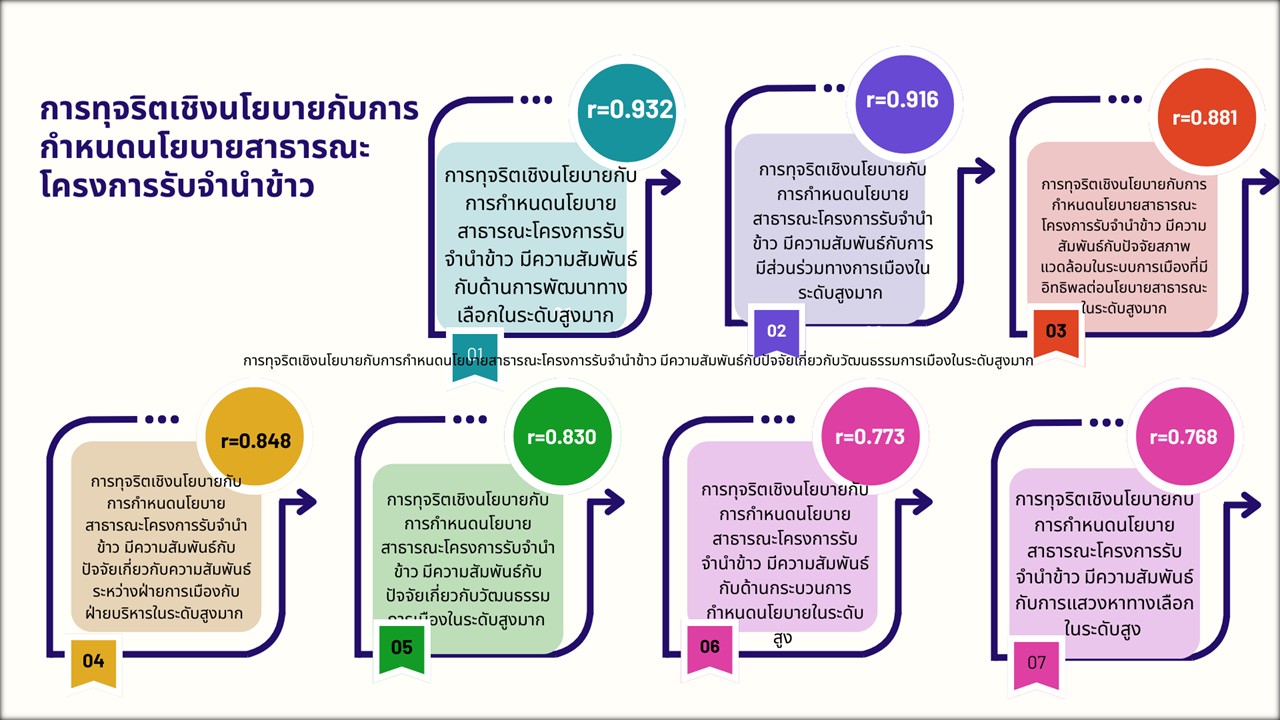
This research aimed to study: (1) the level of policy corruption and public policy formulation in the rice pledging scheme; (2) the factors contributing to policy corruption and public policy formulation in the rice pledging scheme; and (3) the relationship between policy corruption and public policy formulation in the rice pledging scheme. The sample group consisted of 2,250 individuals, including government officials from the Ministry of Commerce, staff from the Bank for Agriculture and Agricultural Cooperatives, and farmers participating in the rice pledging scheme. The sample was selected through purposive sampling. The research instrument used for data collection was a questionnaire. Data were analyzed using statistical software, including frequency distribution, percentage, mean, standard deviation, and Pearson’s correlation coefficient. The findings revealed that: The levels of policy corruption and public policy formulation in the rice pledging scheme in the provinces of Phetchabun, Phichit, Phitsanulok, Sukhothai, Kamphaeng Phet, and Nakhon Sawan were generally high. The factors contributing to policy corruption and public policy formulation in the rice pledging scheme were also at a high level overall, and there was a statistically significant positive correlation at the .01 level between policy corruption and public policy formulation in the rice pledging scheme, with a very high level of correlation.
Article Details

This work is licensed under a Creative Commons Attribution-NonCommercial-NoDerivatives 4.0 International License.
References
กฤษฎา นันทเพ็ชร (2556). การเปลี่ยนแปลงทางสังคมที่มีผลต่อบทบาทการป้องกันและปราบปรามคอร์รัปชั่น ของคณะกรรมการป้องกันและปราบปรามการทุจริตแห่งชาติ (ป.ป.ช.) .ดุษฎีนิพนธ์นี้เป็นส่วนหนึ่งของการศึกษาตามหลักสูตรปรัชญาดุษฎีบัณฑิต สาขาวิชารัฐประศาสนศาสตร์ วิทยาลัยการบริหารรัฐกิจ มหาวิทยาลัยบูรพา.
กรมการค้าภายใน (2554). โครงการรับจำนำข้าวของรัฐบาลยิ่งลักษณ์ ชินวัตร. . http://www.matichon.co.th/news_detail. php?newside-1315200981&grpid= &catid=02&subc
ณภัทร เตโช, อภิชาติ จันทราธิบดี, ภัชรีย์ มีแก้ว และอรดี ไกรยุทธศักดิ์. (2552). แนวทางการป้องกันและปราบปรามการทุจริตในส่วนราชการไทย. http://www.opsmoac.go.th/download/s_2567_038.pdf
บุญธรรม กิจปรีดาบริสุทธิ์. (2549). สถิติวิเคราะห์เพื่อการวิจัย. พิมพ์ครั้งที่4.กรุงเทพฯ: จามจุรีโปรดักท์.
วรรณนภา วามานนท์. (2550). การบริหารการปราบปรามการทุจริตระดับชาติของไทย: การศึกษาบทบาท ระบบ และการบริหารของคณะกรรมการป้องกันและปราบปรามการทุจริตแห่งชาติ. ปรัชญาดุษฎีบัณฑิต รัฐประศาสนศาสตร์, สาขาวิชารัฐประศาสนศาสตร์, คณะรัฐศาสตร์, มหาวิทยาลัยรามคำแหง.
สังศิต พิริยะรังสรรค์ และผาสุก พงษ์ไพจิตร. (2549). คอร์รัปชั่นและประชาธิปไตย. ศูนย์วิจัยและนวัตกรรมเพื่อการพัฒนาสังคมและความมั่นคงของมนุษย์.
สัมฤทธิ์ ยศสมศักดิ์. (2549). คอร์รัปชั่น ธรรมาภิบาล และจริยธรรมในสังคมไทย. กรุงเทพฯ:
ธรรกมลการพิมพ์.เสาวณีย์ ไทยรุ่งโรจน์. (2555). ดัชนีคอร์รัปชั่นในรัฐบาลยิ่งลักษณ์ ชินวัตร. http://talk.mthai.com/topic/345887
Forbis, J. S. (2008). Organized civil society: A cross national evaluation of the socio-politicaleffects of non-governmental organization density on governmental corruption, stateterror, and anti-government demonstrations. Doctoral dissertation, Sociology,Graduate School, Ohio State University.
Dorhoi, M. (2005). Anti-corruption strategies and fighting corruption in central and eastern Europe. Doctoral dissertation, Political Science, Michigan State University.
Igoni, S. E. (2009). Perceptions of societal corruption and levels of trust in government: A case study of benin city, nigeria. Doctoral dissertation, Public Policy and Administration, Walden University.
Werner J. M., & Desimone, R. L. (2006). Human Resource Development 4th ed.). Mason, Ohio: Thomson South-Western.
