
A Survey of Opinions Towards the Marking Mix (7P’S) in Bubble Tea Consumption Choice Among Loei Rajabhat University Students: A Case Study of Kongsi Tea Bar
Article Sidebar
Main Article Content
Abstract
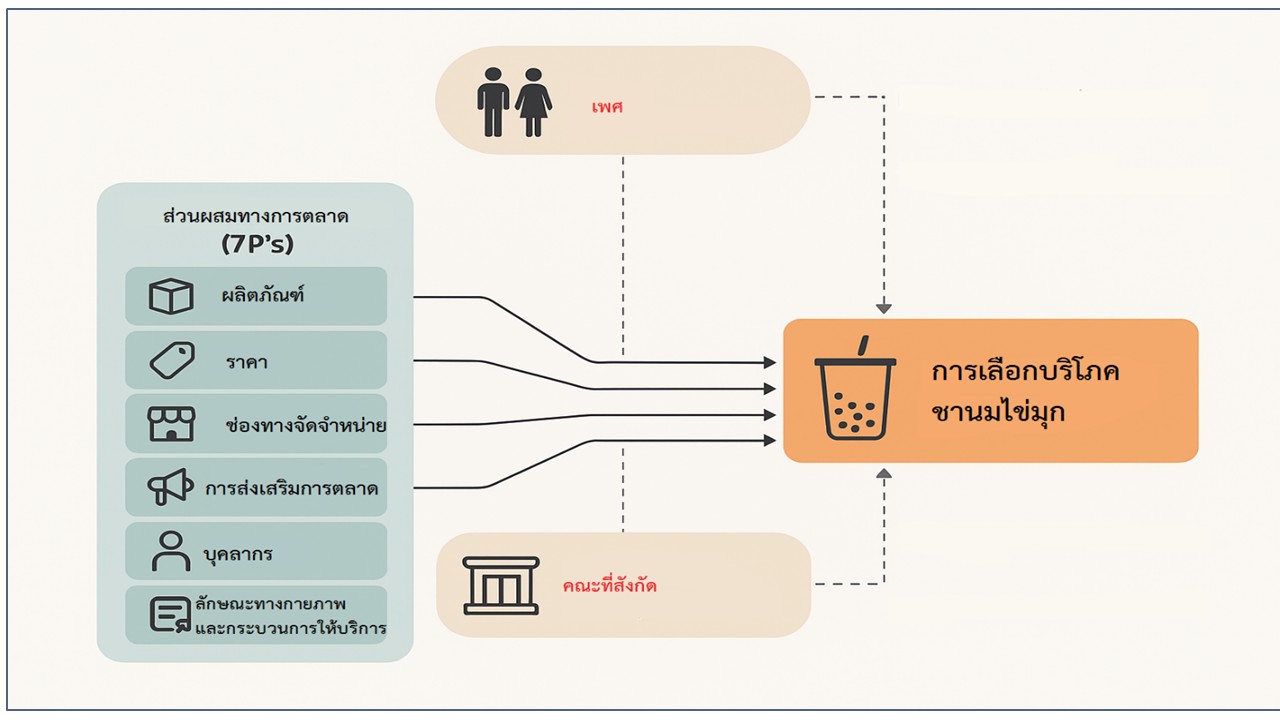
The current bubble tea business is highly competitive. Therefore, entrepreneurs need to understand and apply marketing mix strategies to meet consumer needs and gain a competitive advantage. This research aimed to 1) study the level of opinions towards the marketing mix (7P’s) influencing Loei Rajabhat University students' bubble tea consumption choice, with a case study of Kongsi Tea Bar, and 2) compare opinions towards the marketing mix (7P’s) influencing bubble tea consumption choice, classified by personal factors. This quantitative research utilized an online questionnaire as the data collection instrument, with a total reliability coefficient of 0.90. The sample consisted of 375 Loei Rajabhat University students, selected through stratified random sampling and simple random sampling. Data were analyzed using descriptive statistics, namely mean and standard deviation, and inferential statistics, namely Independent Samples t-Test and One-way ANOVA. The research findings indicated that 1) the overall opinion level towards the marketing mix affecting bubble tea consumption choice was at the highest level. The aspect with the highest mean was Place, followed by Price. 2) Female students showed higher levels of opinion towards the marketing mix in bubble tea consumption choice regarding Product, Promotion, Physical Evidence, and Process compared to male students. Furthermore, differences were found in Promotion and Physical Evidence when classified by faculty affiliation. The implications of the findings suggest that the marketing mix influences students' bubble tea consumption choice, particularly in the aspects of Place and Price.
Article Details

This work is licensed under a Creative Commons Attribution-NonCommercial-NoDerivatives 4.0 International License.
References
กัลยา วานิชย์บัญชา. (2561). สถิติสำหรับงานวิจัย (พิมพ์ครั้งที่ 12). สามลดา.
ชนิกานต์ คําหอมกุล. (2566). ปัจจัยที่มีผลต่อการเลือกซื้อชานมไข่มุกของร้าน Bear House สาขาเดอะมอลล์ท่าพระ (วิทยานิพนธ์บริหารธุรกิจมหาบัณฑิต). บัณฑิตวิทยาลัย มหาวิทยาลัยสยาม.
ชัชวาลย์ เรืองประพันธ์. (2543). สถิติพื้นฐาน พร้อมตัวอย่างการวิเคราะห์ด้วยโปรแกรม MINITAB SPSS และ SAS. มหาวิทยาลัยขอนแก่น.
ไทยรัฐ. (2567). ชานมไข่มุก กับพฤติกรรมคนไทย ชอบความหลากหลายและใส่ใจคุณภาพ. สืบค้นเมื่อ 11 มกราคม 2568, จาก https://www.thairath.co.th/lifestyle/life/2780363
นาวิน ทองหล่อ, อรัญญา ทักทาย, สุธาทิพย์ ประพัฒน์โพธิ์, ฉลวย ยวนแห่ว, & พิมกาญดา จันดาหัวดง. (2565). ปัจจัยที่มีความสัมพันธ์ต่อพฤติกรรมการบริโภคชานมไข่มุกของผู้บริโภคในเขตอำเภอเมือง จังหวัดกำแพงเพชร. ใน การประชุมวิชาการระดับชาติสำหรับนักศึกษา มหาวิทยาลัยราชภัฏกำแพงเพชร ครั้งที่ 2 (15 มีนาคม 2565). มหาวิทยาลัยราชภัฏกำแพงเพชร.
ปดิพัทธ จูไหล. (2564). ปัจจัยช่องทางการจัดจำหน่ายแบบบูรณาการที่ส่งผลต่อการตัดสินใจซื้อของผู้บริโภคชานมไข่มุกในเขตกรุงเทพมหานคร (วิทยานิพนธ์บริหารธุรกิจมหาบัณฑิต). มหาวิทยาลัยกรุงเทพ.
Chowdhury, R. (2023). Impact of perceived convenience, service quality and security on consumers’ behavioural intention towards online food delivery services: The role of attitude as mediator. SN Business & Economics, 3(1), Article 23. https://doi.org/10.1007/s43546-023-00421-7
Event pop. (2562). เทรนด์ชานมไข่มุกในปี 2020: ควรลงทุนหรือแค่กระแส. สืบค้นเมื่อ 11 มกราคม 2568, จาก https://www.eventpop.me/blogs/trend-bubbletea-in-thaiand
Feraco, A., Rapa, E., Barone, M., & Vitiello, G. (2024). Assessing gender differences in food preferences and physical activity: A population-based survey. Frontiers in Nutrition, 11, Article 1414217. https://doi.org/10.3389/fnut.2024.1414217
Kongsiteabar. (2568). Our story is here. สืบค้นเมื่อ 11 มกราคม 2568, จาก https://kongsiteabar.com/kongsistory
Kotler, P., & Armstrong, G. (2018). Principles of Marketing (17th ed.). Pearson Education.
Solomon, M. R. (2018). Consumer Behavior (12th ed.). Pearson Education Limited.
Xu, J., Sukpasjaroen, K., & Chankoson, T. (2024). The research on M milk tea brand: Market positioning, consumer insights, and future strategic outlook. Migration Letters, 21(4), 277–293. https://doi.org/10.33182/ml.v21i4.10243
Yamane, T. (1973). Statistics: An introductory analysis (3rd ed.). Harper and Row.
