
Perceptions of Thai University Students on Chinese Popular Culture in Learning Chinese as a Foreign Language
Article Sidebar
Main Article Content
Abstract
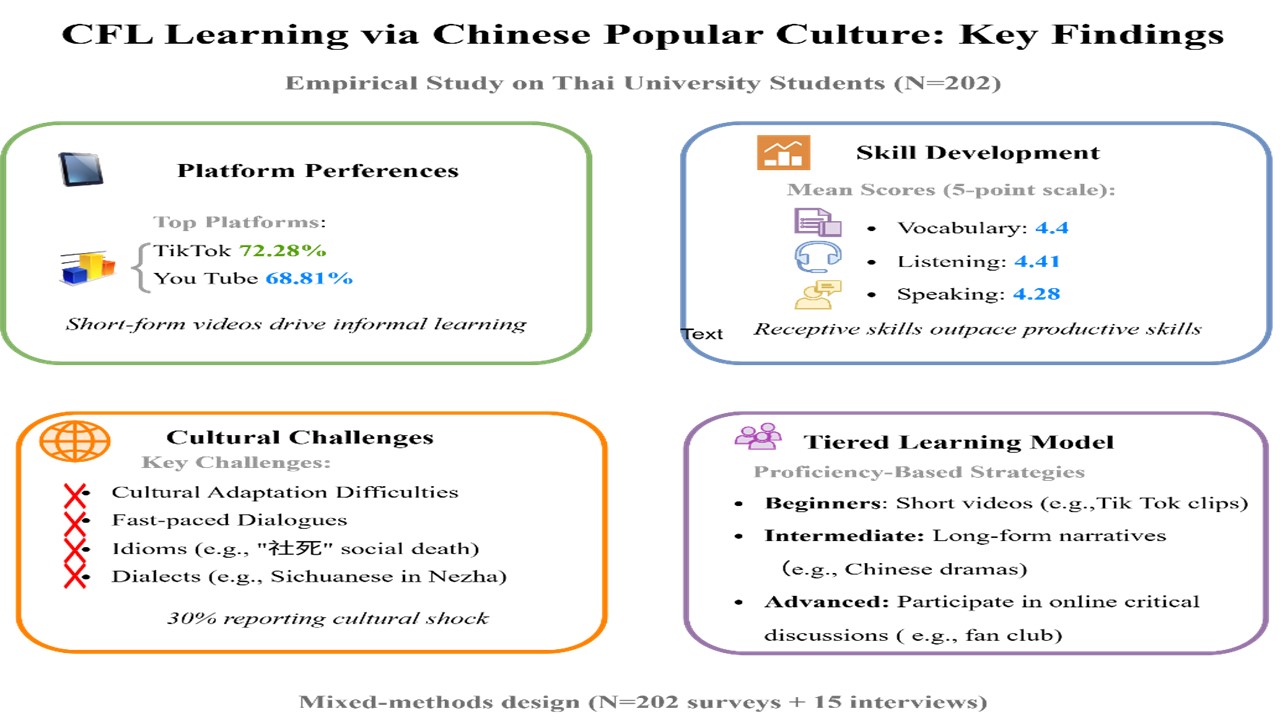
This study investigates Thai university students' perceptions of using Chinese popular culture in learning Chinese as a foreign language (CFL), focusing on their preferred engagement methods, perceived opportunities, and intercultural challenges. A mixed-methods approach combining questionnaires (N=202) and semi-structured interviews (n=15) was employed, with stratified and purposive sampling ensuring representative insights. Findings revealed that digital platforms, particularly TikTok (72.28%) and YouTube (68.81%), served as primary channels for accessing Chinese popular culture, with short-form videos favored for their contextualized language input. Students reported significant opportunities in vocabulary acquisition (=4.46), listening comprehension (=4.41), and intercultural understanding, such as grasping social norms (=4.30). However, challenges included cultural dissonance (=3.90), non-standard language structures (=3.92), and difficulties in interpreting idioms or dialects. Qualitative insights emphasized the need for guided cultural contextualization to mitigate misunderstandings. The study concludes that integrating Chinese popular culture into CFL curricula enhances learner motivation and linguistic skills but requires pedagogical scaffolding to address cultural and linguistic complexities. Recommendations include leveraging digital platforms for immersive learning, fostering cross-cultural exchanges, and incorporating critical media literacy to navigate stereotypes. These findings contribute to optimizing CFL instruction through culturally responsive pedagogies.
Article Details
References
Bahrani, T., & Sim Tam, S. (2012). Exposure to audiovisual programs as sources of authentic language input and second language acquisition in informal settings. Southern African Linguistics and Applied Language Studies, 30(3), 347–359. https://doi.org/10.2989/16073614.2012.750824
Baker, C., Baker, C. J., & Phongpaichit, P. (2022). A history of Thailand. Cambridge University Press.
Bangkok post. (2024, February 6). Investment applications up 43% in 2023. Bangkok
Post. Retrieved from https://www.bangkokpost.com/business/general/2737406
/investment-applications-up-43-in-2023
Barker, G. G. (2016). Cross-cultural perspectives on intercultural communication competence. Journal of Intercultural Communication Research, 45(1), 13-30. https://doi.org/10.1080/17475759.2015.1104376
Bowes, J. (2018). Preferred Learning Style and Academic Self-Efficacy as Predictors of Academic Engagement amongst University Students. https://e-space.mmu.ac.uk/id/eprint/621698
Byram, M. (2020). Teaching and assessing intercultural communicative competence: Revisited. US: Multilingual matters.
Byram, M., & Wagner, M. (2018). Making a difference: Language teaching for intercultural and international dialogue. Foreign Language Annals, 51(1), 140-151. https://doi.org/10.1111/flan.12319
Cain, C. L., Surbone, A., Elk, R., & Kagawa-Singer, M. (2018). Culture and palliative care: preferences, communication, meaning, and mutual decision making. Journal of pain and symptom management, 55(5), 1408-1419. https://doi.org/10.1016/j.jpainsymman.2018.01.007
Cheney, A. W., & Terry, K. P. (2018). Immersive learning environments as complex dynamic systems. International journal of teaching and learning in higher education, 30(2), 277-289. https://eric.ed.gov/?id=EJ1185091
Creswell, J. W., & Plano Clark, V. L. (2018). Designing and conducting mixed methods research (3rd ed.). US: Sage.
Deng, T. (2018). The auxiliary role of Chinese songs in teaching Chinese as a foreign language. Literature Education, 33(1), 2. doi: cnki: sun: wxux.0.2018-11-012
Dörnyei, Z., & Taguchi, T. (2009). Questionnaires in second language research: Construction, administration, and processing. Routledge.
Edensor, T. (2020). National identity, popular culture and everyday life. Routledge.
Fang, S. (2015). Engagement with Chinese popular culture in adult Mandarin language learning and socialization (Doctoral dissertation). Retrieved from
https://open.library.ubc.ca/soa/cIRcle/collections/ubctheses/24/items/1.0166435
Guo, L. (2022). Research on the Application of Material Cultural Heritage in the Teaching of Chinese as a Foreign Language under the Background of New Media (Unpublished Master’s thesis). Tianjin University of Technology, China.
Heilporn, G., Lakhal, S., & Bélisle, M. (2021). An examination of teachers’ strategies to foster student engagement in blended learning in higher education. International journal of educational technology in higher education, 18(1), 25. https://doi.org/10.1186/s41239-021-00260-3
Ilin, V. (2022). The role of user preferences in engagement with online learning. E-Learning and Digital Media, 19(2), 189-208. https://doi.org/10.1177/204275302110355
Jang, H., Reeve, J., & Halusic, M. (2016). A new autonomy-supportive way of teaching that increases conceptual learning: Teaching in students’ preferred ways. The Journal of Experimental Education, 84(4), 686-701. https://doi.org/10.1080/00220973.2015.1083522
Javaid, Z. K., Andleeb, N., & Rana, S. (2023). Psychological perspective on advanced learners’ foreign language-related emotions across the four skills. Voyage Journal of Educational Studies, 3(2), 191-207.
Jia, M. (2024). A Survey Study on Teaching Chinese Language and Culture at Intermediate Level in Thailand (Unpublished Master’s thesis). Zhejiang University, China.
Jiang, H., & Phusawisot, P. (2023). Chinese EFL Learners' Perceptions of English Speaking Difficulties in Thailand. English Language Teaching, 16(8), 69-82. https://doi.org/10.5539/elt.v16n8p69
Kahanurak, S., Dibyamandala, J., & Mangkhang, C. (2023). Digital storytelling and intercultural communicative competence through english as a foreign language for multilingual learners. Journal of Curriculum and Teaching, 12(1), 14-26. https://doi.org/10.5430/jct.v12n1p14
Kramsch, C. (2014). Language and Culture. AILA Review, 27(1), 30–55. https://doi.org/10.1075/aila.27.02kra
Kramsch, C., & Uryu, M. (2020). Intercultural contact, hybridity, and third space. In The Routledge handbook of language and intercultural communication (pp. 204-218). Routledge.
Krashen, S. D. (1982). Principles and practice in second language acquisition. Pergamon Press Inc
Li, J. (2020). The application of short online videos in teaching Chinese as a foreign language and culture in the context of new media. Journal of Liaoning University of Technology (Social Science Edition), 22(05), 140-142.
Liu, S. (2022). Application Analysis on TikTok Short Video about Chinese Culture in Chinese Teaching of Belarus Primary Schools. International Journal of Education and Management, 97.
Louws, M. L., Meirink, J. A., van Veen, K., & van Driel, J. H. (2017). Teachers' self-directed learning and teaching experience: What, how, and why teachers want to learn. Teaching and teacher education, 66, 171-183. https://doi.org/10.1016/j.tate.2017.04.004
Otajonova, S. (2024). Incorporating authentic materials in ESL curriculum: Enhancing language learning. Science and innovation, 3(B4), 15-22.
Oxford, R. L., & Gkonou, C. (2018). Interwoven: Culture, language, and learning strategies. Studies in Second Language Learning and Teaching, 8(2), 403-426.
Pai, R., & Duff, P. A. (2020). Pop culture in teaching Chinese as an additional language: Theory, research, and practice. In Pop culture in language education (pp. 185-198). Routledge.
Placer, M. F., Ngo, C. G., Nano, S., & Calambro, A. (2024). Pop Culture and English Language Learning Motivation among Ab-English Students. International Journal Corner of Educational Research, 3(1), 39–46. https://doi.org/10.54012/ijcer.v3i1.237
Tang, X., & Hou, Y. (2024). Research on the Perception and Evaluation of Chinese Culture Dissemination in Thailand: An Analysis Based on Literature Review and Questionnaire Survey. Communication across Borders: Translation & Interpreting, 4(01).
Wang, C. (2022). Research on the Application of Short Video Online Chinese Comprehensive Course——Taking the teaching of Wukong Chinese platform as an example (Master’s dissertation). Lanzhou University, China.
Wang, J., & Tananuraksakul, N. (2023). Explore Acculturation Strategies and Intercultural Communication Competence of Chinese International Students at a Private University in Thailand. เส ฏ ฐ วิทย์ ปริทัศน์, 3(3), 39-56.
Warner, C., & Dupuy, B. (2018). Moving toward multiliteracies in foreign language teaching: Past and present perspectives… and beyond. Foreign Language Annals, 51(1), 116-128. https://doi.org/10.1111/flan.12316
Wei, X., & Weerasawainon, A. (2024). Analyzing lifelong learning tendency in language classrooms, Thailand. International Journal of Educational Reform, 33(1), 62-80. https://doi.org/10.1177/10567879221081112
Wei, Y. (2020). A study on the Applicability of Chinese Internet pop culture phenomenon to the Chinese as a foreign language: a case study of NawaminthachinuthitBodindecha School (Unpublished Master’s thesis). Xi’an shiyou Normal University, China.
Werner, V. (2020). Teaching grammar through pop culture. In Pop culture in language education (pp. 85-104). Routledge.
Werner, V., & Tegge, F. (2020). Pop culture in language education. Pop culture in language education: Theory, Research, Practice. Routledge: London, United Kingdom, 3-30.
Xu, Y. (2023). Research on the Application of Short Video in Teaching Chinese as a Foreign Language and Culture. Journal of Education and Educational Research, 2(3), 89-91. https://doi.org/10.54097/jeer.v2i3.7579
Yang, Y. (2024). Study on the Selection and Arrangement of Cultural Factors in International Chinese Teaching Textbooks for Learning Chinese in Singing——Taking" Learning Chinese by Listening to Songs" as an Example (Unpublished Master’s thesis). Chongqingjiaotong University, China.
Ye, L. (2024). Innovative pedagogical strategies in second language acquisition. In SHS Web of Conferences (Vol. 183, p. 03013). EDP Sciences. https://doi.org/10.1051/shsconf/202418303013
Yuan, X. (2021). A Study on the Application of Popular Culture in Teaching Chinese as a Foreign Language. Sinogram Culture, (22), 82-83.
Yuan, X. (2022). The Research on the Application of TikTok in Chinese Culture Teaching (Unpublished Master’s thesis). Dongbei University of Finance and Economics, China.
Zhang, Y. (2021). A Study on the Application of Li Ziqi's Short Video in Chinese Language and Culture Classes for Foreigners (Unpublished Master’s thesis). Heilongjiang University, China.
Zheng, Y. (2023). Modern language education programs in Asia and Pacific countries. In International handbook on education development in Asia-Pacific (pp. 1-20). Singapore: Springer Nature Singapore.
