
The 21st Century Competencies of Administrators in Private Vocational Colleges under Khon Kaen Provincial Vocational Education Office
Article Sidebar
Main Article Content
Abstract
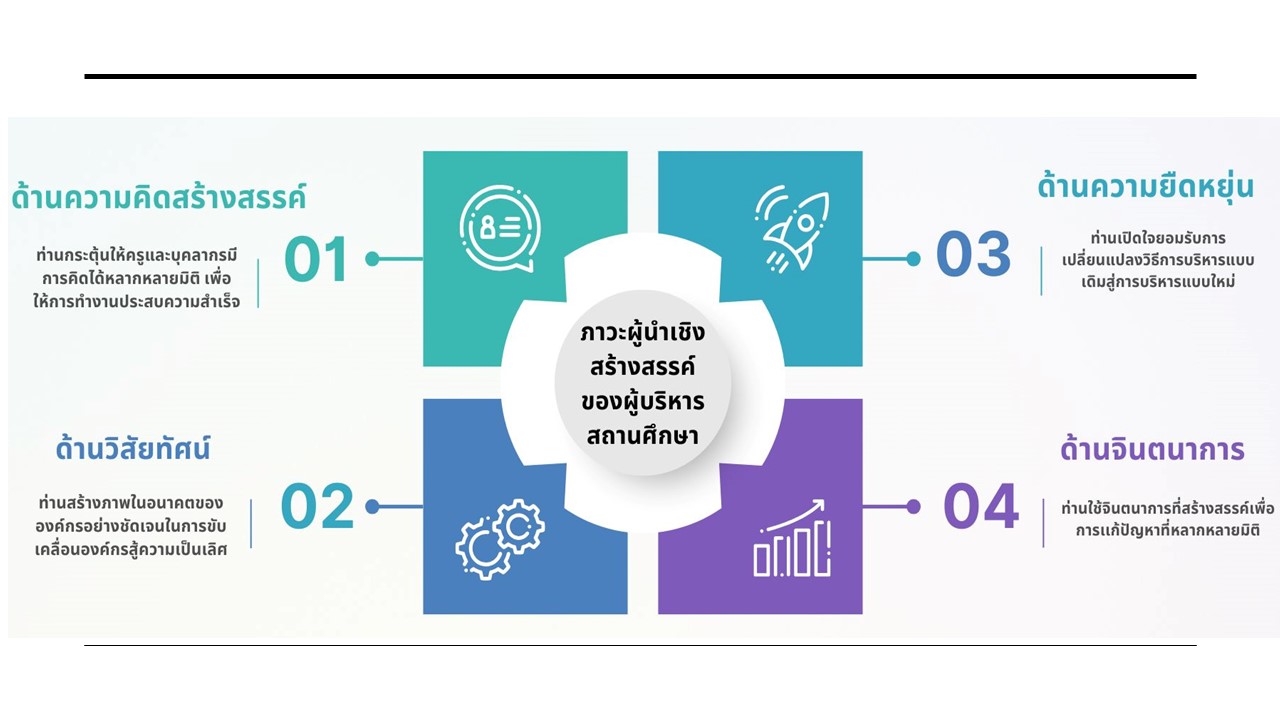
The objectives of this research were as follows: 1) to study the level of creative leadership of administrators in private vocational education institutions under the Khon Kaen Provincial Office of Vocational Education. and 2).to compare the creative leadership of administrators in private vocational education institutions under the Khon Kaen Provincial Office of Vocational Education based on gender and work experience., with 98 questionnaires returned, representing a 93% response rate. The research instrument was a questionnaire. Statistics used for data analysis included frequency, percentage, mean, standard deviation, t-test, and one-way analysis of variance. The research findings were as follows: 1) The overall level of creative leadership among administrators of private vocational education institutions under the Khon Kaen Provincial Office of Vocational Education was found to be high, with a mean of 4.37. When considering each aspect individually, all aspects were rated at a high level. Ranked from highest to lowest average scores, the aspects were: creativity, vision, flexibility, and imagination, with means of 4.43, 4.40, 4.38, 4.37, 4.33, and 4.32, respectively. 2) The results of the comparison of creative leadership among administrators of private vocational education institutions under the Khon Kaen Provincial Office of Vocational Education by gender and work experience revealed no statistically significant differences in perceptions at the 0.05 level.
Article Details
References
กรองทิพย์ นาควิเชตร. (2552). ภาวะผู้นำสร้างสรรค์เพื่อการศึกษา. สมุทรปราการ: ธีรสาส์น
กระทรวงศึกษาธิการ. (2553). พระราชบัญญัติการศึกษาแห่งชาติ พ.ศ. 2542 แก้ไขเพิ่มเติม (ฉบบัที่ 2) พ.ศ. 2545 และ (ฉบับที่ 3) พ.ศ. 2553. https://ผู้บริหารสถานศึกษา.moe.go.th/พรบ-การศึกษาแห่งชาติ-พ-ศ-2542/
เกรียงศักดิ์ เจริญวงศ์ศักดิ์. (2553). ความคิดเชิงสร้างสรรค์. กรุงเทพฯ: ซัดเซส มีเดีย.
คณะกรรมการร่างรัฐธรรมนูญแห่งราชอาณาจักรไทย.(2560).เล่ม 134 ตอนที่ 40 ก ราชกิจจา นุเบกษา 6 เมษายน 2560. https://cdc.parliament.go.th/draftconstitution2/more_news.php?cid=87
ธีระ รุญเจริญ และวาสนา ศรีไพโรจน์ (2554). กลยุทธ์การพัฒนาความเป็นบุคคลแห่งการเรียนรู้. กรุงเทพฯ: คุรุสภา ลาดพร้าว.
ณัฐยา สนตระการผล. (2554). การบริหารจัดการนวัตกรรม. (พิมพ์ครั้งที่ 4). กรุงเทพฯ:บริษัทเอ็กซเปอร์เน็ท.
นพพงษ์ บุญจิตราดุล. (2557). หลักการและทฤษฎีการบริหารการศึกษา. นนทบุรี: ตรีณสาร.
บุญชม ศรีสะอาด. (2553) .การวิจัยเบื้องต้น. (พิมพ์ครั้งที่ 8). กรุงเทพฯ: สุวีริยาสาส์น.
บุญชม ศรีสะอาด. (2560). การวิจัยเบื้องต้น (พิมพ์ครั้งที่ 10). กรุงเทพฯ: สุวีริยาสาส์น.
บรรจบ บุญจันทร์. (2556). การบริหารสถาบันเพื่อความเป็นเลิศ. มหาสารคาม: โรงพิมพ์มหาวิทยาลัยราชภัฏมหาสารคาม.
ไพฑูรย์ สินลารัตน์. (2553). ผู้นำเชิงสร้างสรรค์นและผลิตภาพ : กระบวนทัศน์ใหม่และผู้นำใหม่ทางการศึกษา. กรุงเทพฯ: สำนักพิมพ์แห่งจุฬาลงกรณ์มหาวิทยาลัย.
วิโรจน์ สารรัตนะ. (2555). แนวคิด ทฤษฎี และประเด็นเพื่อการบริหารทางการศึกษา. กรุงเทพฯ:
ทิพยวิสุทธิ์.
วิโรจน์ สารรัตนะ. (2557).ภาวะผู้นำ ทฤษฎีและนานาทัศนะร่วมสมัยปัจจุบัน. กรุงเทพฯ: ทิพยวิสุทธิ์.
สำนักงานคณะกรรมการการศึกษาแห่งชาติ. (2562). พระราชบัญญัติการศึกษาแห่งชาติพุทธศักราช
แก้ไขเพิ่มเติม (ฉบับที่ 2) พ.ศ. 2545 แก้ไขเพิ่มเติม (ฉบับที่ 3) พ.ศ.2553 และแก้ไข
เพิ่มเติม (ฉบับที่ 4) พ.ศ. 2562. กรุงเทพมหานคร: บริษัท พริกหวานกราฟฟิค จำกัด.
สำนักงานคณะกรรมการการอาชีวศึกษา. (2559). คำสั่งคณะรักษาความสงบแห่งชาติ. การบริหารจัดการรวมสถานศึกษาอาชีวศึกษาภาครัฐและภาคเอกชน. เล่ม 133 ตอนพิเศษ 52 ง วันที่ 12 กุมภาพันธ์ 2559.
สำนักงานคณะกรรมการการอาชีวศึกษา. (2566). การจัดตั้งสำนักงานอาชีวศึกษาจังหวัด. สังกัดสำนักงานคณะกรรมการการอาชีวศึกษา
Basadur, M. (2008). Leading Other to Think Innovatively Together : Creative Leadership. Journal of the Leadership Quarterly,15(1): 103.
Coste, T.G. (2009). Creative Leadership & Women. Retrieved September 9.
http://www.pptsearch.net/details-creative-leadership-amp-women-
htm
Danner, S.E. (2008). Creative leadership in art education. Perspectives Educator,
Master of Art, Ohio University.
DuBrin, A. J. (1998). Leadership: Research findings, practice, and skills. Boston: Houghton Mifflin Company.
Harris, A. (2009), Creative leadership. Journal of Management in Education, 23(1), 55-67.
Hayes B. (2007). Customer Loyalty study of Wireless Service Providers. Business over
Broadway, 21(2), 112-132.
Isaksen,S.G., & Dorval, K. B., & Treffinger, D. J. (2011). Creative approaches to problem
solving: A framework for innovation and change. New York: Sage.
Krejcie, R.V. and Morgan, D.W. (1970). Determining Sample Size for Research Activities. Educational and Psychological Measurement, 30, 607-610. https://psycnet.apa.org/record/1971-03263-001
