
Teacher Development in Producing Media to Promote Learning for Early Childhood Children from Waste Materials at Ban Hin Lat Wang To School, Under the Office of the Primary Educational Service Area, Khon Kaen Area 1
Article Sidebar
Main Article Content
Abstract
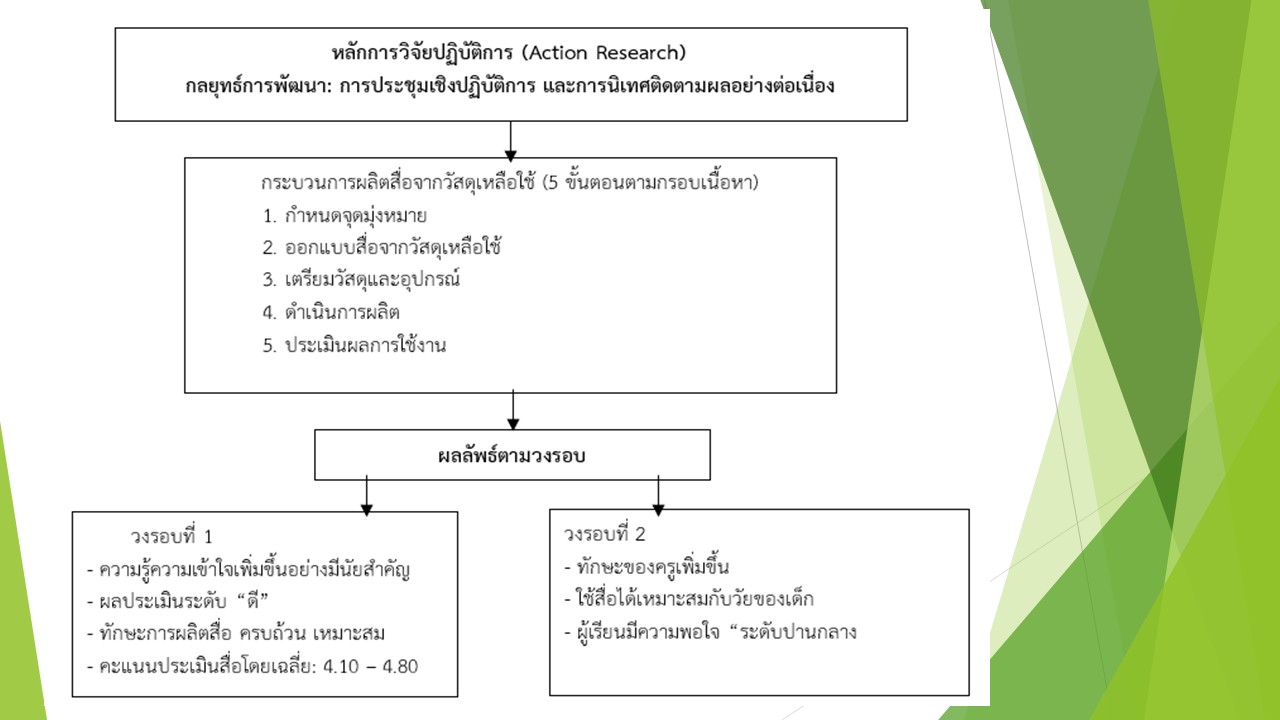
This research aimed to 1) develop teachers’ knowledge and understanding in producing media from waste materials for early childhood children, 2) develop teachers’ media production capabilities, and 3) study the satisfaction of participants in the production of such media. The research instruments included meeting minutes, tests, interviews, media assessment forms, media use assessment forms, behavioral observation forms, and satisfaction questionnaires. The sample consisted of 6 early childhood teachers at Ban Hin Lat Wang to School and 3 additional information providers. The data were analyzed using percentages, means, and standard deviations. The research results showed that, following the development in the first round using the workshop strategy, task assignment, and follow-up supervision, participants had a high level of knowledge and understanding of producing media to promote learning for early childhood children from waste materials. They were able to apply the knowledge they gained to organizing learning activities. The satisfaction of the participants in the overall activities was at the highest level, with a mean of 4.63 and a standard deviation of 0.42. The development in the second round used the internal supervision strategy. The results showed that all participants in the research group possessed knowledge and understanding of media production and were able to effectively apply it to organizing learning activities for early childhood children. They were able to produce media correctly, completely, appropriately, and in accordance with the objectives. Both in terms of format, usage methods, and suitability for the learner's development, as well as the learner's satisfaction with using media to promote learning from waste materials, were at a moderate level.
Keywords: Teacher Development, Production of Media, Early Childhood
Article Details

This work is licensed under a Creative Commons Attribution-NonCommercial-NoDerivatives 4.0 International License.
References
กระทรวงศึกษาธิการ. (2560). หลักสูตรแกนกลางการศึกษาขั้นพื้นฐาน พุทธศักราช 2551 (ฉบับปรับปรุง 2560). กรุงเทพฯ : โรงพิมพ์แห่งจุฬาลงกรณ์มหาวิทยาลัย.
กัญจ์หทัย คนหลัก.(2557). ผลของโปรแกรมเครือข่ายป้องกันตนเองของเกษตรกร.กรุงเทพฯ : จุฬาลงกรณ์ มหาวิทยาลัย.
กมลรัตน์ คนองเดช และคณะ. (2563). ผลการจัดประสบการณ์โดยใช้สื่อและของเล่นที่มีต่อทักษะ EF (Executive Functions) ของเด็กปฐมวัยในโรงเรียนร่วมพัฒนาวิชาชีพครู เขตพื้นที่จังหวัดชายแดนใต้. รายงานการวิจัย. คณะครุศาสตร์ มหาวิทยาลัยราชภัฏยะลา.
กิ่งแก้ว ภูทองเงิน. (2561). รูปแบบการพัฒนาครูตามแนวคิดชุมชนการเรียนรู้เพื่อเสริมสร้างจิตสาธารณะ ของ นักเรียนระดับประถมศึกษา. วิทยานิพนธ์ปริญญาครุศาสตรดุษฎีบัณฑิต สาขาวิชาหลักสูตรและการ เรียนการสอน คณะครุศาสตร์ มหาวิทยาลัยราชภัฏมหาสารคาม.
ข้อบังคับคุรุสภาว่าด้วยมาตรฐานวิชาชีพ ฉบับที่ 4 พ.ศ. 2562, ” (19 เมษายน 2562). ราชกจิจานุเบกษา. เล่ม ที่ 136 ตอนพิเศษ 68 ง. หน้า 19-20.
คณะกรรมการพัฒนาเด็กปฐมวัยแห่งชาติ. (2562).มาตรฐานสถานพัฒนาเด็กปฐมวัยแห่งชาติ. เอกสาร ประกอบการประชุมชี้แจงแนวทางการดำเนินงานตามมาตรฐานสถานพัฒนาเด็กปฐมวัยแห่งชาติ.
ชาญชัย ยมดิษฐ์. (2548). เทคนิคและวิธีการสอนร่วมสมัย.กรุงเทพมหานคร: หลักพิมพ์.
ธงชัย คำปวง. (2561). การพัฒนาครูแบบองค์รวมโดยการเทียบเคียงสมรรถนะ. วิทยานิพนธ์ ปริญญา การศึกษาดุษฎีบัณฑิต สาขาวิชาการบริหารการศึกษา บัณฑิตวิทยาลัย มหาวิทยาลัยนเรศวร
เพ็ญทิพา อ่วมมณี.(2547). ความสามารถด้านมิติสัมพันธ์ของเด็กปฐมวัยที่ใช้ลวดภามะหยี่สีในการทำกิจกรรม ศิลป์สร้างสรรค์. ปริญญานิพนธ์ กส.ม. กรุงเทพฯ : มหาวิทยาลัยศรีนครินทรวิโรฒ.
ภูมิภัทร กลางโคตร และคณะ. (2561). กลยุทธ์การบริหารโรงเรียนเพื่อเป็นองค์กรแห่งการเรียนรู้แบบมืออาชีพ สำหรับโรงเรียนมัธยมศึกษาสังกัดสำนักงานเขตพื้นที่การศึกษา ภาคตะวันออกเฉียงเหนือ, วารสาร มหาวิทยาลัยนครพนม 8, 2 (พฤษภาคม – สิงหาคม 2561).
สิริพัชร์ เจษฎาวิโรจน์. (2550). การจัดการเรียนการสอนแบบบูรณาการ. กรุงเทพฯ: บุ๊ค พอยท์ จำกัด.
สุธรรม ธรรมทัศนานนท์. (2560). การบริหารการศึกษา: แนวคิดและหลักการ. กรุงเทพฯ: สำนักพิมพ์แห่ง จุฬาลงกรณ์มหาวิทยาลัย.
สุนันท์ รุ่งอรุณแสงทอง. (2561). การบริหารสถานศึกษาขั้นพื้นฐานให้เกิดประสิทธิภาพ. วิทยานิพนธ์. ปร.ด. (การบริหารการศึกษา).กรุงเทพฯ : มหาวิทยาลัยศิลปากร.
อรุณี ทองนพคุณ. (2558). การศึกษาบทบาทการบริหารงานของผู้บริหารสถานศึกษา สังกัดสำนักงานเขตพื้นที่ การศึกษาประถมศึกษาฉะเชิงเทรา. (ครุศาสตรมหาบัณฑิต, มหาวิทยาลัยราชภัฏรำไพพรรณี).
อำนวย เดชชัยศรี. (2542). สื่อการศึกษาพื้นฐาน. กรุงเทพฯ : ฟิสิกส์เซ็นเตอร์.
Brown, J.W., Lewis, R.B. and Harcleroad, F.F. (1977). AV Instruction - Technology, Media, and Method. 5th ed. New York: McGraw-Hill Book.
Heinich, R., Molenda, M. and Russell, J.D. (1990). Instructional Media and the New Technologies of Instruction. 3 rd.ed. University of California: Macmillan.
Imogie, A.I. (1979). Instructional Media Use by Faculty Members in Ahmadu Bello University, Zaria: A Study of Factors Related to Educational Innovations in a Nigerian University Context. Dissertation Abstracts International. 41 (6) : 2545-A.
Heinich,Robert, and Others. (1993). Instructional Media and New Technologies of Instruction. 5th ed. New Jersey: Prentice-Hall,Inc.,
