
Health Knowledge, Health Conditions, and Quality of Life of the Elderly Who Study and Do Not Study at the Institute for Improving the Quality of Life of the Elderly, Hang Dong Subdistrict Municipality, Hang Dong District, Chiang Mai Province
Article Sidebar
Main Article Content
Abstract
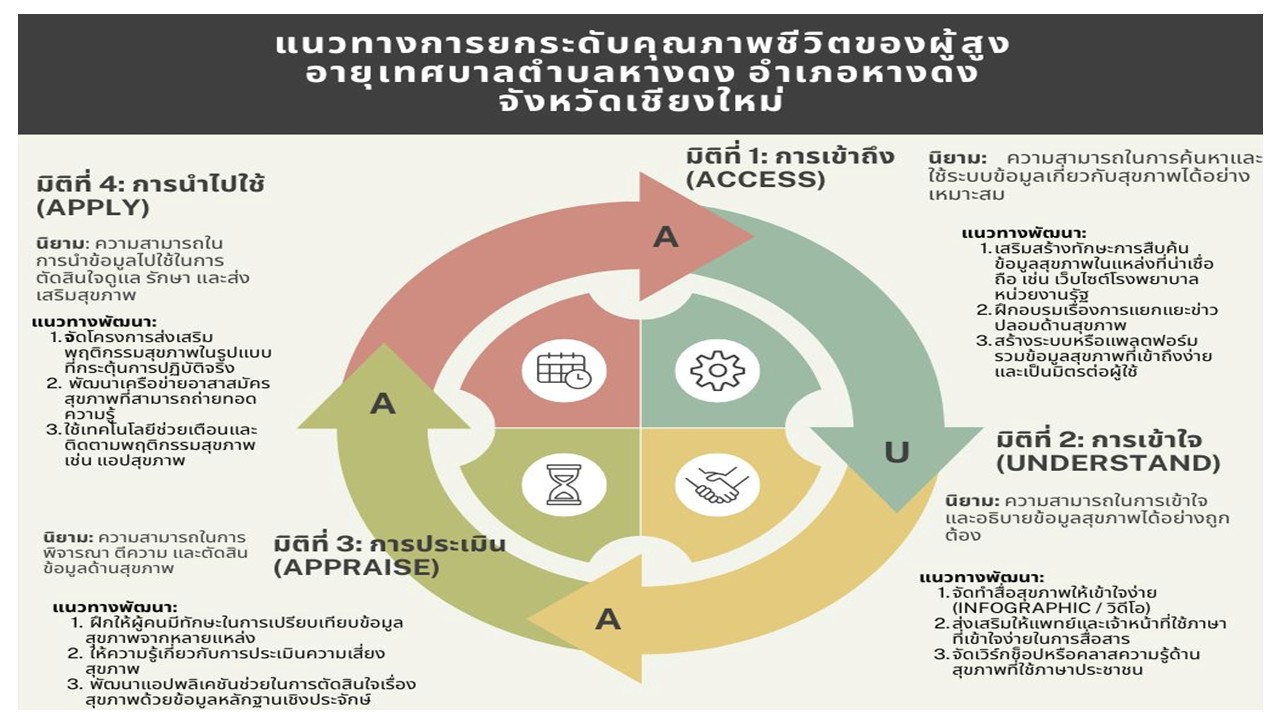
This research aimed to: 1. Study the level of health literacy, health status, and quality of life; 2. Compare the health literacy, health status, and quality of life of the elderly who attended and did not attend the Institute for the Development of Elderly Quality of Life, Hang Dong Subdistrict Municipality, Hang Dong District, Chiang Mai Province; and 3. Develop recommendations for improving the quality of life of the elderly in Hang Dong Subdistrict Municipality, Hang Dong District, Chiang Mai Province. A mixed research methodology was used, comprising both quantitative and qualitative research. The quantitative sample consisted of 180 elderly people, divided into groups of 90 attendees and non-attendees at the institute, and 13 local stakeholders. The instruments included questionnaires, interview forms, and focus group discussion guideline. Data were analyzed using descriptive statistics, independent t-test, and content analysis. The research instruments included questionnaires, interview forms, and focus group discussion guideline. Data were analyzed using descriptive statistics and an independent t-test, and content analysis. The results found that 1) health literacy was at a high level. Most respondents, 67.20 percent, had chronic diseases. Health behaviors were at a moderate level (mean = 3.05). Mental health of the elderly was at the lowest level. Overall quality of life of the elderly was at the highest level. 2) The elderly who attended the institute had a significantly higher level of health literacy and overall quality of life than the group who did not attend (p < 0.05). However, there was no significant difference in health status between the groups. 3) Guidelines for improving the quality of life of the elderly should focus on promoting the 4 dimensions of health literacy: Access, Understand, Appraise, and Apply.
Keywords: Health Literacy, Health Status, Quality of Life, Elderly
Article Details

This work is licensed under a Creative Commons Attribution-NonCommercial-NoDerivatives 4.0 International License.
References
กนกวรรณ อังกสิทธิ์, อภิชาต ไตรแสง, เฉลิมชัย ปัญญาดี, และสมคิด แก้วทิพย์. (2566). ความรอบรู้ด้านสุขภาพและปัจจัยที่มีผลต่อความรอบรู้ด้านสุขภาพของผู้สูงอายุ อำเภอสันทราย จังหวัดเชียงใหม่. วารสารสันติศึกษาปริทรรศน์ มจร, 11(1), 267-279. https://so03.tci-thaijo.org/index.php/journal-peace/article/view/251729/176979
กรเกล้า รัตนชาญกร. (2566). การพัฒนาความรอบรู้ด้านสุขภาพของผู้สูงอายุ เพื่อคุณภาพชีวิตที่ดี. วารสารพยาบาลศาสตร์ มหาวิทยาลัยคริสเตียน, 10(1): 85-97.
กระทรวงการพัฒนาสังคมและความมั่นคงของมนุษย์. (2560). แผนยุทธศาสตร์กระทรวงการพัฒนาสังคมและความมั่นคงของมนุษย์ พ.ศ. (2560-2564). กรุงเทพฯ. กองยุทธศาสตร์และแผนงาน.
จิราพร เกศพิชญวัฒนา. (2563). ความรอบรู้ทางสุขภาพของผู้สูงอายุในชมรม/ศูนย์เรียนรู้ผู้สูงอายุในเขตกรุงเทพมหานคร. วารสารพยาบาลตำรวจ. 12(1) 171-180.
ฝนทิพย์ สีสรรค์. (2565). ความสัมพันธ์ระหว่างความรอบรู้ด้านสุขภาพและพฤติกรรมการออกกำลังกายของผู้สูงอายุในโรงเรียนผู้สูงอายุตำบลบ้านสวน อำเภอเมืองชลบุรี จังหวัดชลบุรี. คณะสาธารณสุขศาสตร์ มหาวิทยาลัยบูรพา.
มนต์ชัย อโณวรรณพันธ์. (2564). การพัฒนารูปแบบการเสริมสร้างความรอบรู้ด้านสุขภาพของผู้สูงอายุในจังหวัดอุทัยธานี. วารสารวิชาการ กรมสนับสนุนบริการสุขภาพ, 17(1), 15-22.
วิมล โรมา และคณะ. (2561). การสำรวจความรอบรู้ด้านสุขภาพของประชาชนไทย อายุ 15 ปี ขึ้นไป. เอกสารอัดสำเนา.
สมใจ อ่อนละเอียด. (2564). ความรอบรู้ด้านสุขภาพ ที่มีความสัมพันธ์กับพฤติกรรมสุขภาพของผู้สูงอายุพฤฒพลัง จังหวัดนครปฐม. วารสารวิจัยและพัฒนาระบบสุขภาพ, 14(3), 333–345.
Nutbeam, D. (2000). Health literacy as a public health goal: A challenge for contemporary health education and communication strategies into the 21st century. Health Promotion International, 15(3), 259–267.
Pender, N. J., Murdaugh, C. L., & Parsons, M. A. (2015). Health promotion in nursing practice (7th ed.). Pearson.
WHO. (2002). The world health report 2002 - Reducing Risks, Promoting Healthy Life.
World Health Organization. (1995). The World Health Organization quality of life assessment (WHOQOL): Position paper from the World Health Organization. World Health Organization. http://www.who.int/whr/2002/en/
