
The Exploratory Factor Analysis of Growth Mindset of School Administrators under Sakon Nakhon Primary Educational Service Area Office 2
Article Sidebar
Main Article Content
Abstract
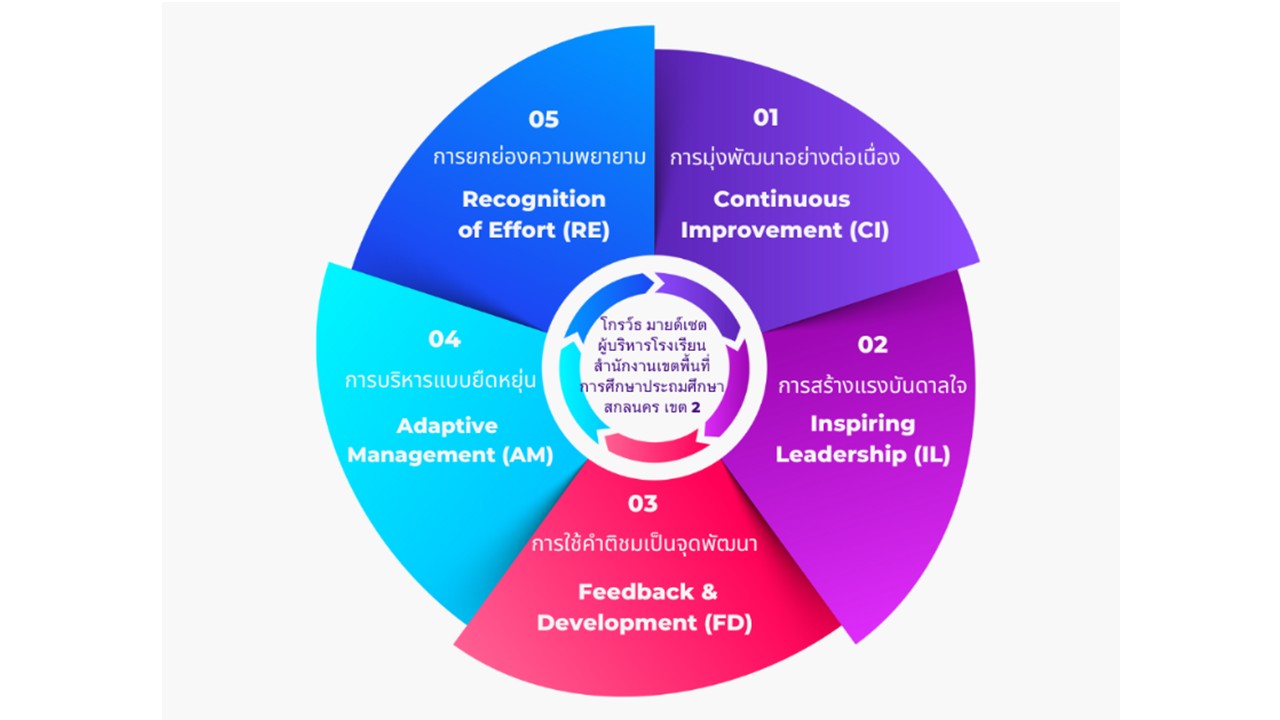
The purpose of this research was to analyze the Grow Exploration Element. School Administrators' Mindsets The sample group includes 300 school administrators and teachers affiliated with the Sakon Nakhon Primary Education Area Office, District 2, for the 2025 school year. The tools used were the 50-question Grow Mindset Questionnaire of School Administrators on a 5-level scale with a content accuracy value from .60 to 1.00, an item total correlation value from 0.463 to 0.829, and a total confidence of 0.975. Rotate the orthogonal element axis by the Varimax method. The results showed that the Growth Mindset of school administrators obtained five variables with 46 indicators that were not unique matrices (Bartlett's test: x-2.= 3686.572, df = 1225, p = .000). The KMO = .859 is the result of the analysis of the element when the axis is rotated by the varimax method. It was found that there were five components: 1) Continuous Improvement Focus, 2) Motivation, 3) Use of Feedback as a Development Point, 4) Flexible Management, and 5) Praise of Diligence, which predicted the growth mindset of school administrators by 33.424 percent. Therefore, the development of the growth mindset of school administrators should take into account these five elements as a framework for the development of the growth mindset.
Article Details

This work is licensed under a Creative Commons Attribution-NonCommercial-NoDerivatives 4.0 International License.
References
จุฬาลักษณ์ ทิพวัน และวราพร เอราวรรณ. (2563). การพัฒนาตัวบ่งชี้กรอบความคิดแบบเติบโต สำหรับนักเรียนชั้นประถมศึกษาปีที่ 6. วารสารการวัดผลการศึกษา มหาวิทยาลัยมหาสารคาม, 26(2),
-133.
ธนะดี สุริยจันทร์หอม และอารยา ปิยะกุล. (2561). การพัฒนารูปแบบการเสริมสร้างโกรว์ธ มายด์เซต สําหรับนักศึกษาหลักสูตรวิชาชีพครู. วารสารบัณฑิตวิทยาลัย พิชญทรรศน์, 14(1), 81-90.
ธราเทพ เตมีรักษ์, อนงลักษณ์ หนูหมอก, บุญส่ง วงค์คำ, สรินดา อุคำ และปิยะนันท์ ปลื้มโชค, การวิเคราะห์องค์ประกอบเชิงสำรวจสมรรถนะนักศึกษาสาขาวิชาการศึกษาปฐมวัย, วารสารครุศาสตร์ปัญญา,4(2), 135-147.
มุทิตา อดทน, วรากร ทรัพย์วิระปกรณ์ และจุฑามาศ แหนจอน. (2561). ผลของโปรแกรมการพัฒนากรอบความคิดเติบโตในนักเรียนชั้นมัธยมศึกษาตอนปลาย. วารสารการวัดผลการศึกษา มหาวิทยาลัยมหาสารคาม, 24(2), 182-194.
วีระยุทธ แสนพินิจ. (2562). รูปแบบการพัฒนากรอบความคิดแบบเติบโตของผู้บริหารโรงเรียนมัธยมศึกษา:การวิจัยผสมผสานวิธี. วิทยานิพนธ์ ศษ.ม. ขอนแก่น: มหาวิทยาลัยขอนแก่น.
สำนักงานคณะกรรมการการศึกษาขั้นพื้นฐาน. (2566). แผนพัฒนาการศึกษาขั้นพื้นฐาน (2566 – 2570). http://www.bopp.go.th.
Cattell, R. B. (1966). The scree test for the number of factors. Multivariate Behavioral Research, 1(2), 245–276.
Comrey, A. L., & Lee, H. B., (1992), A first course in factor analysis (p.125), Hillsdale, NJ: Lawrence Erlbaum Associates.
Dweck, C. S. & Yeager, D. S. (2019). "Mindsets: A View From Two Eras." Perspectives on Psychological Science, 14(3), 481–496.
Dweck, C. S. (2016). Mindset: The new psychology of success (Updated ed.). New York: BallantineBooks.
Field, A. (2018). Discovering statistics using IBM SPSS Statistics (5th ed.). SAGE Publications.
Gorsuch, R. L. (2015). Factor analysis: Classic edition. Routledge.
Hair, J. F., Black, W. C., Babin, B. J., & Anderson, R. E. (2019). Multivariate data analysis (8th ed.). Cengage Learning.
Kaiser, H. F. (1958). The varimax criterion for analytic rotation in factor analysis. Psychometrika, 23(3), 187–200.
Rattan, A., Savani, K., Naidu, N., & Dweck, C. S. (2019). The role of growth mindset in leadership development. Journal of Leadership & Organizational Studies, 26(3), 287–299. https://doi.org/10.1177/1548051819831293.
Tabachnick, B. G., & Fidell, L. S. (2019). Using multivariate statistics (7th ed.). Pearson.
